You’ve talked to the same person at the climbing gym for weeks. Or a colleague from another team makes you laugh at every lunch. You’d like to see them outside that room, and the message sits unwritten in your phone because “do you want to be friends?” sounds like something from elementary school.
An adult version of that question can be one plan: a day, a place, and an easy way to say no. This guide covers why the first move feels harder than it is, the lines to send, what to do with a yes, a maybe or a no, and how to fill the first hangout with more than the basics. It works with the Thesis deck, the free online table, or a word written on a napkin.
The short answer
Ask for one thing with a time attached. “I’m going to the flea market on Sunday morning, want to come?” does the work of “will you be my friend” without the weight. The other person can say yes to coffee without signing up for anything bigger.
Then do it again. Friendship grows from repeated time together, and the first invite only opens the door.
Why the first move feels risky
The hesitation has a pattern, and research has measured parts of it.
People expect others to be less interested than they are. London-area train commuters predicted that starting a conversation with a stranger would be less pleasant than it turned out to be, partly because they expected others to be uninterested in talking. Those assigned to talk to a stranger had a more positive ride than those who sat in silence (Schroeder et al. 2022).
After a conversation, you’re liked more than you think. Across studies with strangers in a lab, first-year dorm mates and people at a workshop, partners underestimated how much the other person liked them and enjoyed their company. Among the dorm mates, that gap lasted for several months (Boothby et al. 2018). The person from the gym may already think you’re good company.
Reaching out is appreciated more than expected. In preregistered experiments, people underestimated how much others appreciate being reached out to. The gap was larger when the message was more of a surprise (Liu et al. 2023). A first invite to someone you don’t know well is that kind of surprise.
None of this guarantees a yes. It means the fear of the ask can run ahead of how the ask lands.
Five lines to send
A good invite names something real, gives a time, and leaves room to decline. These five fit different situations:
- “I’m going to that photo exhibition on Saturday afternoon. Want to come along?”
- “You mentioned you’ve never had proper ramen. There’s a place near the office. Thursday after work?”
- “A few of us play a card game at my place on Friday. You’d fit right in, if you’re free.”
- “I liked talking to you today. Want to grab a coffee next week? Tuesday or Wednesday works for me.”
- “No pressure at all, but I’d like to hang out outside of class sometime. Any day next week?”
The first two tie the plan to something you already talked about, which shows you listened. The third lowers the stakes with other people in the room. The fourth and fifth say the quiet part plainly: you enjoyed their company. That’s as close to “be my friend” as an adult message needs to get.
A change of setting helps too. In a summary of his research, Jeffrey Hall suggests switching up the context, like lunch with a colleague, as a way to signal interest in a friendship. His study also found that hours spent working together counted for less than time spent hanging out (University of Kansas summary).
Yes, maybe or no
Each answer has a next step, and none of them is a verdict on you.
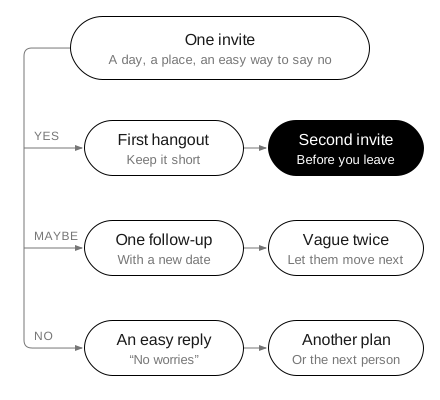
Yes. Confirm the day and place in the same message. Keep the first meeting short, so it ends while it’s still good.
Maybe. “Maybe, I’ll check” or “This week’s busy” can mean busy. Send one follow-up with a new date. If the answer is vague twice, let them make the next move.
No. A no to one plan is a no to that Saturday. Reply with something easy, like “No worries, another time.” Then put your energy into another plan, or the next person on your list.
Making the first hangout more than small talk
The first meeting can run on the facts: job, neighborhood, where you’re from. That’s fine for a start. After that, one word on the table gives you both a story to tell.
The Thesis cards each have an idea on one side and an everyday thing on the other. Draw one, pick a side, and roll the die. Its six faces are MEMORIES · BODY · PEOPLE · VALUES · CHILDHOOD · FUTURE, and the only instruction is “Look at the word from that side.” Without a deck, open the online table on a phone between you.
Agree on passing first. The rules say, “Before you start, agree together how passing works.” For two people who barely know each other, “anyone can pass, no reason needed” keeps it light. If the talk goes somewhere, the rule card’s follow-ups help: What did that feel like? Who else was there? Has it always meant that to you?
Questions for a first hangout
If you’d rather skip the cards, these questions go one step past the basics. They’re sorted from light to deeper:
- What did you do last weekend that you’d do again?
- What’s something you got into in the last year?
- Which place in this city do you keep going back to?
- Who was your closest friend at 12?
- How did you end up living here?
- What’s a skill you’d like to learn from a friend?
- What does a good weekend look like for you?
- Who’s someone you’ve stayed friends with for a long time, and why them?
Two or three of these are plenty. The rest can wait for the second meeting.
Three cards for the first move
These three cards read well for two people at the start of a friendship.
Courage has Bicycle on its other side. The idea side fits the moment you’re in: you made the first move, and they said yes. Each of you can say what took courage recently, and the answers can be small and specific, like a phone call or a new class. The bicycle side is gentler: learning to ride, a first bike in a new city, a long ride somewhere.
Friendship has Ball on its other side. Talking about friendship with someone you’re becoming friends with can feel direct. Start with older ones: a school friend, a teammate, a neighbor. The ball side goes to playgrounds and sports clubs, and those stories show how each of you makes friends.
Belonging has Headphones on its other side. It suits people who’ve moved recently or joined a new group. The headphones side is the easy way in: the album from your first year in a new place, or what you listen to on the way to the gym where you met.
The second invite
The first yes is the start. In the same summary, Hall says that when people move to a closer stage, they double or triple their time with that person within three weeks. The summary puts the move from acquaintance to casual friend at roughly 50 hours together (University of Kansas summary). One coffee doesn’t add up to that. A standing plan does: a walk every other Sunday, or a card game once a month.
At the end of the first hangout, try the last round from the rules: “each player names one thing they discovered about someone at the table today.” Then suggest a date for the next time before you leave. For what comes after that, see how to keep a new friendship going.
See the rules and the box, or play on the online table. The cards above have their own pages: Courage, Friendship and Belonging. For playing with a group, see Thesis for friends. For the studies behind the deck, see the research page.