You’ve met a new friend a few times. You like them. You know where they work and what they cook on Sundays. You don’t know yet if you can tell them the thing that’s been on your mind for a while, or if it will come back to you through someone else.
Trust in a new friendship grows in small steps. One person shares something a little personal, the other answers in kind, and both see what happens to it. This guide covers why that works, five steps to take over the next few meetups, ten questions about trust, and one word to put on the table. The Thesis deck helps, and a word written on a napkin works too.
The short answer
Trust between new friends builds through small, matched risks. Share one thing that’s a bit more personal than small talk. Let the other person match it, or not. Keep what they tell you to yourself. Repeat at the next meetup, one step further. Each round shows both of you that the last thing was safe with the other person.
What research says about opening up
Four studies explain why small steps work better than one big confession.
Telling and liking feed each other. Nancy Collins and Lynn Miller combined studies on self-disclosure and found three links. People who make intimate disclosures tend to be liked more. People disclose more to those they already like. And people come to like the person they’ve disclosed to (Collins and Miller 1994). Each small thing you share can start the loop again.
Taking turns matters. Susan Sprecher and colleagues paired strangers for a structured get-to-know-you task. In some pairs, partners took turns asking and answering. In others, one person disclosed while the other listened, and they switched roles in a second round. The pairs who took turns from the start reported more liking, closeness, perceived similarity, and enjoyment. The gap stayed after the other pairs had switched roles (Sprecher et al. 2013). A long monologue followed by a long monologue lands differently from a back-and-forth.
Gradual works. Arthur Aron and colleagues had pairs of strangers spend 45 minutes on self-disclosure tasks that grew more personal step by step. In their first study, those pairs felt closer afterward than pairs who did small-talk tasks for the same time (Aron et al. 1997). The prompts started light and went deeper later, never the other way round.
Holding back hides the evidence. Detlef Fetchenhauer and David Dunning found that people underestimated how trustworthy strangers were. Their explanation is an asymmetry: when you trust someone, you find out whether they kept their word. When you hold back, you never learn whether they would have. Participants who got feedback on every person, trusted or not, were less cynical (Fetchenhauer and Dunning 2010). This may be one reason the obvious advice to “open up” gets skipped. Caution feels safe, and it also keeps you from seeing the times trust would have paid off.
Five steps for the next few meetups
These steps follow the order you’d take them in, from the next coffee to the meetup after that.
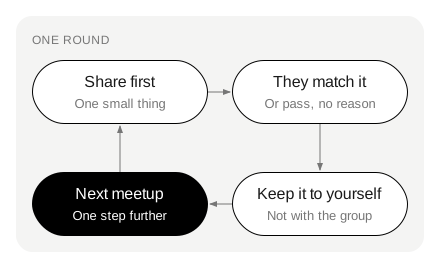
Step 1: Share one small thing first
Pick something a notch past small talk: a worry about a project, a family habit you find funny, a place you miss. It costs little if it falls flat. Going first takes the pressure off the other person to decide how personal the conversation should be.
Step 2: Match, then wait
When your friend shares something, answer at the same level. A story about a lost job doesn’t call for your whole childhood, and it doesn’t call for a joke either. Then leave a pause. The turn-taking study above suggests the back-and-forth itself does part of the work.
Step 3: Keep it to yourself
One way to learn whether a person is safe is to see what they do with something small. If a friend tells you about their sister, don’t bring it up with the group. Thesis puts this on the box as one line: “What is said at the table stays there.” The same rule works over coffee.
Step 4: Make passing easy
A new friend may not want to answer everything yet. Say out loud that a short answer is fine. The rules on the box put it this way: “Say as much or as little as you like.” A friend who can say no without a reason may find it easier to say yes the next time.
Step 5: Do the small things you said
Trust grows outside conversation too. If you said you’d send the recipe, send it. If you said you’d come on Thursday, come. These are small, and a new friend has few other things to go on.
Ten questions about trust for a new friend
These go from light to deeper. Pick one or two per meetup, and answer each one yourself as well.
- Who was the first person you told a secret to?
- What’s something you lend without thinking twice?
- Who do you call when something goes wrong?
- How do you know when you can trust a new person?
- What’s a small thing someone did that made you trust them?
- Has a friend ever kept something for you that mattered?
- What made you stop trusting someone?
- Is trust easier for you with people or with places?
- What do you need from a friend before you tell them something hard?
- How has your idea of trust changed since you were a teenager?
For more on keeping a new friendship moving between meetups, see how to keep a new friendship going.
The Trust card, from two sides
The Thesis die has six faces: MEMORIES · BODY · PEOPLE · VALUES · CHILDHOOD · FUTURE. The only instruction is “Look at the word from that side.” For a new friendship, PEOPLE and VALUES are good faces to land on with Trust. Without a die, write the six words on paper and choose one.
Trust has Window on its other side. The idea side can feel heavy for an early meetup, so the object side is a light way in: the window of a first flat, a window someone climbed through, a view you looked at for years. Window stories can bring up who was in the room, and from there the talk can find its way back to Trust.
Privacy has Diary on its other side. It fits the question every new friendship carries: what stays private, and with whom. The diary side brings out old notebooks, locked drawers, and siblings who read them, which is easier to tell than a current secret.
Honesty has Radio on its other side. New friends may hold back honest opinions to keep things pleasant. Talking about Honesty as a word lets both of you say where your line is before you test it. The radio side goes to car rides, kitchen songs, and who chose the station.
Playing it with a new friend
Before the first card, agree on passing. The rules say “Before you start, decide together how passing works.” Anyone can pass without a reason, or turn the card over and take its other side. With two people, the format fits a café table or a walk.
- Draw a card. Pick a side: the idea or the thing.
- Roll the die and look at the word from that side.
- Say as much or as little as you like. The other person asks, gently.
- Hand the die over.
Three short follow-up questions keep the turn going: What did that feel like? Who else was there? Has it always meant that to you? As the rules put it, “There are no right answers.”
What to do at the next meetup
Bring one word. Share one thing a notch past small talk, and wait for your friend to match it. After you part, keep what they told you to yourself. That’s one round, and the next meetup can go one step further.
See the rules and the box, or play on the online table. The cards above have their own pages: Trust, Privacy and Honesty. For playing with a group, see Thesis for friends. For the studies behind the deck, see the research page.