You run a weekly group and want something on the table besides “How was your week?” A card deck looks like the easy answer, until you compare three of them and find three different promises on the boxes. This guide gives six checks you can run on any conversation deck before it reaches your group: what it claims, who it’s written for, how a person gets out of a card, how deep it goes, what format it uses, and how it holds up in one test round. It’s written for counselors, therapists, support group hosts and youth workers, and it names no brands.
The examples use the Thesis deck, a card game built on single words. The checks work the same on any deck, or on a stack of index cards you write yourself.
Check 1: Read what the box claims
Start with the words on the box and the product page. Some decks describe a conversation format. Others promise outcomes for the people who play. A therapist resource site, Between Sessions, puts it plainly: “Use caution when you purchase decks for use with your clients.” The same article notes that many newer decks “aren’t endorsed by therapists, nor are they informed by tested clinical concepts” (Between Sessions 2023).
A deck that promises an outcome hands you a claim you’ll have to stand behind in the room. A deck that describes itself as a format leaves the clinical frame where it belongs, with you. Look for plain facts on the box: the number of cards, the player count, the age range, the rules. Treat promises about feelings or results as a reason to read further before you buy.
The same article adds a second point: “Some card decks are intended only to entertain.” A deck built for parties can still work in a group. Its prompts may tilt toward jokes and quick answers, so read a handful of cards before you decide.
Check 2: Match the age range to the youngest person in the room
The printed age range tells you who the writer had in mind. Wording written for younger teens can land as childish with a group of older teens, and a deck rated for adults may hold words you don’t want in a mixed-age room. Check the rating against the youngest member you expect, not the average.
Then read ten random cards with one person from your group in mind. If you’d skip several of them, the deck will need sorting before every session. Sorting is fine for a one-off. For a weekly group it adds up.
Check 3: Find the way out of every card
Every card in a group deck will be the wrong card for someone on some day. The question is how that person leaves it. The Between Sessions article describes one simple exit: “If presented with an uncomfortable topic, your client can shuffle the deck and select another card.” Look for exits like these in the rules or in the design of the cards:
- A pass rule. The rules say how a person passes, or ask the group to agree on it.
- A second side. Each card offers two prompts, and the player picks one.
- A swap. The player draws again without explaining why.
- A short answer. The rules count one sentence as a full turn.
The Thesis rule card opens with the pass: “Before you start, agree together how passing works.” Each card has an idea on one side and an everyday thing on the other, so the second side is built in. The table card adds, “A short answer is a full answer. You can always ask for more.” If a deck’s rules say nothing about leaving a card, you’ll be writing that rule yourself.
Check 4: Look at the range of depth
A deck with only light prompts keeps every round safe and every round similar. A deck with only heavy prompts asks a lot of a group in its first weeks. Read the whole deck once and sort it into three piles: light, medium and heavy. A usable group deck has cards in all three, and the heavy ones are easy to take out.
Groups can stay lighter than they need to. In experiments by Kardas, Kumar and Epley, participants expected deeper conversations with strangers to feel more awkward than they did, and expected others to care less about their disclosures than the others did (Kardas et al. 2021). A deck with a few deeper cards gives a group the chance to find that out, as long as the way out from check 3 is in place.
Rest sits on the back of Clock. It’s a light card for a first session: a member can talk about a slow Sunday or about a clock that ticked too loudly in a childhood bedroom. Either answer takes one sentence, and both count.
Death is on the back of Phone. It’s one of the heavier words in the deck, and it’s the kind of card to look at before the session. Some groups keep it out of the first weeks. Others leave it in, because the phone side gives a member an everyday way to answer.
Check 5: Choose a format that fits your session
Decks come in a few formats, and each one shapes the conversation differently. Full-sentence questions tell the player what to talk about. Single words or images leave the angle to the player, so two people can answer the same card in different directions. Mixed decks pair a prompt with an activity.
Three practical questions narrow the choice. How many players do the rules support, and can you split a larger group into tables? How many cards are there, and how many weeks will that last if you use one or two per session? Can you read the rules aloud quickly? Thesis has 50 double-sided cards, a fold-out die and rules for 2–6 players, so a group of ten plays at two tables.
The Thesis die has six faces: MEMORIES · BODY · PEOPLE · VALUES · CHILDHOOD · FUTURE. The only instruction is “Look at the word from that side.”
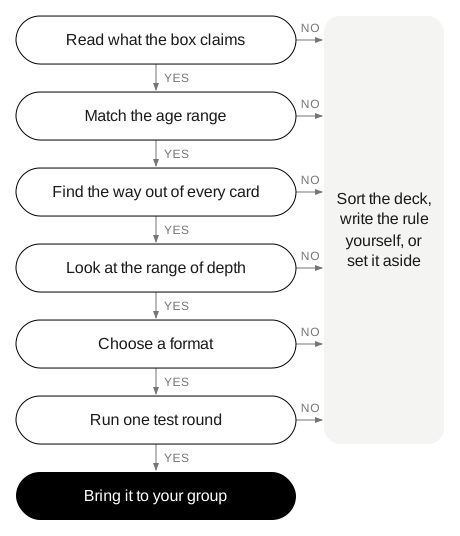
Check 6: Run one test round before the group sees it
A deck reads differently out loud. Before you bring it to your group, play one round with a colleague or two. Pay attention to how a turn feels and which cards you’d quietly skip. These questions help you judge a deck after that round:
- Did each turn end before the table lost interest?
- Could you answer every card you drew in one sentence?
- Did any card ask for something you wouldn’t ask in your own group?
- Was the way out of a card clear without asking the host?
- Did the rules hold up when someone passed?
- Did any card assume a family, a partner or a job?
- Did the deck work for the quietest person at the table?
- Would the follow-up questions stay gentle without your help?
- Which cards would you take out before the first session?
- Would you still use this deck a few weeks in?
Thesis is a conversation format and makes no clinical claims. You know your group, its purpose and its limits, and you decide how far a game goes in your sessions. The rule card’s confidentiality line, “What is said at the table stays at the table,” can sit next to the agreement your group already has.
Try a round before you decide
The quickest test needs no box. Open the online table on a shared screen, agree on passing, and play one round each.
The box isn’t on sale yet. You can see the box and play online for free. The cards above have their own pages, Rest and Death, and the rule card’s pass agreement fits well with a word like Boundaries. For running the game in a session, see Thesis for therapy groups, and for an opening round, check-in questions for group therapy. You can also read the research behind the deck. Related: group coaching exercises with a deck of words.
Before your next session, take any deck you own and sort it into light, medium and heavy. The heavy pile tells you what to set aside, and the light pile tells you where to start.