You finally sit down for the talk you’ve both been putting off. It starts with what each of you wants from the next year. Later that evening you’re arguing about who did the dishes in March, and both of you go to bed tired. The next time a deep talk comes up, one of you changes the subject.
This post is for couples who’ve been together for years and find that talks about needs and wants keep ending in a fight. It explains why that happens and offers a way out: keep two kinds of talk apart. One is a short needs check-in with a clear end. The other is an open talk about one word, where nobody has to decide anything. You need no app and no deck for either.
Why the talk turns
A talk about needs carries a hidden request. When one of you says “I need more time together,” the other may hear “you’re not giving me enough.” The first sentence was about a wish. The second is a verdict, and a verdict gets an answer in defense. From there the talk is about who’s right, and the original wish gets lost.
Couples on marriage forums describe this loop in plain terms. A deeper conversation about needs and wants starts well, then turns into an argument. Several of them say they’ve started to avoid those talks to keep the peace.
Three things can push a deep talk into a fight:
- Two talks at once. One of you came to explore an idea. The other came to fix a problem. Each hears the other as off topic.
- A heavy start. The first sentence is a list of what’s missing, so the rest of the talk answers that list.
- No way out. Neither of you knows how to pause without it looking like a retreat, so you both keep going past the point where it helps.
The start can matter a lot. Carrère and Gottman coded the conflict discussions of 124 newlywed couples. The emotion coded in the first three minutes of the discussion predicted, over six years, which couples divorced (Carrère & Gottman 1999). The study was about conflict talks between newlyweds, and it measured prediction, not cause. It still suggests that the opening of a hard talk deserves care.
Quiet can hide the same problem
Avoiding the talk looks like a solution. On the same forums, people who’ve been together for years write that they thought the relationship was fine because they didn’t fight. Later they found that the lack of fights came from the lack of hard talks, and the distance had grown in the quiet.
What helps is a format where a disagreement can come up without taking over the evening.
Two talks, two formats
The fix is to name which talk you’re having before you start. Each one gets its own rules.
The needs check-in has a topic, a time limit, and an end. It’s for “I’d like more help in the mornings” or “I want us to plan one trip this year.” One of you names one need. The other repeats it back in their own words before answering. You end with one small, concrete step, or with a date to come back to it. One need per check-in keeps it from turning into a list.
The open talk has no goal. It’s for exploring an idea together: what honesty means to each of you, or what fair looked like in the house you grew up in. Nobody has to agree, decide, or change anything. If a need comes up, write it down and save it for the next check-in.
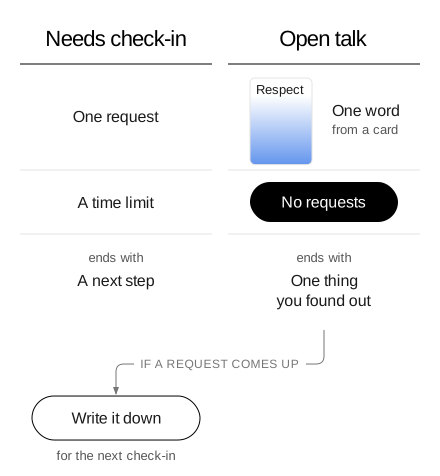
Keeping them apart works because each talk then has a fair expectation. In a check-in, a request is expected. In an open talk, a request is out of place, and both of you know to park it.
How to keep an open talk open
The open talk works best with something outside both of you at the center. A word does that job. It gives you a shared subject, so the talk is about the idea and less about each other’s faults.
- Agree how passing works before you start. Either of you can pass without a reason.
- Pick a word. Use a card, the online table, or a word one of you writes on a napkin.
- One of you says what the word brings up: a memory, a person, a place. Say as much or as little as feels right.
- The other asks one follow-up and listens to the answer.
- Swap. The second person takes the same word somewhere else.
- Stop when it feels done. End with one thing each of you found out.
The Thesis rule card has three follow-ups that fit any word: What did that feel like? Who else was there? Has it always meant that to you? None of them asks the other person to defend anything.
How you answer each other counts too. In studies by Gable and colleagues, people in close relationships whose partners typically responded with active interest when they shared good news reported more intimacy and higher daily satisfaction with the marriage (Gable et al. 2004). That research was about good news, and it’s correlational. It fits the open talk well: interest in the story keeps it going, and a correction stops it.
Three words that suit this talk
These three words from the Thesis deck sit close to what couples argue about. They’re gentle enough for an open talk, because each one is about an idea before it’s about the two of you.
Honesty has Radio on its other side. Couples can fight about honesty without saying what it means to each of them. For one of you it may mean telling everything. For the other it may mean not lying when asked. Radio is the softer door: the station in a parent’s car, the song that was on when some news came.
Respect has Blanket on its other side. Respect can be what’s at stake when a needs talk turns sharp. Talking about where each of you learned what respect looks like can explain a lot of old fights. Blanket leads to a different story: who tucked you in, a blanket that came with you through every move.
Fairness has Sweater on its other side. An argument about chores can be an argument about fairness. In an open talk, the word lets you compare how fairness worked in your two childhood homes, without anyone keeping score tonight. Sweater can lead to a hand-me-down, or to someone who knitted.
If you roll the die, it gives the word a side: MEMORIES, BODY, PEOPLE, VALUES, CHILDHOOD, FUTURE. Look at the word from that side.
Questions for an open talk
If you’d rather start from a question, these stay on ideas and stories and away from requests:
- What did honesty look like in your family growing up?
- Who was the fairest person you knew as a kid?
- When did you feel most respected at work or school?
- What’s something you believed about relationships at 20 that you don’t believe now?
- How did your parents end an argument, if they ended it at all?
- What does a good day together look like to you?
- Which promise from someone stayed with you the longest?
- What’s a value you got from your family that you’ve kept on purpose?
Use one question per evening and follow it with one of the three follow-ups.
When it turns anyway
Sometimes a word opens a real disagreement. That’s allowed. The rules put it this way: “Every view is welcome, especially one that differs from yours.” If the talk starts to sound like a check-in, say so out loud, write the need down, and pick a time for it this week. Then go back to the word, or turn the card to the object side. “A short answer is a full answer. You can always ask for more.”
Try it this week
Plan two short evenings. On the first, hold one needs check-in with one need and a time limit. On the second, put Honesty on the table and talk about it with no goal at all. Afterward, notice which evening ended in a fight, if either did.
For more on the space between everyday chat and big talks, see between small talk and deep conversation. The three cards have their own pages: Honesty, Respect, and Fairness. For more on playing as a couple, see Thesis for couples. For the studies, see the research behind the deck. To see the cards and die, read the rules and the box.