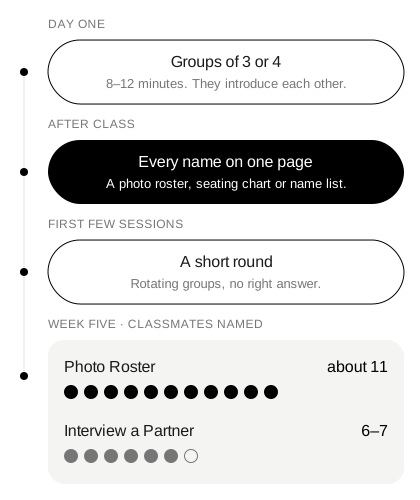
A first-day icebreaker in a college class pays off in week five. In one study of 140 students, the group whose opener kept going after the first class could name about 11 classmates by week five. The groups with a one-day “interview a partner” round named 6–7. This guide is for instructors planning the first session of a seminar or a small lecture section. It gives a first-day opener in five steps, a way to keep it running for a few weeks, and a word-based round for the first real discussion. Each step works with a whiteboard and a stack of sticky notes. The free online table covers the card version.
What the research says about first-day openers
The evidence is thin, and it’s honest to say so. Sawyer, Braz and Babcock compared two first-day activities across eight sections of a required speaking course taught by four instructors. Some sections used “Interview a Partner”: students interviewed a classmate and introduced them to the room. The other sections used a “Photo Roster”: small groups shared names, majors and a short story, took a group photo, and got a printed roster with every face and name. Students kept the roster for the rest of the term (Sawyer et al. 2009).
At the next class meeting, the two groups looked the same. By the fifth week, the roster group named almost twice as many classmates and reported liking classmates and the instructor more. There was no difference in class anxiety between the groups. Whole sections used one activity or the other, so this is one study in one course, and the effects were small. Its useful point for planning: the opener that kept going did better than the one that ended when the class did.
A second study suggests why classmates matter at all. Sandstrom and Dunn followed students’ everyday contact with classmates. On days they talked with more classmates than usual, students reported more happiness and a stronger sense of belonging (Sandstrom and Dunn 2014). Classmates there are weak ties: people you know a little, the kind a first-day opener introduces.
Step 1: Say what the opener is for
A student may have sat through first-day rounds in every course and know the pattern: share a fun fact, never use it again. Tell the room why you’re opening this way, in one sentence. “You’ll be discussing readings with each other every week, and that goes better when you know names” is a reason. It also tells students the opener has a second half.
Step 2: Put students in groups of 3 or 4
A whole-room round puts each student on stage in front of a room of strangers. A group of 3 or 4 is a table conversation. In the study, the roster activity started this way, with groups formed at random. The study’s instructions give each group 8–12 minutes. Give them a short list of what to share: name, what they’re studying, and one thing that helps others remember them. Add one line about depth: share only what you’d be fine with the whole class hearing.
Step 3: Make passing free, and say it first
Being put on the spot without warning is one complaint students raise about icebreakers. The Thesis rules open with this line: “Before you start, agree together how passing works.” In a class, a pass costs nothing and needs no reason. Say it before the first group starts talking.
The roster study built passing into the term. When a student didn’t know an answer, or chose not to answer, they could pass the question to a classmate by name. Each question could be passed twice, and nobody could receive a pass more than twice per class. The rule can do two jobs: it takes the pressure off, and it gives everyone a reason to learn names.
Step 4: Have students introduce each other
Self-introductions put each student on stage alone. When a group member introduces someone else, the speaker reads from their notes and the person being introduced only has to nod. Keep each introduction to two or three sentences. Go first yourself with a short introduction of your own, so the room hears the length you expect.
Step 5: Turn the names into something students keep
This is the step that makes the opener last. After class, put every name on one page: a photo roster if your students agree to photos, a seating chart or a name list by group if not. Share it on your course page and ask students to bring it. In the study, students weren’t penalized for forgetting the roster. They could look at a classmate’s copy. Then use names in class every week: when you call on someone, when groups report back, when a student passes a question.
Keeping it going after day one
A short round at the start of the first few discussion sessions keeps people talking to new classmates. Rotate the groups so each student meets different people. Use a prompt with no right answer, so nobody has to perform. A word works well because each student decides how personal the answer gets.
Each Thesis card has an idea on one side and an everyday thing on the other. The thing side is the easy way in for a student who doesn’t want to talk about their life in week two. Anyone can say something about a bicycle or a pair of headphones.
Curiosity has Sewing machine on its back. In a class, Curiosity can bring up how someone came to their subject: a book they read at fourteen, a teacher, a question nobody could answer. A student who’d rather keep it light can pick the sewing machine and talk about a thing they once took apart or learned to use.
Courage has Bicycle on its back. For first-year students, Courage can be read as moving to a new city, speaking up in a seminar, or changing majors. The bicycle gives a neutral way in: learning to ride, a commute, a bike stolen outside the library.
Belonging has Headphones on its back. It fits the middle of the first term, when students are working out where they fit. The headphones side lets someone talk about what they listen to on the way to class instead.
Prompts for the first weeks
The questions below work at any depth and give no slot for family, money or health details. Use one per session:
- What’s a subject you got curious about before you had to study it?
- What’s an object you brought from home that you use every day?
- What’s a skill you picked up outside school?
- What’s something you learned the slow way?
- What’s a place on campus you’ve already started to like?
- What’s a question you hope this course answers?
- What’s a tool you’d hate to lose during exam week?
- What’s something you’re looking forward to this term?
Running it as a card round
With the deck or the online table, each group of 3 or 4 follows the same turn. Draw a card, choose the idea or the thing, roll the die and look at the word from that side. The die has six plain words: MEMORIES · BODY · PEOPLE · VALUES · CHILDHOOD · FUTURE. The only instruction is “Look at the word from that side.” The rule card says “A short answer is a full answer,” which suits a first-week group. The others can ask one short question. The rule card gives three examples: What did that feel like? Who else was there? Has it always meant that to you?
Before your first class
Write the one-sentence reason for your opener and put it on the first slide, next to the pass rule. Decide now how you’ll share the roster, so it’s ready by the second session. To end the round at the close of a session, the rules suggest one line: “each player names one thing they discovered about someone at the table today.” Two or three students are enough.
The cards above have their own pages: Curiosity, Courage and Belonging. For more on running it with a group, see Thesis for teams and classes. For the studies, see the research behind the deck. For the complaints these steps answer, see why people hate icebreakers, and for quieter students, icebreakers for introverts. See the rules and the box.