Some of your friends have been waiting weeks to open the new strategy game. Others came to eat, catch up, and laugh. You pick the board, and by the middle of the evening the talkers are on the sofa with their phones. You pick something light, and the gamers spend the evening glancing at the unopened box.
Games for mixed groups of gamers and non-gamers work best when nobody has to give up their evening for the others. This guide sets up a two-table plan: one table for the strategy game, one table for talk, and one shared round at the end. The talk table runs on the Thesis deck, the free online table, or words written on scraps of paper.
Why one big table splits anyway
A whole game night at one table can be past a limit researchers have measured. In a study of freely forming groups across several settings, the number of people who could take part in one spontaneous conversation had an upper limit of about four (Dunbar et al. 1995). The authors linked that limit to how people produce and hear speech.
That number fits a mixed game night well. A strategy game for four is one group with its own focus. The friends who came to talk are a second group of about the same size. Splitting them on purpose gives each group a table where everyone can follow along, instead of one long table where half the room is waiting.
Hosts on board game forums ask how to bring non-gamers into the hobby, and in what order. The two-table plan sets that question aside for the night. Nobody has to be converted. Each friend picks the table that fits their evening, and can move.
The two-table plan, step by step
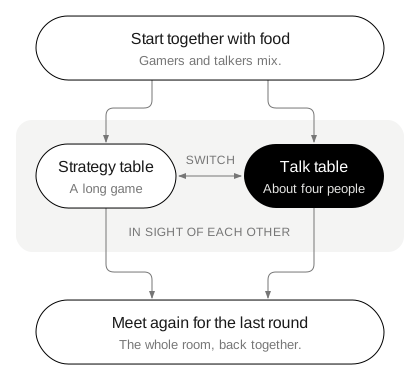
The plan follows the evening in the order it happens:
- Ask in the invite. Name both tables: “I’m setting up the new board game, and there’ll be a card game for talking at the other table.” Friends arrive knowing they have a choice.
- Eat together first. Everyone starts at one table. The food and the catch-up belong to the whole group.
- Set up two spaces. The strategy game goes on the big table, where pieces can stay out. The talk table can be the kitchen counter, the sofa with a low table, or a corner with chairs pulled in.
- Split after the meal. Gamers start their setup and rules. Talkers start their first word at the same time, so nobody waits for anybody.
- Leave the door open. A gamer who is out of the game, or waiting for a long turn, can sit in on one word at the talk table. A talker who gets curious can watch the board for a round.
- Bring both tables together. When the strategy game ends, everyone gathers for one shared last round.
What the talk table needs
The talk table has its own needs. It runs without a host, so the rules fit in one breath and anyone can start it. Turns can be short, so a gamer can join for one word and go back. There’s no score, so a friend who arrives late can sit down mid-round.
The Thesis rule card covers that in six steps:
- Whoever suggested the game goes first.
- Draw a card. Choose a side: the idea or the thing.
- Roll the die.
- Look at the word from that side. Say as much or as little as feels right.
- The others ask what they’re curious about, gently, without judging.
- Hand the die to the left.
The deck has 50 double-sided cards, an idea on one side and an everyday thing on the other, for 2–6 players. The die has six faces: MEMORIES · BODY · PEOPLE · VALUES · CHILDHOOD · FUTURE. The only instruction is “Look at the word from that side.” You fold it from a card into a six-sided prism and roll it like a pencil.
Agree on passing before the first card. The rules open with “Before you start, agree together how passing works.” A gamer who drops in for one turn and isn’t in the mood can pass, or turn the card to its everyday side.
If nobody has the deck, open the online table on a phone at the talk table. It draws, flips and rolls.
Follow-ups keep the talk table going
The talk table stalls when a story ends and nobody asks a second question. The rule card gives three that fit any word:
What did that feel like? Who else was there? Has it always meant that to you?
A short answer is fine too. The rule card puts it this way: “A short answer is a full answer. You can always ask for more.” That line matters for a gamer who joins between turns of the board game. They can say one sentence and go back to their move.
Questions that bridge both tables
If the talk table wants a starting push, these questions work with any word drawn. A few of them are about games, so the strategy table has something to say when people move across:
- When did you last notice this word in your week?
- What object do you connect with it?
- What game did you play as a kid that had something to do with it?
- Who taught you the rules of your first game?
- When did losing at something teach you about this word?
- Who in this room comes to mind first?
- Has it meant something different to you in the last few years?
- What would you like it to mean ten years from now?
Two or three per word are enough. The follow-ups from the rule card do the rest.
Three cards for a mixed table
Each of these three cards reads in its own way for a room of gamers and talkers.
Betrayal has Chess on its other side. Gamers may know betrayal from the board: the ally who broke a deal, the move nobody saw coming. That makes the idea side easier to start on, because a game story comes first and a life story can follow if the player wants. The chess side goes to a grandparent who taught the moves, a school club, or a board nobody ever finished.
Belonging has Headphones on its other side. A mixed group is a room where people belong to different tables, and this card lets them talk about that. The headphones side is the light way in: the album that got someone through a long commute, or the hours spent alone in a game with a headset on.
Balance has Watch on its other side. Every mixed game night is a balance between the long game and the evening around it. The idea side reaches work and rest. The watch side brings back a first watch, a parent’s watch, or the friend at the board who checks the time every turn.
End with one round for everyone
The two tables meet again at the end. The Thesis rule card has a closing line that fits the whole room: “When the group is ready to stop, finish with one last round: each player names one thing they discovered about someone at the table today.” Played with everyone together, it lets the gamers hear what the talk table found out, and the talkers hear who won and how.
Before your next game night, add one line to the invite that names both tables. See the rules and the box, or open the online table. The cards above have their own pages: Betrayal, Belonging, and Balance. For more ways to play with a group, see Thesis for friends. The studies behind the deck are on the research page. If the whole group leans toward talking, see game night ideas for non-gamers. Related: games for introverts: a game night with room to think. Related: office holiday party games: a conversation table plan. Related: board game café with non-gamers: a one-word opener.