Your partner’s mother died a few weeks ago. The funeral is over, the cards have stopped coming, and friends have gone back to their lives. At home, your partner goes quiet at dinner, and you’re not sure whether to ask about her or leave it alone. You don’t want to say the wrong thing, so you say nothing.
This post is for the partner who isn’t grieving, or not in the same way. It covers what to say in the first months, why asking works better than guessing, and a slow way to talk about the person who died when your partner wants to. Thesis is a conversation format and makes no clinical claims. You know your partner, and you decide what fits.
Ask what they want today
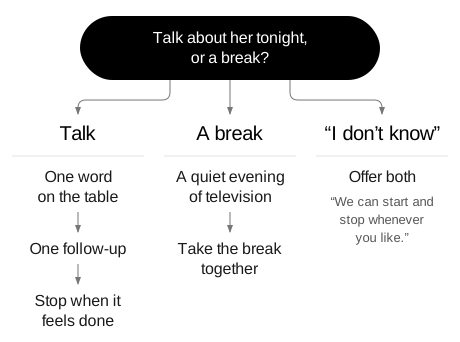
Grief changes from day to day, so the most useful question is a small one: “Do you want to talk about her tonight, or do you want a break from it?” Both answers are fine. A break is part of grieving too.
Researchers Margaret Stroebe and Henk Schut describe this back-and-forth in their dual process model. Grieving people move between facing the loss and turning toward the rest of life: work, a film, a plan for the weekend. The model treats time away from grief as part of coping (Stroebe and Schut 1999). For a couple, this means a quiet evening of television can be the right evening. So can an evening of stories about her.
The question also takes the guessing off your side. You don’t have to read whether today is a talking day. You ask, and your partner tells you. If the answer is “I don’t know,” offer both: “We can start and stop whenever you like.”
What to say, and what to leave out
People who want to help can reach for advice or a bright side. “She had a long life.” “At least she isn’t in pain.” “You’ll feel better in a few months.” Each line is meant kindly, and each one moves the talk away from the person who died.
These lines may land better:
- “I’m here. You don’t have to say anything.”
- “Tell me about her, if you want to.”
- “What do you miss today?”
- “I keep thinking about the way she laughed at dinner.”
- “Do you want company, or time alone?”
The fourth line matters. It brings up a detail of her life. When you bring up a memory of your own, your partner may hear that the person is still part of your shared life. If you didn’t know her well, ask instead of remembering.
When your partner does talk, listen to the end before you respond. A follow-up question shows you heard: “What was that kitchen like?” There’s more on responding to what a partner shares in active constructive responding.
Why holding back can backfire for both of you
Some partners stop mentioning the loss to protect each other. The grieving one hides tears so the other won’t worry. The other avoids the subject so as not to cause pain. It feels like care.
A study by Stroebe and colleagues followed 219 couples who had lost a child, at 6, 13, and 20 months after the loss. When one partner held in grief for the other’s sake, that was linked to more grief in that partner and in the other partner (Stroebe et al. 2013). The links held across the three points in time. The study looked at bereaved parents who were both grieving the same child, so it doesn’t transfer one to one to a couple where one partner lost a parent or a friend. It does suggest that silence meant as protection can cost both people.
This doesn’t mean every feeling has to be said out loud. It means the choice to talk or not talk works better when it’s made together, out loud, and not guessed.
A slow way in: one word
Direct questions about the person who died can feel like too much. A single word on the table gives your partner a door they can open as far as they want. A word written on a scrap of paper works. So does a card.
- Agree how passing works before you start. Either of you can pass without a reason.
- Put one word on the table.
- Your partner says what it brings up, if anything. A short answer is a full answer.
- You ask one follow-up, then listen.
- Share your own memory if you have one.
- Stop when it feels done.
Thesis uses three follow-up questions that suit grief because none of them asks for a conclusion:
What did that feel like? Who else was there? Has it always meant that to you?
Three words for a couple after a loss
The cards below come from the Thesis deck. Each one has an everyday object on its other side, and the object can be the gentler way in.
Death has Phone on its other side. The word is direct, and on some days it’ll be too direct. That’s what the pass agreement is for. Phone can open a smaller story: the last call, a voicemail your partner keeps, the way she always called on Sundays.
Loneliness has Perfume on its other side. Grief can feel lonely even with a partner in the room, and the word gives your partner a way to say so without it sounding like a complaint about you. Perfume can bring back a person through smell: a scarf, a bathroom shelf, a hug at the door.
Silence has Tree on its other side. It fits the quiet evenings, and it can help you check that you read the quiet the same way. One of you may find it restful. The other may feel shut out. Tree can lead to a garden, a walk you took together, or a tree planted after the funeral.
When a word lands hard
A light word can open something heavy, and a heavy word can open nothing at all. Both are normal. If your partner stops, let the stop stand. Turn the card to the object side, or put it away and make tea. The rules put it plainly: “There are no right answers.”
If your partner’s grief stays the same for months, or they talk about not wanting to go on, that’s a moment for a doctor or a grief counselor. A conversation at the kitchen table is company, and it isn’t treatment.
Tonight
Ask the small question: “Do you want to talk about her tonight, or do you want a break?” If the answer is talk, write one word on a scrap of paper. Phone is a good one. If the answer is a break, take the break together.
The three cards have their own pages: Death, Loneliness, and Silence. For playing as two, see Thesis for couples. For the studies, see the research page. To try a word together, use the online table, or see the rules and the box.