Ask a team what’s wrong with icebreakers and the answers repeat. People join the call five minutes late to miss them. They get asked for a fun fact with no warning. A harmless question about the weekend ends up revealing who has kids, who has money and who goes to church. This guide turns those complaints into nine rules for a short opener your team won’t dodge. Each rule works with a word on a sticky note, and the free online table covers the rest.
Why bother with an opener at all
Skipping the opener is a fair option. Still, the minutes before the agenda do some work. In a survey of 252 working adults, Allen, Lehmann-Willenbrock and Landowski found that small talk before a meeting predicted how effective people rated the meeting, even after accounting for good meeting procedures. The link was stronger for less extraverted people (Allen et al. 2014). It was a one-time survey, so it shows a link and not a cause. The rules below keep that small talk and drop the parts people complain about.
1. Say why you’re doing it
An opener with no stated purpose reads as filler, and people treat it like filler. Name the reason in one sentence before you start. “We’re new to each other and we’ll work together for six months” is a reason. “We had a hard quarter and I want to hear how people are doing” is a reason. If you can’t finish that sentence, skip the opener and start the agenda.
2. Make passing free, and say it first
The Thesis rules open with this line: “Before you start, agree together how passing works.” At work, a pass has to cost nothing. Agree that anyone can pass without giving a reason, and say it out loud before the first turn. If you’re the manager, you say it.
Consent changes how a game lands. Wharton researchers Ethan Mollick and Nancy Rothbard studied a sales game with several hundred salespeople. Players who accepted the game felt more positive about the company. Players who didn’t reported negative feelings, and some performed worse (Wharton Magazine). A free pass is the cheapest form of consent you can offer in a meeting.
3. Give people time to think
Being put on the spot comes up again and again in complaints about the fun-fact round. Post the prompt in the calendar invite or the chat a few minutes before the meeting. In the room, go first yourself, so others hear an example while they think. Then go around in a fixed order, so nobody wonders when their turn is coming.
4. Let each person set the depth
Forced intimacy is the other end of the same problem. At one offsite, a tech lead went around the group asking each person to name their biggest fear. Pick a prompt that works at any depth, and let the speaker choose. The rule card puts it in one line: “A short answer is a full answer. You can always ask for more.” The first answer sets the length for the round. Keep yours to two or three sentences.
5. Ask about ideas and things, not private life
Weekend and hobby questions look safe. The answers can still point to family status, religion, disability, class, age or heritage. A word works better because it gives no slot for those details. Each Thesis card has an idea on one side and an everyday thing on the other. The thing side is the easy way in: a mug, a watch, a backpack. Anyone can talk about an object for half a minute without telling the room about their home life.
Rest has Clock on its back. On a team, Rest can be read as lunch breaks, a weekend that started on Friday, or a project that’s finally off someone’s desk. The Clock side gives anyone who’d rather not talk about their workload a neutral topic: the clock in their kitchen, a deadline, a time zone.
6. Drop the formats built on lying or performing
Some classic games ask people to make something up, or to perform something funny on demand. Facilitators point out that starting a session with lies sets a strange tone, and that these rounds take long and reveal little. There’s a quieter version of the same problem. When people feel watched, they pick the work-appropriate version of every answer. A prompt with no right answer removes the pressure to perform. Thesis prints this on its rule card: “There are no right answers.”
Curiosity has Sewing machine on its back. It suits a team because the answer tends to be about how someone learns. Someone might talk about taking apart a radio as a kid. Someone else might pick the sewing machine and talk about a skill they picked up from a parent.
7. Keep it short and stop on time
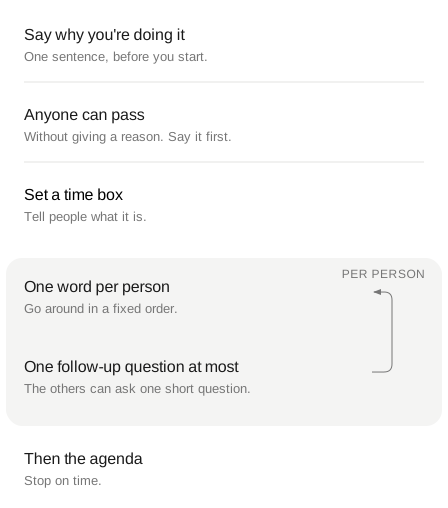
A round that takes twenty minutes eats the meeting it was meant to open. Set a time box and tell people what it is. One word per person, one follow-up question at most, then the agenda.
8. Treat adults as adults
People describe many icebreakers as childish. Props, costumes, singing and running around the room all appear in those complaints. Planners of team days ask for nothing sporty and nothing that requires sharing feelings. A word and a few sentences of talk fit that brief. Nobody has to stand up, move or act.
Play has Laptop on its back. It’s a useful card for this rule because it lets a team talk about play without playing anything. Someone might talk about a game they still play with friends. Someone else might pick the laptop and describe the one app they open when a meeting runs long.
9. End with something the team can use
Close the round with a line people will remember. The Thesis rules end each game the same way: “each player names one thing they discovered about someone at the table today.” In a meeting, a shorter version works. Ask two or three people to name one thing they heard that surprised them. Then move to the agenda.
Prompts that pass the nine rules
The questions below give no slot for family, money or health details, and each one works at any depth:
- What’s a tool you use every day that you’d hate to lose?
- What’s something you learned the slow way?
- What’s an object on your desk that has a story?
- What does a good break look like for you?
- What’s a skill you picked up outside work?
- What’s a small thing that makes a meeting go well?
- What’s something you’re curious about right now?
- What’s a game you still play?
Running it as a card round
With the deck or the online table, each turn follows the same steps. Draw a card, choose the idea or the thing, roll the die and look at the word from that side. The die has six plain words: MEMORIES · BODY · PEOPLE · VALUES · CHILDHOOD · FUTURE. The only instruction is “Look at the word from that side.” The others can ask one short question. The rule card gives three examples: What did that feel like? Who else was there? Has it always meant that to you?
For your next meeting, write one sentence about why you’re opening with a round, and add it to the invite with the word. The cards above have their own pages: Rest, Curiosity and Play. For a longer session with your team, see team building card games for work. Thesis for teams and classes covers group sizes and setup, and the research behind the deck explains where the words came from. See the rules and the box. For the research behind these rules, see why people hate icebreakers.