You went to the climbing gym intro, the trivia night and a colleague’s birthday. You had a few good conversations and swapped numbers. A month later, nobody has texted. Meanwhile the friends from your 20s got married, moved to the suburbs or had kids, and a dinner now takes weeks of planning.
The short answer: in your 30s, friends come from repetition. Pick one night, fix the date, invite the same small group every time, and give the evening a format so nobody has to carry it. This guide sets that up step by step, with or without the Thesis deck.
Why one-off events don’t add up to friends
Friendship runs on hours. In Jeffrey Hall’s research at the University of Kansas, it took about 50 hours together to go from acquaintance to casual friend, about 90 hours to become friends, and more than 200 hours to become close friends (Hall 2018, KU summary). His first study surveyed 355 adults who had moved in the previous six months and were looking for friends in a new place.
A single event gives you a few of those hours with someone, and then the count stops. The next event has new people, so the count starts again at zero. That’s why a year of meetups can end with many names and no one to call.
The difficulty isn’t rare. In the American Friendship Project, 46.6–48.9% of US adults in two national samples agreed that it’s difficult to make friends, and over 40% felt less close to their friends than they’d like (Pennington et al. 2024). The same paper reports school as the most common place to meet friends, particularly for students. After school ends, the daily schedule that used to put the same people in one room every week is gone. A recurring night rebuilds a small piece of it.
Why the obvious advice gets skipped
The usual advice is “put yourself out there.” It’s sound, and in your 30s it competes with work, a partner, a commute and the energy left on a Thursday. Going alone to a group event can feel odd, and going again to a second one can feel like starting over.
Hosting a fixed night removes two of those costs. You don’t have to decide every week whether to go out, and you don’t arrive alone, because you’re the one who opened the door. Hall’s advice in the KU summary points the same way: “Make it a priority to spend time with potential friends.”
Familiarity also does some of the work for you. In two lab experiments, pairs of strangers who talked for longer liked each other more, and feeling understood and comfortable in the conversation helped explain why (Reis et al. 2011). A monthly night gives the same people more time to talk.
Set up the recurring night
The plan below fits a small flat, a back room in a bar or a video call. It takes one evening to set up and a message a month to keep going.
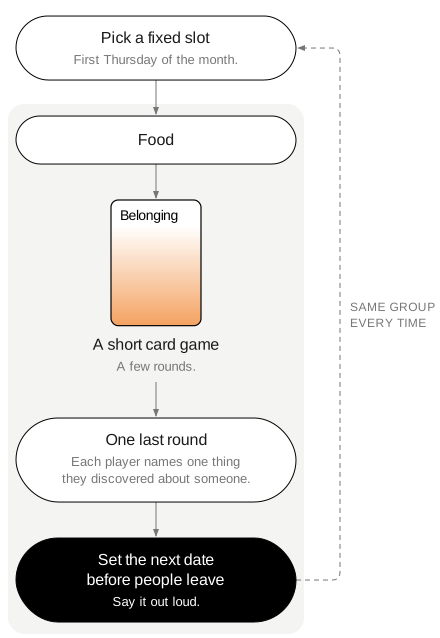
- Pick a fixed slot. First Thursday of the month, or every second Sunday. A rule that never changes is easier to remember than a date you negotiate.
- Invite 4–6 people. Mix two or three people you half-know with one or two old friends. A colleague you get along with, a neighbor, the person from the climbing intro.
- Send one message with the whole plan. Date, time, place, and one line on what happens: food, then a short card game, and a set time to head home.
- Keep the same group for three months. New faces can join later. The first months are for the hours to add up between the same people.
- Give the evening a format. A conversation game with a few rounds means nobody has to come up with topics.
- Set the next date before people leave. Say it out loud at the end of the evening and send it the next morning.
One evening a month adds hours slowly, and a year of them can still fall short of the 50 hours in Hall’s research. The fixed night is the base, and a coffee or a walk between two evenings adds hours on top of it.
A format so the night carries itself
Thesis is a deck of 50 double-sided cards for 2–6 players: an idea on one side, an everyday thing on the other. You fold the die from a card into a six-sided prism and roll it like a pencil. Its faces are MEMORIES · BODY · PEOPLE · VALUES · CHILDHOOD · FUTURE. The rule is “Look at the word from that side.”
The rules open with “Before you start, agree together how passing works.” For a group that’s still getting to know each other, an easy pass can make it easier to come back. Then each turn follows the rule card:
- Whoever suggested the game goes first.
- Draw a card. Choose a side: the idea or the thing.
- Roll the die.
- Look at the word from that side. Say as much or as little as feels right.
- The others ask what they’re curious about, gently, without judging.
- Hand the die to the left.
The thing side is the light way in. A new acquaintance who doesn’t want to talk about Belonging can talk about the headphones they wore on a long bus ride to school. The idea side is there for the evening when the group is ready for it.
No deck? Open the online table on a phone in the middle of the table. It draws, flips and rolls. A word written on a napkin works too.
Questions for a group in their 30s
If you’d rather start with questions, these fit people who are building a life in a new decade. They go from light to deeper:
- What did a normal Saturday look like for you at 22?
- Who was the first friend you made as an adult?
- What’s something you do now that your 20-year-old self would laugh at?
- Which friendship from school would you pick back up tomorrow?
- What’s a place where you felt you belonged right away?
- What did your parents’ friendships look like when they were 35?
- What do you want more of in your week?
- Who do you call first with good news?
- What would you like a group like this one to be in a year?
The rule card adds three follow-ups that work for any answer:
What did that feel like? Who else was there? Has it always meant that to you?
Three cards for friends in their 30s
These three cards read in their own way for a new group in their 30s.
Adulthood has Coin on its other side. In your 30s, everyone at the table has a different date for when they felt grown up: a first rent check, a parent’s illness, a child. Hearing those dates tells you a lot about someone in a few minutes. The coin side is lighter: pocket money, a coin collection, the first thing you saved up for.
Belonging has Headphones on its other side. A group that meets every month is trying to become a place where people belong, so this card lets them talk about other places that did that. The headphones side goes to music: the album from a first move, a commute, a summer.
Tradition has Fridge on its other side. A recurring night is a small tradition in the making, and this card brings up the ones people grew up with and the ones they’ve started themselves. The fridge side goes to kitchens: what was always in it, the notes and photos on the door, a shared flat.
End with the last round and the next date
Close every evening the way a game of Thesis ends: “When the group is ready to stop, finish with one last round: each player names one thing they discovered about someone at the table today.” Then say the next date before anyone puts on a coat.
This week, choose the slot and send the first message to four people. See the rules and the box, or play on the online table. The cards above have their own pages: Adulthood, Belonging and Tradition. For playing with a group, see Thesis for friends. For the studies behind the deck, see the research page. For the first evening itself, see how to host a game night. Related: how to make friends in your 40s.