It’s Thursday evening. You closed the laptop, and the only people you spoke to today were faces in a video grid and the courier. The week had calls and no hallway. Friends from before live across town or in another country, and nobody new has turned up since you started working from home.
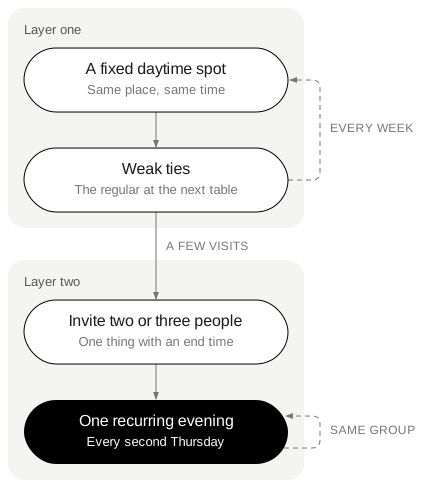
The short answer: an office gave you the same faces at the same time every week, without planning. Working from home, you rebuild that on purpose in two layers. First, one fixed daytime place where you keep seeing the same people. Second, one recurring evening where a few of them sit at your table. This guide sets up both, with or without the Thesis deck.
What the office did without asking
An office puts the same people in one room every weekday. You nod at the person by the coffee machine, and a few months in you know their dog’s name, with no invite needed. Working from home takes the room away, and with it the repeated, unplanned contact.
The gap shows up in survey data. In Gallup’s 2024 data, 25% of fully remote employees said they felt lonely a lot of the previous day. For hybrid employees the figure was 21%, and for employees who work only on-site it was 16% (Gallup 2024). The survey reports how people felt, so it can’t show that the missing office is the cause.
The office wasn’t a friend machine either. In Jeffrey Hall’s research at the University of Kansas, the hours that count toward friendship are time spent hanging out and joking around. Hours spent working together count for less, the study found (Hall 2018, KU summary). So the part worth rebuilding is the repetition, plus time together that isn’t work.
Layer one: a fixed daytime spot
Working from home has one advantage over the office: your daytime is yours to place. Pick one spot and go there at the same time every week. The same café on Tuesday mornings, a coworking desk on Wednesdays, a lunchtime swim on Fridays, the library reading room. The rule that matters is “same place, same time,” because it puts the same people in front of you without anyone planning it.
Small contact there counts for more than it seems. In a field study, customers asked to smile, make eye contact, and chat briefly with a barista reported more positive affect than customers asked to be as efficient as possible (Sandstrom and Dunn 2014). In a separate paper, students reported more happiness and belonging on days they interacted with more classmates than usual, and later studies linked contact with weak ties to well-being across daily interactions (Sandstrom and Dunn 2014). Weak ties are the people at the edge of your network: the barista, the regular at the next table. A weekly spot keeps them coming back.
The obvious advice here is “talk to people at the café.” It gets skipped because a stranger with headphones on looks busy, and so do you. Repetition lowers that cost. On the first visit, a nod. A few visits in, you know who sits by the window, and a comment about the Wi-Fi or the rain is easy.
Layer two: one recurring evening
Weak ties can lift a day, and friendship takes hours. Hall’s research puts it at about 50 hours together to go from acquaintance to casual friend (Hall 2018, KU summary). A nod at the café won’t add up to that. An evening will, if it repeats. The steps below turn the daytime faces into a small group:
- Pick two or three people. The regular at the next coworking desk, a neighbor you see on the stairs, a former colleague who also went remote, a friend of a friend from the group chat.
- Invite them to one thing with an end time. “Tea and a short card game at mine on Thursday evening,” with the end time in the same message. A clear end makes it easier to say yes to someone you half-know.
- Fix the slot before anyone leaves. Every second Thursday, or the first Sunday of the month. A rule that never changes needs no planning messages.
- Keep the same group for a few months. Hours add up only between the same people. New faces can join once the first ones know each other.
- Give the evening a format. People who met over a coffee machine don’t have years of stories in common yet. A game hands them a topic.
Working from home also frees the commute. The time you used to spend on a train can go to a walk with one of these people between two evenings, which adds non-work hours on top.
A format for people who met last month
Thesis is a deck of 50 double-sided cards for 2–6 players: an idea on one side, an everyday thing on the other. You fold the die from a card into a six-sided prism and roll it like a pencil. Its faces are MEMORIES · BODY · PEOPLE · VALUES · CHILDHOOD · FUTURE. The only rule for the die is “Look at the word from that side.”
The rules start with “Before you start, agree together how passing works.” For a table of near-strangers, an easy pass keeps the first evening low-stakes. Then each turn follows the rule card:
- Whoever suggested the game goes first.
- Draw a card. Choose a side: the idea or the thing.
- Roll the die.
- Look at the word from that side. Say as much or as little as feels right.
- The others ask what they’re curious about, gently, without judging.
- Hand the die to the left.
No deck? Open the online table on a phone in the middle. It draws, flips, and rolls. A word written on a napkin works too.
The rule card also gives three follow-up questions for any word: What did that feel like? Who else was there? Has it always meant that to you? With people you met at a café, the second one fills in the parts of their life you haven’t seen.
Questions for people who work from home
If you’d rather start with questions, these fit a table of remote workers. They go from light to deeper:
- Where did you work the day before you went remote?
- What’s the first thing you do when you close the laptop?
- Who from an old office do you still miss?
- What does a good workday at home look like for you?
- Which sound from an office would you bring back?
- Where do you go when the apartment gets too quiet?
- What did you expect working from home would give you?
- Who would you call first if you had a free afternoon tomorrow?
Three cards for a remote worker’s table
Each reads in its own way for remote workers.
Play has Laptop on its other side. For a remote worker, the laptop is the office, the commute and the coffee machine at once. The thing side brings out how people’s days look: a desk by the window, a laptop on an ironing board. The idea side, Play, is close to the hanging out and joking around that Hall’s research counts toward friendship.
Belonging has Headphones on its other side. Headphones are the remote worker’s closed door, in a café or on a call. The thing side is easy for a new group: the album from a long bus ride, the pair you wore through exams.
Community has Mirror on its other side. It fits a table that came together from a café, a stairwell and a group chat. People hear it differently: a street, a club, a team, a group online. The mirror side is lighter: a first flat, a hallway mirror, a reflection someone still remembers.
Start with Tuesday
This week, pick the daytime spot and go once. Next week, go again at the same time. After a few visits, a few faces will be familiar, and two or three of them are the first invite list. When the first evening ends, finish the way every game of Thesis ends: “each player names one thing they discovered about someone at the table today.” Then set the next date before anyone leaves.
See the rules and the box, or play on the online table. The cards above have their own pages: Play, Belonging, and Community. For more on playing with a group, see Thesis for friends. See also the research behind the deck. For evenings that cost nothing, see free things to do with friends at home.