You lead a group outdoors: a support group that meets on a trail, a recovery walk, a wellness group that moved its circle to the park. The walk goes well, but the talk stays on the weather and the mud. A walk-and-talk session works with three things: one word for the whole route, pairs that swap at fixed stops, and a short circle at the end. This guide sets that up step by step, with prompts that fit a walking pace.
Everything here works with a word written on an index card in your pocket. The examples use the Thesis card deck, where Nature is card 10 and has a Car on the other side.
Why talking side by side changes the talk
Walking next to someone can take the pressure off eye contact. The view ahead gives both people something to look at while they think. A pause in the talk can read as part of the walk, so there’s less need to fill it.
Practitioners who take their sessions outside describe the same effect. In a survey of 18 walk-and-talk practitioners, participants said walking and talking could help shift “stuckness” and that walking side by side could support a more collaborative way of working. They also named the hard parts: uncertainty, keeping boundaries outdoors, and the need for new skills (Revell and McLeod 2016). That survey is about therapists, and a small one, but the hindering factors are useful to any host planning a walk.
Walking also changes how ideas come. Across four experiments, walking boosted creative ideation during the walk and shortly after. In the first, participants took a test of divergent thinking seated and then walking on a treadmill, and walking raised the scores of 81% of them. In the fourth, walking outside produced the most novel analogies (Oppezzo and Schwartz 2014). For a group, that suggests open prompts suit a walk better than prompts with one right answer.
Step 1: Agree on the pass at the trailhead
Outdoors the group spreads out, and the host can’t hear every pair. Settle the pass before the first step. The Thesis rules say: “Before you start, decide together how passing works.”
Keep the agreement to one sentence everyone can repeat on the trail. For example: anyone can pass with no reason, or turn the card over and take its other side. A pass on a walk is easy to use. The person says “pass” and the pair keeps walking and looks at the view.
Add one outdoor line to the agreement: what is said on the walk stays on the walk. The rule card puts it as “What is said at the table stays there.” On a path where strangers pass by, say this out loud, and agree that pairs lower their voices near other walkers.
Step 2: Pick one word for the whole route
One word can carry a walk better than a new prompt at every bend. People can come back to it, drop it and pick it up again. Read the word out at the trailhead and hand each pair a card with it.
Nature is the obvious word for an outdoor group, and that’s a reason to use it on the first walk. It splits two ways: wild places like forests and mountains, and nature close to home like a garden or a park. The other side is a Car. A player who doesn’t want to talk about landscapes can talk about a car trip, a first drive, or the car a family had when they were small.
These prompts work at walking pace. Hand out two or three per pair, not all of them:
- Which place outdoors did you know best as a child?
- Where do you go when you want to be outside alone?
- What’s a walk you remember, and who was with you?
- Is there a plant or tree you’d recognize anywhere?
- What does this kind of weather remind you of?
- Which outdoor place would you show a friend from far away?
- What did the adults around you think about being outdoors?
- Where were you the last time you lost track of time outside?
- What place outdoors has changed since you first knew it?
- If you could spend one free day outside, where would it be?
Follow-up questions keep the talk going without steering it. These three are short and open: What did that feel like? Who else was there? Has it always meant that to you?
Step 3: Walk in pairs and swap at the stops
Pairs give everyone a turn without anyone speaking to the whole group. Plan three stops on the route: a bench, a bridge, a gate. At each stop, the group gathers briefly, and people swap partners.
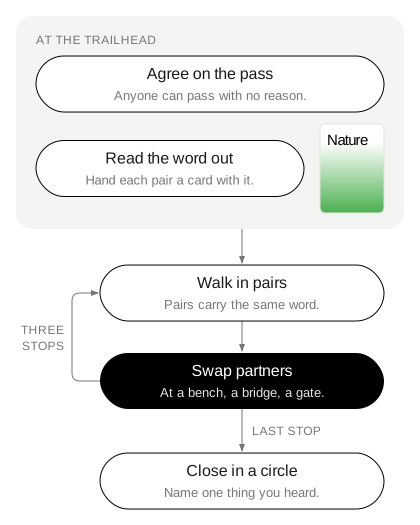
Swaps help with two things on a walk. A pair that stalls gets a fresh start at the next stop, and a pair that clicks gets to hear a new voice on the same word. Slow walkers and fast walkers also get mixed instead of splitting into a front group and a back group.
A die adds a new angle at each stop without a new word. Roll the Thesis die at the stop, or draw one of six words written on paper: MEMORIES · BODY · PEOPLE · VALUES · CHILDHOOD · FUTURE. The only instruction is “Look at the word from that side.” Pairs carry the same word to the next stop, seen from that side.
Silence is on the back of Tree. It suits the second half of a walk, when people have warmed up. A player can talk about a silence that felt safe, or about a tree they climbed or sat under. It also gives a pair permission to walk a stretch without talking, and to call that part of the turn.
Step 4: Plan for what the outdoors brings
The hard parts in the practitioner survey were uncertainty and boundaries, and both show up on a group walk. Plan these before the day:
- Pace. Walk at the speed of the slowest member and pick a route everyone can manage.
- Weather. Pick a short indoor or covered option for rain, and tell the group in advance.
- Strangers. Agree that pairs pause when other walkers pass close by.
- Distance. Keep the group within sight of the host between stops.
- Leaving early. Tell people they can turn back at any stop, and how they’ll get home.
You know your group and its limits, and you decide how far a walking format goes in it. Thesis is a conversation format and makes no clinical claims.
Step 5: Close in a circle
A walk ends better with the group together than with people drifting to their cars. At the last stop, stand or sit in a circle for a few minutes.
Rest is on the back of Clock, and it fits the end of a walk. A player can say where they rest best, or talk about a clock in a house they grew up in. After a long route, the word gives tired people an easy last turn.
For the closing round, each person names one thing they heard from a partner on the walk. It asks for nothing new about themselves, so a person who passed on every prompt can still take part. For more closing formats, see check-out questions for group therapy and support groups.
Try one stop before the walk
Test the format with one stop’s worth of play before you take it outside. Open the online table on a shared screen, agree on the pass, and give everyone one turn with Nature.
Before your next outdoor session, write Nature on one side of an index card and Car on the other. Mark three stops on your route map, and read the pass agreement at the trailhead.
For running the game in a group, see Thesis for therapy groups. If some members prefer to listen on the walk, see do you have to talk in group therapy. The three cards above have their own pages: Nature, Silence and Rest. You can play online for free, see the rules and the box, or read the research behind the deck.