By the fifth meetup with a new friend, you know their job, their flatmate and their plans for the weekend. On the sixth evening, the questions are used up and the talk circles back to “how was your week.” Old friend groups hit the same wall from the other side: the same three stories, the same jokes, nothing new in years.
A list of topics runs out because topics are finite. A word keeps going, because each person takes it somewhere else, and so does each angle you look at it from. This guide sets up a format for that: one word, six angles, three follow-up questions. It works with the Thesis deck, the free online table, or a word written on a napkin.
Why topics run out and words don’t
A topic asks for information: where you grew up, what you do, where you went on holiday. Once you have the answer, the topic is closed. After a few evenings, the easy facts are known on both sides.
A word asks for a view. Say “Silence” to four friends at a bar. One thinks of a quiet house after a breakup. One thinks of a teacher who waited out the class. One thinks of a road trip where nobody talked for an hour and it felt fine. One says they can’t stand it and need music on. None of these is the answer. Each one is a story the others haven’t heard.
The same word comes back different the next time. The person changed, the evening changed, and you look at it from another side.
One word, six angles
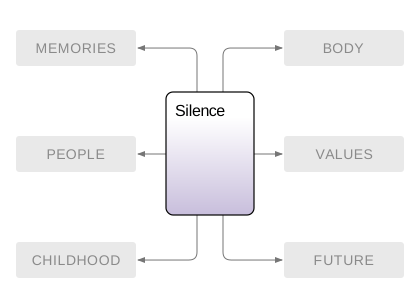
The Thesis die has six faces, each a plain word: MEMORIES · BODY · PEOPLE · VALUES · CHILDHOOD · FUTURE. The only instruction is “Look at the word from that side.” Roll it, and the same card turns into a different conversation.
Without a die, you can write the six words on a scrap of paper and pick one. The point is that a single word doesn’t have to carry the whole evening. It carries six starts, and each start leads to stories.
Setting it up with friends
The format fits a kitchen table, a bar corner or a video call. Here’s what you need:
- Players. 2–6. A pair of friends is a full game.
- The deck. 50 double-sided cards, an idea on one side and an everyday thing on the other.
- The die. You fold it from a card into a six-sided prism and roll it like a pencil.
- No deck. Open the online table on a phone in the middle. It draws, flips and rolls.
Agree on passing before the first card. The rules open with “Before you start, agree together how passing works.” A pass without a reason keeps the evening easy, and so does turning the card to its other side.
One round
Each turn follows the same six steps from the rule card:
- Whoever suggested the game goes first.
- Draw a card. Choose a side: the idea or the thing.
- Roll the die.
- Look at the word from that side. Say as much or as little as feels right.
- The others ask what they’re curious about, gently, without judging.
- Pass the die to the left.
The thing side is the light way in. A friend who doesn’t want to talk about Friendship can talk about a ball they kicked against a wall for a whole summer. Things bring up places and people, and the talk often finds its way to the idea anyway.
Follow-ups keep it going
The conversation doesn’t stall on the first answer. It stalls when nobody asks a second question. The rule card gives three that work for every word:
What did that feel like? Who else was there? Has it always meant that to you?
In three studies of live conversations, people who asked more questions, particularly follow-up questions, were better liked by their partners. The same studies found that people didn’t expect asking questions to make them more liked (Huang et al. 2017). That gap may explain why the obvious advice to “ask more questions” gets skipped: it feels like prying, and the other person reads it as listening.
A short answer from a friend isn’t a dead end. The rule card covers it: “A short answer is a full answer. You can always ask for more.” One follow-up, then a pause, gives them room to add something if they want to.
Small talk can stay
Some friends dislike heavy topics at a bar, and that’s a fair reason for caution. The format doesn’t replace the catch-up. It adds one thread of something more after it.
A pooled study of 486 adults found that life satisfaction was moderately associated with time spent in substantive conversations, and had no reliable association with small talk (Milek et al. 2018). In that data, small talk showed up as neither a plus nor a minus. So keep the “how was your week” and put one card on the table after it.
Questions to start with one word
If you’d rather start with questions, pick any word from the deck and use it in these. They’re sorted from light to deeper:
- When did you last notice this word in your own week?
- What’s an object that reminds you of it?
- Who taught you what it means?
- What did it mean to you at 12?
- Where do you see it in this group?
- Has your view of it changed in the last five years?
- What would your parents say about it?
- What would you like it to mean ten years from now?
One word and two or three of these can fill a whole evening.
Three cards that work for friends
Each of these three cards reads in its own way for friends.
Friendship has Ball on its other side. The idea side asks friends to talk about the thing they’re doing right now, which can feel strange at first. Start with old friendships instead: a school friend, a neighbor, a team. The ball side brings back playgrounds and sports clubs, and the stories there often include people at the table.
Nostalgia has Key on its other side. Old friend groups have shared memories, so this card pulls out the versions nobody agrees on. The key side works for new friends: a first flat, a lost set of keys, a door you still remember opening.
Silence has Tree on its other side. It fits the exact moment this guide is about: the pause when nobody has anything to say. Friends tend to read silence differently, and hearing why is a conversation in itself. The tree side goes outside, to a park, a garden or a climbing tree from childhood.
End with the last round
When the evening winds down, finish the way every game of Thesis ends: “When the group is ready to stop, finish with one last round: each player names one thing they discovered about someone at the table today.” That one thing is a ready start for the next meetup.
Next time you meet, bring one word. See the rules and the box, or play on the online table. The cards above have their own pages: Friendship, Nostalgia and Silence. For more on playing with a group, see Thesis for friends. The research behind the deck explains where the words came from. For two people at home, see deep date night questions for couples. To turn it into a regular evening, see how to host a game night.