You have a room of colleagues, one evening slot and a lot of tables. A game at the front with one microphone turns nearly everyone into an audience. A game at each table gives everyone a turn early on. This guide covers offsite games played at the table: how to split the room into groups of 2–6, which format suits which table size, and how one host can run it all. Everything works with a word written on a card, and the free online table works on a phone if a table has no deck.
Why the table size decides the game
Conversation has a size limit. Dunbar, Duncan and Nettle studied freely forming conversation groups and found an upper limit of about four people who take part in one conversation. They linked the limit to how speech is produced and heard (Dunbar et al. 1995). Past that size, a group can split into two conversations or into speakers and listeners.
Even turns matter too. Woolley and colleagues ran two studies with 699 people in groups of two to five. A group’s performance across many tasks was linked to how evenly members shared speaking turns and to their average social sensitivity. The average and the highest individual intelligence in the group were not strongly tied to the result (Woolley et al. 2010). That study measured problem solving, not offsite games. Still, it points the same way as the first one: small groups where each person gets a turn. A table of 2–6 with a fixed turn order gives you both.
Split the room before people sit down
Seating decides who talks to whom, so plan it on paper. Tables of four are a good default, since four is about the upper limit of one conversation. Tables of five or six also work. If the venue sets large round tables, put two games on each one and seat people as two groups of four or five.
Mix the tables on purpose. Put people from different teams together, and keep each manager away from their own reports for the first round. Print table numbers on the name badges, or draw them from a bowl at the door. People who came with a friend can still sit near them at the next table.
Anyone who’d rather sit out can do that at a side table with coffee. Say so in the invite. In one forum thread about a remote team’s yearly retreat, an engineer credited it to two things: the team chose the activities, and every social part was optional.
Pick a format for each table size
Each table size runs a little differently. The formats below cover 2–6 players, plus what to do with a bigger table. One host can run them all at the same time.
- Pairs (2). One card between two people, three turns each. Pairs suit a walk, a late arrival or a table where two people know nobody else.
- Small tables (3–4). One deck per table, one round each, then a second round if the time allows. This is the size where a conversation stays one conversation.
- Full tables (5–6). One deck, one round each, and one follow-up question per turn. Six turns take longer, so keep answers short and set the time box first.
- Big rounds (7 or more). Split the table in two. One group of seven can turn into a speaker and an audience again.
Run the session with one host
One host can brief the whole room in a few sentences. Stand where every table can hear you and say four things: how passing works, how long the session runs, who goes first, and how it ends. Then step back. The host’s job after the briefing is the clock.
The Thesis rule card opens with the first point: “Before you start, agree together how passing works.” At an offsite, a pass has to cost nothing, because people can’t leave the room. Say that anyone can pass without a reason. The card’s next line answers who goes first: “Whoever suggested the game goes first.” At an offsite, that can be the person whose birthday is closest, or whoever sits nearest the window.
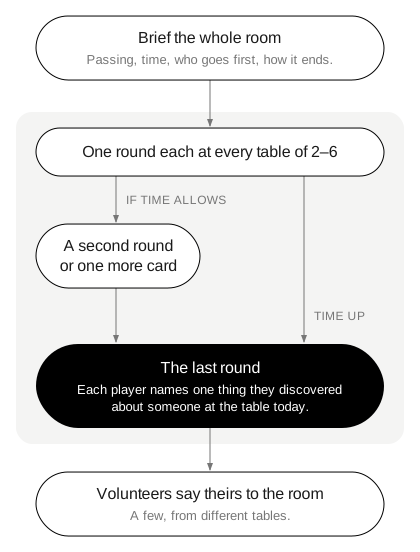
Give the session a fixed length, and announce the last round a few minutes before the end. Tables move at different speeds, and that’s fine. A table that finishes early can draw one more card. A table that runs late stops with the others and finishes the last round.
End every table the same way
A shared ending turns separate tables into one session. The Thesis rules end each game with one last round: “each player names one thing they discovered about someone at the table today.” Each table does it on its own. Then the host can ask a few volunteers from different tables to say theirs to the room. Nobody else has to speak in front of the whole room.
Three cards that suit a table of colleagues
If you use the deck, three cards work well at an offsite table. Each card has an idea on one side and an everyday thing on the other, and the thing side is the easy way in.
Competition has Bench on its back. At an offsite table it lets people talk about a rival team, a sport they played, or the moment they stopped comparing themselves to a coworker. The bench side is lighter: a bench in a park they like, or a season they spent waiting to play.
Community has Mirror on its back. Colleagues who’ve met on video calls can talk about a group they belong to outside work, a neighborhood or a club. Someone who’d rather keep it light can pick the mirror and talk about the one in their hallway.
Gratitude has Fence on its back. It suits the end of a long day, when people can name someone who helped them this year. The fence side gives a neutral topic: a fence they built, painted or climbed over as a kid.
Questions for a table without cards
The questions below work at a table of colleagues. None asks about family, money or health, and each one works at any depth:
- What’s a skill you picked up at a past job?
- What’s a place you go to think?
- What’s a tool you’d take with you to any job?
- What did you get better at this year?
- What’s a team you were part of that worked well?
- What’s something you’re learning outside work?
- What’s a small habit that makes your week go better?
- Who taught you something you still use?
Running a table round with the deck
With the deck or the online table, each turn follows the same steps. Draw a card, choose the idea or the thing, roll the die and look at the word from that side. The die has six plain words: MEMORIES · BODY · PEOPLE · VALUES · CHILDHOOD · FUTURE. The only instruction is “Look at the word from that side.” The others ask what they’re curious about, gently, without judging. The rule card gives three examples: What did that feel like? Who else was there? Has it always meant that to you? It also says, “A short answer is a full answer. You can always ask for more.”
Take your attendee list now and split it into tables of four, with each manager away from their own team. The cards above have their own pages: Competition, Community and Gratitude. For a longer card session in the office, see team building card games for work. For more on running it at work, see Thesis for teams and classes. The studies are on the research page. See the rules and the box.