A client picks a photo of an empty road and talks about leaving a job. Another client gets the word Balance and says, “I don’t have any.” Both cards did their job, and they did different jobs. A picture card leaves the topic open, so the client brings the meaning. A word card names the topic, so the client brings a position on it. This guide covers what each format opens up in a coaching session, when to reach for which, and how to run a round with either.
The steps work with a magazine photo and a word on a sticky note. The examples use the Thesis card deck, which is a word deck with two kinds of word: an idea on one side and an everyday thing on the other.
What a picture card opens up
A picture starts with the senses. The client looks, notices something, and the meaning arrives second. That order gives the client control over the topic. A coach who lays out a spread of photos and asks “Which one is your week?” doesn’t know what the session will be about until the client points.
Research on interviews points the same way. In a review of photo elicitation, where a researcher puts a photograph into an interview, Douglas Harper argues that the method produces a different kind of information. A photo “evokes information, feelings, and memories” that are due to the photograph’s particular form of representation (Harper 2002). The claim is about research interviews. A coaching session uses the same move: a picture on the table between two people, and talk about what each of them sees in it.
Picture cards fit three moments well:
- The start of a first session. The client can show something before they can say it.
- A client who answers in plans and lists. An image gives them a scene to describe.
- A topic the client hasn’t named yet. The photo they pick can name it.
The cost is drift. A picture can lead anywhere, and a long stretch on a childhood beach may not reach the goal the client came with. The coach carries the job of bringing it back.
What a word card opens up
A word starts with meaning. Balance, Success, or Freedom each points to a topic the client already has opinions about. The client’s first sentence can be a definition, a number or a complaint, and each of those shows how they think about the subject.
That makes word cards useful when the session has a theme. A client working on a promotion can draw Success and say what it would look like in a year. The word keeps the talk close to the goal. It also surfaces the gap between how the client defines a word and how their manager, partner, or parent might define it. Thesis is built on that gap: one word, read differently by different people.
Word cards fit three moments well:
- A session with a set theme. The word holds the topic in place.
- A client who stays in stories. A word asks for a view.
- Goal-setting. A client can rank, define, or redefine a word.
The cost is a word’s weight. Some words land as a test, and a client may give the answer they think a coach wants. A short answer and a pass both need to be allowed from the first card.
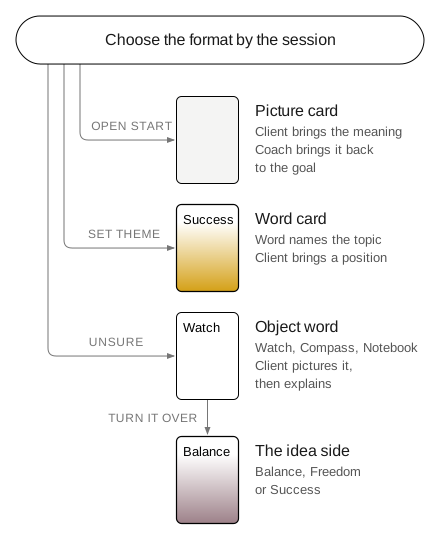
A word that names an object
There’s a format between the two: a word that names an everyday thing. Watch, Compass, or Notebook is a word, so it reads fast and fits in a pocket. It also names something the client has held, so they picture it before they explain it. It can start a session the way a photo does, with a specific thing the client describes.
Every Thesis card carries both kinds of word. The rules give the choice to the player: “Draw a card. Choose a side: the idea or the thing.” In coaching, the client can start on the object and turn the card over once the talk warms up.
Balance sits on the back of Watch. A client who says they have no balance at work can start with the watch instead: whose it was, when they check it, what they’re counting down to. The talk about time can lead back to Balance without a prompt.
Freedom is on the back of Compass. Freedom pulls toward big statements. Compass asks for a direction, which suits a client deciding between two options. A coach can ask which way the needle points today.
Success sits on the back of Notebook. A client can describe what they write in a notebook, or would, and what they cross out. The list they describe can show how they define success, in their own order.
How to run a card round in a coaching session
The round works the same with picture cards, word cards, or both, inside a longer session.
- Agree on the pass. The Thesis rule card opens with “Before you start, agree together how passing works.” In one-to-one work, say what a pass looks like before the first card.
- Choose the format by the session. Use pictures for an open start, words for a set theme, and the object side when you’re unsure.
- Let the client pick or draw. Picking from a spread gives control. Drawing blind adds surprise. Both work.
- Ask one opening question, then wait. Let the client fill the silence.
- Follow with short questions. The rule card lists three: What did that feel like? Who else was there? Has it always meant that to you?
- Bring it back to the goal. Ask what the card says about the thing they came to work on.
These questions start a card in a coaching session. Pick two or three, not all of them:
- What’s the first thing you notice on this card?
- Where have you seen this in your own week?
- What would this word mean to you a year from now?
- Who in your life would define this word differently?
- What part of this card would you leave out?
- If this card were about your goal, what would it say?
- What did you expect to see when you turned it over?
- Which side of this card is easier to talk about today?
A short answer counts. The Thesis table card puts it this way: “A short answer is a full answer. You can always ask for more.”
Try the object side in your next session
The quickest test is one card. Open the online table, draw a card, and offer your client the side with the thing on it first.
The die has six faces: MEMORIES · BODY · PEOPLE · VALUES · CHILDHOOD · FUTURE. The only line is “Look at the word from that side.” In coaching, the die gives the client an angle the coach didn’t choose.
Before your next session, write three object words on sticky notes, such as Watch, Compass and Notebook. Put them next to your picture cards and let the client choose between a photo and a word. What they pick tells you something about how they want to start.
The three cards above have their own pages: Balance, Freedom and Success. For coaching in teams and classes, see Thesis for teams and classes. For a remote group, see how to get to know your remote team. You can play online for free, see the rules and the box, or read the research behind the deck.