A student gets halfway through an answer, hears it go wrong, and stops. The next week, that student writes in the notebook and keeps quiet. Research on work teams has a name for what the class learned in that moment: psychological safety, the shared sense that it’s safe to take a risk in front of the group. This guide takes six practices from that research and turns each one into something an instructor can do in the next class. Each works with a question on the board, and the free online table covers the short word round at the end.
What the team research found
The paper that introduced team psychological safety as a construct was a study of 51 work teams in a manufacturing company, by Amy Edmondson. She defined team psychological safety as “a shared belief held by members of a team that the team is safe for interpersonal risk taking.” Teams with more of it showed more learning behavior, and that learning behavior linked it to team performance. The results point to team structures, such as team leader coaching, alongside shared beliefs as shaping team outcomes (Edmondson 1999).
In a class, asking a question, saying “I don’t follow,” and offering a half-formed idea are all interpersonal risks. The instructor plays the team leader, with one difference: the instructor also gives the grades.
1. Name the risks you want students to take
“Participate more” is too vague for a student to act on. Name three concrete risks on the first day and write them on the syllabus. Asking a question that sounds basic is one. Giving an answer you’re unsure of is another. Disagreeing with a classmate, or with the instructor, is the third. When a student does one of them, say which one it was. “That’s the kind of question I asked for” tells the room the rule is real.
2. Invite in words and in deeds
Lower status can make speaking up harder, and the instructor has the most status in the room. Ingrid Nembhard and Amy Edmondson surveyed 23 neonatal intensive care units and described “leader inclusiveness”: words and deeds by leaders that invite and appreciate others’ contributions. Staff with lower professional status felt less psychologically safe, and leader inclusiveness predicted psychological safety and softened that status gap (Nembhard and Edmondson 2006).
The words are the easy half. The deeds are what students watch: whether you wait after a question, whether you write a student’s idea on the board in their words, and whether you come back to a point a student raised the week before.
3. Decide how you’ll respond to a wrong answer
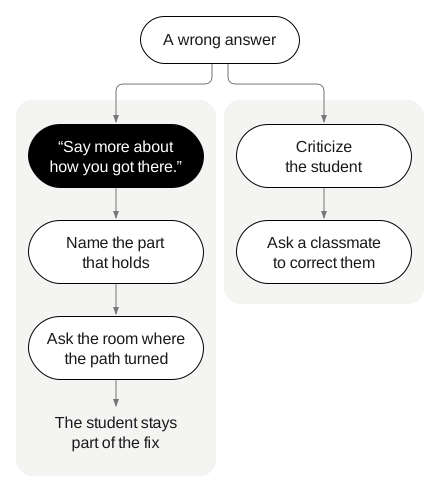
Gonda and colleagues asked 244 students aged 18 and 19 what made them willing to present their own solutions in class. In the psychological safety part of the questionnaire, the highest-rated items were about how the teacher and classmates would react to a possible mistake. The authors describe two ways teachers handle errors. One discusses the mistake with the whole class and treats it as useful for learning. The other criticizes the student and asks a classmate to correct them (Gonda et al. 2024).
Plan your first sentence before the wrong answer comes. One option: “Say more about how you got there.” Then find the part of the reasoning that holds, name it, and ask the room where the path turned. The student who made the error stays part of the fix, and nobody is asked to correct them in public.
4. Brief the class before the hard part
Medical simulation teachers have a routine for this, because their students work through cases and discuss their mistakes in front of peers. Jenny Rudolph, Daniel Raemer and Robert Simon describe a “safe container” built in the briefing before a simulation. It has four parts: clarify expectations, agree on a “fiction contract” with learners, attend to the logistics, and declare and enact respect for learners and concern for their psychological safety. They add that consistency between what instructors say and what they do may matter for how much learners engage (Rudolph et al. 2014).
A seminar doesn’t need a fiction contract, but the other three parts carry over. Before a discussion or a problem at the board, take a moment for what’s coming: what it’s for, how long it takes, who goes in what order, and what happens if someone gets stuck.
5. Move feedback out of the spotlight
Peer feedback in front of the room can read as exposure. Arafa and Ali interviewed 18 undergraduate health students about peer feedback on presentations. Public critique felt like a social threat and raised worries about losing face. Students saw the instructor as a “safety broker” who frames, moderates and shields them from harsh comments. They valued anonymous or written channels. They didn’t reject peer feedback itself, only the formats that raised the social risk (Arafa and Ali 2026).
Keep the critique and change the channel. Collect peer comments in writing and read them before they reach the presenter. In the room, ask for one thing that worked and one question.
6. Make the call predictable
Cooper, Downing and Brownell interviewed 52 students in large active learning science courses. Students said clicker questions and group work could raise or lower their anxiety, depending on how they were run. Cold call and random call only raised it. The authors named fear of negative evaluation as the main reason (Cooper et al. 2018). Post the question first, give time to write, and tell the room who you’ll ask.
Where the borrowing stops
A class and a team differ in ways that limit the transfer. Groups in a class may reshuffle every week, and the person who sets the norms also sets the grades. Safety isn’t the only lever either. In the Gonda study, students rated their own interest in the task and trust in the class collective as stronger reasons to engage than the psychological safety items. The authors still call the teacher’s influence on safety decisive. Safety lowers the cost of speaking, and an interesting task gives students a reason to.
Questions for a first-week discussion
The questions below let students practice a small risk on a topic that isn’t graded:
- What’s a question you once held back in a class?
- When did a mistake teach you more than getting it right?
- What does a teacher do that makes you want to speak?
- What makes a class feel like a group?
- When have you changed your mind because of a classmate?
- What helps you say “I don’t follow” out loud?
- What does a fair discussion look like to you?
- What’s a subject you got curious about on your own?
Running a word round with the class
A word round gives students a low-stakes first answer. The Thesis rules open with this line: “Before you start, agree together how passing works.” In a class, make passing free and say so before the first turn.
Failure has Washing machine on its back. It’s a useful first card for a class because it turns practice 3 into a topic. A student might talk about failing a driving test. Another might pick the washing machine and describe shrinking a sweater the first week away from home.
Courage has Bicycle on its back. Courage can sound like something big, and the bicycle brings it back to size: learning to ride without training wheels, or riding in a new city for the first time.
Trust has Window on its back. In a class, Trust can mean trusting a group partner, or trusting that a wrong answer won’t follow you. The window side lets anyone talk about a view instead.
Each turn, a student draws a card, chooses the idea or the thing, rolls the die and looks at the word from that side. The die has six plain words: MEMORIES · BODY · PEOPLE · VALUES · CHILDHOOD · FUTURE. The only instruction is “Look at the word from that side.” The rule card says “There are no right answers.” The others ask what they’re curious about, gently, without judging. Good questions are short and open: What did that feel like? Who else was there? Has it always meant that to you?
Before your next class, write the three risks from practice 1 at the top of your notes, and the sentence you’ll say after the first wrong answer. The cards above have their own pages: Failure, Courage and Trust. For more on running it with a group, see Thesis for teams and classes. For the sources behind the deck, see the research page. See the rules and the box. For the same ideas in a workplace setting, see how to build psychological safety in teams. Related: psychological safety exercises: 7 low-risk formats for team leads.