Your seminar group has to discuss nature vs nurture. Two people take sides, quote a twin study, and the rest of the room goes quiet. The topic has a lot more in it than two sides. Everyone at the table carries an example: a laugh they share with a parent, a fear nobody taught them, a habit picked up from a roommate.
This guide turns the debate into a conversation built on those examples. It gives ten questions, one research finding with its limits, and a word you can read two ways. It works in a class, at a dinner table, or with a friend and a word written on a napkin.
The short answer
The question “nature or nurture?” has no single answer for a person. Research measures how much genes explain differences between people in a group, and that number changes with the group and its surroundings. For one person, the more useful question is which parts of you feel inherited, which feel learned, and how you can tell.
That second question can’t be settled by a study. It can be answered with stories. Each story gives the group something concrete to talk about, and two people who disagree can still compare stories without anyone losing.
What the twin studies found
In 2015, a meta-analysis pooled fifty years of twin studies. Tinca Polderman and colleagues analyzed 17,804 traits from 2,748 publications, covering 14,558,903 partly dependent twin pairs. Across all those traits, the average reported heritability was 49% (Polderman et al. 2015).
That 49% reads like “half of you comes from genes.” It describes something else. Heritability measures how well differences in people’s genes account for differences in their traits. An estimate is specific to one population in one environment, and it can change over time as circumstances change (MedlinePlus Genetics). So the figure tells you about a group of people. It says little about why you, in particular, hum when you cook.
This is where the debate can stall. The research answers a question about populations, and the people in the room want to talk about themselves. Questions about your own life fill that gap.
Ten questions about nature vs nurture
These questions start with your own life and move out toward the big topic. Answer with a story where you can: a place, a year, a person. Disagreement is welcome, as long as it comes as another story.
- Which of your habits would your family recognize as “so like your mother” or “so like your father”?
- What did you pick up from a place you lived, and not from a person?
- Is there something you were good at before anyone taught you?
- What did you learn so early that it feels like it was always there?
- Which trait of yours surprised your family because nobody else had it?
- What did you decide to do differently from the way you were raised?
- If you had grown up in another country, which parts of you would stay the same?
- Which of your friends changed something about you, and what was it?
- When do you notice yourself acting like a younger version of you?
- What would you want a child of yours to inherit, and what would you want them to learn?
Look at where the answers land. Some people tell mostly nature stories, others mostly nurture stories. The pattern says something about how each person explains themselves, and that can be the most interesting part of the conversation.
One word, two readings
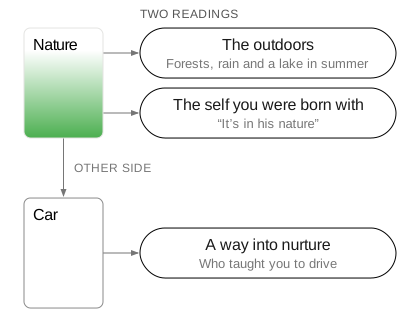
The Thesis deck has a card that fits this topic in an unexpected way. The word on it can mean the outdoors, or it can mean the self you were born with.
Nature has a Car on its other side. Some players read Nature as forests, rain and a lake in summer. Others hear “human nature” or “it’s in his nature.” Both readings belong at the table. Ask the person holding the card which one they chose, and why that one came first. The Car side is a way into nurture: who taught you to drive, the radio station on family trips, the seat you always sat in.
The die adds a second angle. It has six faces: MEMORIES · BODY · PEOPLE · VALUES · CHILDHOOD · FUTURE. The only instruction is “Look at the word from that side.” Roll it with Nature in hand and the same word gives a new story each time.
Try it with your group
A topic like this works best when everyone speaks from their own life. The game is for 2–6 players.
Before you start, agree on passing. The rules say: “Before you start, decide together how passing works.” Then take turns:
- Draw a card. Pick a side: the idea or the thing.
- Roll the die. Look at the word from that side.
- Say as much or as little as you like. The others ask, gently.
- Hand the die to the left.
Three follow-up questions fit every word: What did that feel like? Who else was there? Has it always meant that to you? The third one suits nature vs nurture well. A trait that has always been there points one way; one that arrived at 15 points another.
One more line from the rules helps when the room splits into camps: “Every view is welcome, especially one that differs from yours.” And another: “There are no right answers.”
Two more words for this topic
Two other cards pull the conversation toward where traits come from and when they settle.
Family has Bread on its other side. Family is the obvious word for inheritance, and it can get heavy fast. The Bread side keeps it light: a recipe passed down, the way someone sliced it, the bakery on the corner. Food stories can carry both nature and nurture in one scene, a taste you were born liking and a dish you learned to love.
Adulthood has a Coin on its other side. Adulthood can bring up which parts of you were set early and which you chose later. A student at 20 and a parent at 45 answer it differently, which makes it a good word for a mixed table. The Coin side brings up the first money you earned and who taught you what to do with it.
If a word lands too close, choose the other side, or pass.
What to do in your next discussion
Write the word Nature on a piece of paper. Ask the group which reading came to mind first, the outdoors or the self. Then pick one question from the list and let each person answer with one story. “A short answer is a full answer. You can always ask for more.”
To finish, each player names one thing they discovered about someone at the table today. “Sometimes one word is enough.”
See the rules and the box, or open the free online table. The cards above have their own pages: Nature, Family and Adulthood. For seminars and workshops, see Thesis for teams and classes. The research behind the deck explains where the words came from. If the talk turns heavy, see conversation questions too heavy? How to keep play in it.