It’s Saturday morning. One of you wants to stay home with coffee and a closed door. The other wants a walk, a market, a friend’s place. By lunch you’ve done half of each, and neither of you feels rested. The free time you shared felt like one more errand.
This post is for couples who get little free time and spend it tired. It helps each of you name what rest means to you, sort it into three formats, and plan a weekend where both of you come out with more than you went in with. You can do the talking part with one word on a scrap of paper: Rest.
Two people can rest in opposite ways
Rest is personal, and a couple holds two versions of it. In the Rest Test, a survey of more than 18,000 people in 134 countries, the activities people most often called restful were reading (58%), being in nature (53.1%), and being on their own (52.1%). Felicity Callard, who led the project, noted that the top activities are often done alone, and suggested that the rhythm of time with and without others may matter alongside the total hours of rest (Wellcome 2016).
For a couple, that rhythm is the tricky part. If one partner rests by being alone and the other rests by being with people, a shared Saturday can drain both. Neither version is wrong. The friction comes from treating “time together” and “rest” as the same thing.
Time together still counts
Time together does carry something. Flood and Genadek looked at American Time Use Survey data from 2003–2010, with 46,883 people in their time-together sample. In the survey’s 2010 well-being data, married people were 1.8 times as likely to report high happiness during activities with their spouse, and 21% less likely to report stress. Parents spent less than half as much time alone with their spouse as nonparents, on weekdays and on weekends (Flood & Genadek 2016). The data is correlational. It can’t say that time together causes the good mood, and it doesn’t measure rest.
Some parents on marriage forums describe the same thing: time together that feels like a chore. When the hours alone together are few and come at the end of the day, both of you can be spent. So it helps to know which kind of rest each hour is for.
Three formats for rest
One way to sort free time for two is into three formats. Naming them makes it easier to say which one you want without it sounding like a rejection.
- Rest apart. One of you leaves the house or closes a door. The other has the place to themselves. Nobody has to check in.
- Rest side by side. Same room, separate things. One reads, one listens to music. No talking needed.
- Rest together. A shared walk, a meal, a slow talk. Both of you are present for each other.
To pick one, start with company. If one of you wants to be alone, rest apart. If you both want company but not talk, rest side by side. If you both want to talk, rest together.
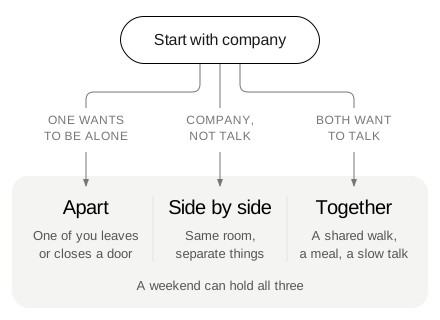
A weekend can hold all three. A morning apart can make the shared walk in the afternoon feel like rest, and keep it from becoming a duty.
Why the obvious advice doesn’t stick
The usual tip is “schedule quality time.” When both of you are tired, quality time can turn into a task: a date night that needs a sitter, a plan, and energy neither of you has. The word “quality” also sets a bar, and a quiet evening on the sofa can feel like a failure next to it.
The second barrier is guilt. The partner who wants time alone may worry it reads as distance. The partner who wants company may worry it reads as need. Talking about rest before the weekend, at a calm moment, takes the weight off the Saturday morning moment when both of you are tired.
A short talk about how you each rest
This talk works on a weeknight, before the weekend arrives. It needs one word and two people who aren’t in a hurry.
- Write the word Rest on a scrap of paper, or draw it at the online table.
- Agree how passing works before you start. Either of you can pass without a reason.
- One of you says what rest means to them: a place, a time of day, a memory of a day that left them rested.
- The other asks one follow-up, then listens.
- Swap. The second person says what rest means to them.
- Together, name one hour this weekend for each format: apart, side by side, together.
Three follow-up questions from the Thesis rules fit here:
What did that feel like? Who else was there? Has it always meant that to you?
The second one tells you a lot about rest. If your partner’s most restful memory has nobody else in it, that’s useful to know before Saturday.
Words that open the topic
These three cards from the Thesis deck fit a talk about rest. Each has an everyday object on its other side, which helps on a night when energy is low.
Rest has Clock on its other side. Rest goes straight to the topic: what it is for each of you, and when you last had it. Clock is a gentler way in. A clock in a childhood kitchen, an alarm you hated, a Sunday when nobody watched the time.
Silence has Tree on its other side. Silence suits the partner who rests by being quiet, and lets the other partner hear what quiet gives them. It can also show whether silence at home feels restful to both of you, or only to one. Tree brings up outside places: a garden, a park, a tree outside a window.
Play has Laptop on its other side. Play asks what each of you does for fun with no goal, which can be where rest together lives. Laptop can go either way: the screen one of you unwinds with, or the work that follows you home.
If you play with the die, the six sides are MEMORIES, BODY, PEOPLE, VALUES, CHILDHOOD, and FUTURE. Look at the word from that side.
Questions about rest for two
If you’d rather start with a question, these ones stay close to how each of you rests:
- What did a restful weekend look like in your family when you were a kid?
- Where do you feel most rested: at home, outside, or somewhere else?
- When did you last feel fully rested, and what were you doing?
- Which do you need more after a long week: company or quiet?
- What’s a small thing that rests you in a few minutes?
- What makes free time feel like a chore for you?
- Is there a kind of rest you’d like to try together?
- What would an hour apart this weekend look like for you?
- Which time of day is the most restful for you?
- What do you do when you’re tired and can’t rest?
Use one or two per evening. Follow each with one of the three follow-ups, and let the answer run.
When rest touches something hard
Rest can open heavier topics: a job that leaves no room, a stretch with a new baby, a parent who never sat down. If a word lands somewhere hard, the pass agreement covers it. Either of you can stop, or turn the card to the object side. The rules put it this way: “Say as much or as little as you like.”
If the talk turns into a disagreement about chores or who gets more time off, name it, set it aside, and agree when you’ll come back to it. The rest talk works best when it stays about rest.
Try it this week
Pick one hour this weekend for rest apart, and say it out loud before Saturday. Then, on the walk or the meal you share, each of you names one thing that rested you this week. That’s the same way a game of Thesis ends: each player names one thing they discovered about someone today.
For more ways to start talks as two, see conversation cards for couples. The three cards have their own pages: Rest, Silence, and Play. More on playing as two is on Thesis for couples, and the research behind the deck covers the studies. To see the cards and die, read the rules and the box.