In a SMART Recovery meeting, the topic can come from the people in the room. The meeting opens with a check-in, and the issues raised there become the discussion. When nobody brings one, the facilitator asks a question built on a SMART tool and takes it around the circle. Other recovery meetings start differently. LifeRing opens with “How was your week?”, and AA’s service material lists Steps, readings and slogans as discussion topics. This explainer walks through each start, as the groups’ own guides describe it, so a new facilitator or chair can see where a topic comes from.
Each section quotes the official material. Your group’s format, script and training come first. Thesis appears near the end as one extra way to fill an empty topic slot, and a word on an index card does the same job.
SMART Recovery: the check-in sets the agenda
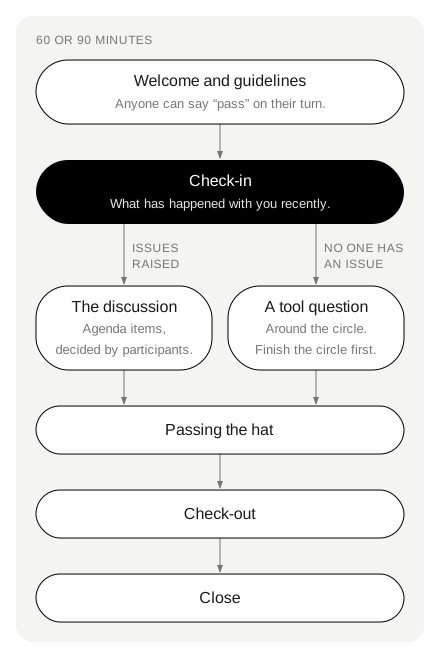
SMART Recovery’s hosted discussion script runs in a fixed order: welcome and guidelines, check-in, discussion, passing the hat, check-out, close. The meeting lasts 60 or 90 minutes (SMART Recovery script). The check-in prompt is open: “Tell us, if you wish, what you’d like us to know, perhaps why you are here or what has happened with you recently.” The discussion is a series of around-the-circle exercises, and the host might pick them based on concerns from the check-in.
SMART Recovery Australia describes the same start in plain terms. The meeting begins with a check-in “where participants discuss how their previous week has been,” and the time after that goes to “agenda items, decided by participants” (SMART Recovery Australia). So the facilitator doesn’t announce a topic at the door. People’s weeks supply it.
The script also sets the tone for speaking. Its first guideline says no one is required to take part, the group goes around the circle at least twice, and a person can say “pass” on their turn. The host is asked to read the script and exercises “as written, no more or no less.”
SMART Recovery: when the check-in brings nothing
Some weeks the check-in ends and nobody has an issue. Tom Horvath, signed as SMART Recovery’s president, wrote a sheet for this case, titled “The Dreaded ‘Dead Zone’.” It opens: “When no one has an issue to discuss in a SMART Recovery meeting, following are some questions to consider asking to get the conversation going” (Horvath, SMART Recovery).
Every question on the sheet is tied to a SMART tool, so the facilitator may find them easy to remember without notes. Each one can be answered quickly, going around the circle. A few examples from the sheet show the range:
- Cost-Benefit Analysis. The greatest benefit and the greatest cost of the addiction, and how the two are related.
- Change Plan. What, if anything, a person will do this coming week about the problem.
- Hierarchy of Values. “What is the value most important to you?” asked twice around the circle, to see if answers change.
- Brainstorming. The most helpful new idea a person ever got about addiction or recovery.
When a discussion starts mid-round, the sheet’s suggested line is to finish going around the circle first, then come back to the point.
The hosted script lists more exercises of the same kind, numbered 1 to 13. Number 13 is based on SMART’s fourth point, Lifestyle Balance, and asks what a person would do more of to lead a more balanced life.
LifeRing: “How was your week?”
LifeRing’s convenor handbook names its opening directly. “How Was Your Week?” “is the starter topic for most LifeRing meetings” (LifeRing). It’s described as an invitation to report on the person’s recovery work since the last meeting, and to “look forward to the challenges of the coming week.”
The weekly report works as both check-in and topic. Each person’s week is the material.
LifeRing has a separate page for the times this doesn’t carry the hour. It says “sometimes discussion lags and the convenor tries to enliven things by raising a topic” (LifeRing convenors). Often the convenor or a member of the group can come up with one, and the page suggests: “You could ask the group for ideas.” Its sample topics are questions, such as “What does sobriety look like to you?”
AA discussion meetings: a Step, a reading or a slogan
In AA discussion meetings, the topic can come from the literature. AA’s General Service Office publishes a sheet called “Suggested Topics for Discussion Meetings” (AA, SMF-56). It describes “some groups” that “discuss one Step a week or read a chapter” and allow discussion after.
The same sheet lists other starts. Readings from Daily Reflections can open a discussion. Slogans can serve as topics, such as “Live and Let Live,” “Easy Does It,” and “First Things First.” It also gives short topics, such as “Acceptance,” “Attitude of gratitude,” and “Complacency.”
Four starts side by side
The four starts differ in who brings the topic and when it’s set. Read side by side, they look like this:
- Check-in to agenda (SMART). Participants bring issues in the check-in, and those become the discussion.
- Tool question (SMART, when the check-in is empty). The facilitator asks a question built on a SMART tool and takes it around the circle.
- Weekly report (LifeRing). “How was your week?” is the topic, with a raised topic when discussion lags.
- Step, reading or slogan (AA). A Step a week, a chapter, a daily reading or a slogan opens the discussion.
A drawn word for the empty slot
Every format above has a moment when the planned start runs dry. SMART has the dead zone, LifeRing has the lagging discussion, and an AA chair can face a room with no topic. A drawn word is one way to fill that slot without choosing for the group. Before the meeting, put a few one-word topics in an envelope. When the room goes quiet, someone draws one and the round begins.
The Thesis deck has one word on each side of a card: an idea on one side, an everyday thing on the other. A speaker can take either side. The rule card keeps it loose: “Say as much or as little as you like. The others ask, gently.” In a SMART meeting, a drawn word sits next to the tool questions, and the facilitator decides whether it fits the script.
Balance is on the back of Watch. In a SMART meeting it lines up with the Lifestyle Balance exercise, so a facilitator can draw it and stay close to the program. A speaker who doesn’t want to talk about their own balance can talk about a watch they wore, or the hours it used to count.
Hope sits on the back of Teddy bear. It suits the forward-looking part of a check-in, the “coming week” that LifeRing’s report asks about. The object side gives a newcomer a turn that asks for no history: a toy they kept, or one they gave away.
Honesty is on the back of Radio. It’s a heavier word for a group that has met for a while. Some speakers will talk about being honest with themselves about use. Others take the radio and talk about a song that comes on at the wrong moment.
A few questions help a group decide how a drawn word fits its own format:
- Does the word replace the tool question, or come after it?
- Who draws: the facilitator, the person to their left, or a newcomer?
- Can a speaker take the other side of the card?
- Can a speaker pass on the word and still check in?
- Does the word go around once, or twice like the values question?
- Where does the word go when a real issue comes up mid-round?
- Who fills the envelope, and how often?
- Which words stay out of the envelope for this group?
Try one word before your next meeting
Try a drawn word with a co-facilitator first. Open the online table, draw a word, and each take a turn.
The die has six faces: MEMORIES · BODY · PEOPLE · VALUES · CHILDHOOD · FUTURE. The only instruction is “Look at the word from that side.” Thesis is a conversation format and makes no clinical claims. The rule card’s line, “Before you start, decide together how passing works,” sits close to SMART’s own guideline on passing.
Before your next meeting, write five one-word topics on slips and keep them with the script. Use them only if the check-in and the tool questions run out.
For more on running a group, see Thesis for therapy groups and 50 one-word recovery group topics. The three cards above have their own pages: Balance, Hope and Honesty. You can play online for free, see the rules and the box, or read the research behind the deck. Related: AA meeting topics for discussion: a chair’s draw-a-word method.