A retro goes wrong in a familiar way. One person names a colleague for the failed release. Two others pile on. The rest of the team goes quiet, the board fills with sticky notes about other teams, and the session ends with no action item. This guide gives a scrum master eight ground rules that keep working on a bad day, and the lines to use in the moment one of them breaks. They need nothing but a whiteboard. If the team wants a lighter reset session afterwards, the free online table has a card round for it.
Why complaint rounds cost more than they seem to
A retro that runs on complaints does damage beyond one lost meeting. Kauffeld and Lehmann-Willenbrock videotaped 92 regular team meetings and coded the interaction. Problem-solving and action planning went with higher meeting satisfaction and team productivity. Criticizing others and complaining went with worse outcomes, and those negative links were stronger than the positive links of good interaction. The researchers also measured organizational success 2.5 years after the meetings and found it linked to constructive interaction in those meetings (Kauffeld and Lehmann-Willenbrock 2012). The data show links, not causes. Still, the pattern suggests that complaining can cost a meeting more than good talk adds to it. That’s the case for ground rules that hold even when a single person tests them.
1. Write the rules with the team, on a calm day
Rules handed down in the middle of a heated retro read as a reprimand. Rules the team wrote together read as an agreement. At the start of a quiet retro, ask the team what makes a retro useful to them. Turn the answers into four or five short lines and keep them on the first slide of every session. When a rule breaks later, you can point to the team’s own words.
2. Talk about the work, and assume good intent
Blame can start with a name in the subject of the sentence. Norm Kerth’s Prime Directive, from his book Project Retrospectives, asks the team to assume that everyone did the best job they could, given what they knew at the time, their skills, the resources they had and the situation (Retrospective Wiki). Read it aloud at the start, or write your team’s version of it. Then hold notes to it: “Alex shipped a broken build” becomes “The build passed review with a failing test.”
3. Every complaint leaves with a request
A complaint names something real. It goes sour when it has nowhere to go. Set a rule that each complaint gets one follow-up line: what would you like to be different next sprint? “The specs are always vague” turns into “I’d like acceptance criteria on each ticket before planning.” That one line moves the talk from complaining toward action planning, the kind of talk that went with better outcomes in the meetings study.
4. The first round has no replies
An argument in a retro can start with a reply to the first note. Let each person read their notes in full while the others listen. Questions and answers wait until everyone has spoken. On a remote call, ask people to stay muted while others read. The rule card puts the listening part in one line: “The others ask what they’re curious about, gently, without judging.”
5. One topic, one owner, no pile-on
A pile-on looks like agreement and works like a trial. When three people add to the same complaint about one colleague, cluster the notes into a single topic and let one person speak for it. The person named gets the next turn, with time to answer in full. If the manager is in the room, the manager speaks last on every topic, so the team’s view comes out before the boss’s view does.
6. Agree on what leaves the room
People may say less when they don’t know where their words will end up. Decide together what goes into the notes and what stays in the meeting. One common split: action items and topics go out, and who said what stays. The Thesis rule card has a line for this: “What is said at the table stays at the table.” Write your version on the first slide next to the other rules.
Respect has Blanket on its back. In a retro, Respect can be read as being heard to the end, getting credit for a fix, or having a calendar block left alone. The Blanket side gives a quieter way in: the shared thing that covers everyone, such as a test suite or an on-call rotation, and who keeps it in shape.
7. A pause word anyone can call
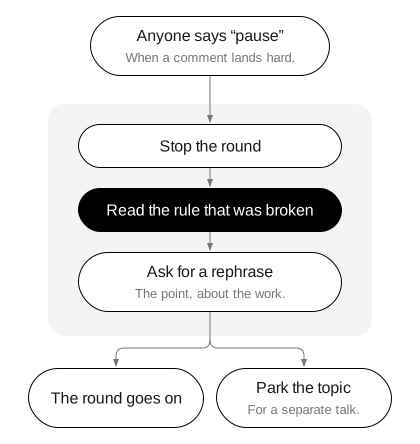
Heat can build faster than a facilitator spots it. Agree on a short word, such as “pause,” that anyone can say when a comment lands hard. The facilitator then stops the round, reads the rule that was broken, and asks the speaker to rephrase the point about the work. Then the round goes on, or the topic is parked for a separate talk. Calling the pause is about the rule, so nobody has to accuse a colleague to use it.
8. Check the rules before you close
Rules can fade when nobody looks at them. Close each retro with one question: which rule did we keep best today, and which one slipped? Change a rule if the team keeps tripping over it. A rule that never comes up can go.
Honesty has Radio on its back. For a team, Honesty can be read as saying an estimate was wrong, or that a deadline was never realistic. The Radio side shifts the talk to signal and noise: which channel the team hears the news on first, and which one carries mostly static.
What to say when a rule breaks
The first broken rule decides whether the others hold. The lines below name the rule and leave the person out of it:
- For blame: “Let’s put that in terms of the work. What happened to the build?”
- For a pile-on: “I’m hearing one topic. Let’s give it one owner and hear from the person named.”
- For a complaint with no request: “What would you like to be different next sprint?”
- For a heated reply: “We’re still in the first round. Hold that until everyone has read.”
If the same person breaks the same rule twice, the talk belongs in a one-on-one after the retro, away from the group.
Boundaries has Shoes on its back. It suits a team that has had a rough retro, because the word lets people talk about limits in general: the hour after which they stop answering messages, the review they won’t approve without tests. The Shoes side brings up the commute, the walk between meetings, or the pair of shoes someone keeps under the desk.
Questions for a ground-rules session
The questions below help a team write its own rules, and each one can be answered at any depth:
- What made the last useful retro useful?
- What do you need from the others when you raise a problem?
- Which comment in a retro makes you stop talking?
- What should go into the retro notes, and what should stay in the room?
- Who should speak last on a topic, and why?
- What word would you use to call a pause?
- How should we handle a complaint about someone who isn’t here?
- What would make you trust that a note leads to a change?
Running a reset round with cards
After a retro that went badly, a lighter session can lower the stakes before the next one. With the deck or the online table, each person draws a card, chooses the idea or the thing, rolls the die and looks at the word from that side. The die has six plain words: MEMORIES · BODY · PEOPLE · VALUES · CHILDHOOD · FUTURE. The only instruction is “Look at the word from that side.” The others ask what they’re curious about. The rule card gives three example questions: What did that feel like? Who else was there? Has it always meant that to you?
Before your next retro, put the team’s four or five rules on the first slide and read them aloud before the first note. The cards above have their own pages: Respect, Honesty and Boundaries. For formats that keep a retro moving, see retrospective ideas built on one word. For more on running it at work, see Thesis for teams and classes. For the studies behind the deck, see the research page. See the rules and the box.