Ask a group “What do you value most?” and the first round comes back fast: family, honesty, health, freedom. The answers are true and can sound a little rehearsed. The useful part comes when the same question goes around a second time, after everyone has heard everyone. Some people keep their word, some change it, and both choices have a story behind them. This guide sets up that two-pass round for therapy groups, recovery meetings and peer-support circles, with a card word as the lens, ten questions, and a plan for one session.
The round works with a word written on an index card. The examples use the Thesis card deck, where every card has an idea on one side and an everyday thing on the other.
Where the two-pass round comes from
The format is written down in SMART Recovery’s facilitator guidance. A handout by SMART Recovery President Tom Horvath lists questions for meetings where no one brings an issue. Each question is tied to a tool and “can be answered quickly, going around the circle.” Under Hierarchy of Values, the handout gives the question “What is the value most important to you?” and the instruction to go around once, then again: “We’ll see if the answers are different the second time around” (Horvath, SMART Recovery 2021).
The second pass is the activity. The first one gives the group material to work with. After it, the group can talk about why someone changed an answer, or why they decided the first one still held. The handout says the same: “Then we might discuss why you changed your answer, or why you decided your first answer was still true.”
Why the first pass sounds the same
A values question in a group has an audience. The first speaker sets a tone, and the next answers can stay near it. People may pick the word that sounds right in this room, an abstract noun nobody can disagree with. A member who wanted to say “being left alone” hears three people say “family” and says “family” too.
A first pass in front of others can sound like this. The second pass happens after people have heard each other. Someone who heard a neighbor talk about loyalty to a brother may now have a word of their own that didn’t feel sayable in the first round.
What people say also affects how the room feels about them. In a meta-analytic review, Collins and Miller found that people who make more intimate disclosures tend to be liked more than people who disclose less, and that people come to like those they have disclosed to (Collins and Miller 1994). The review covers studies of disclosure in general, not therapy groups. It’s still a reason to give the second pass room for a more personal answer, and to leave it optional.
How to run the two passes
The steps below follow the SMART handout and add one card word to narrow the question.
- Agree on passing. The Thesis rule card opens with “Before you start, agree together how passing works.” A pass in the first round also allows a pass in the second.
- Put one word in the middle. Draw a card, or write a word on an index card. The word is the lens for both passes.
- First pass. Each person says what the word means to them, or which value sits behind it. One or two sentences. No replies yet.
- Hold any discussion. If a conversation starts mid-round, the handout’s line works: “Let’s finish going around the circle then come back to what you are saying.”
- Second pass. Same word, same question, same order. People can keep their answer, change it, or add to it.
- Talk about the difference. Ask who changed and why, and who kept their answer and why.
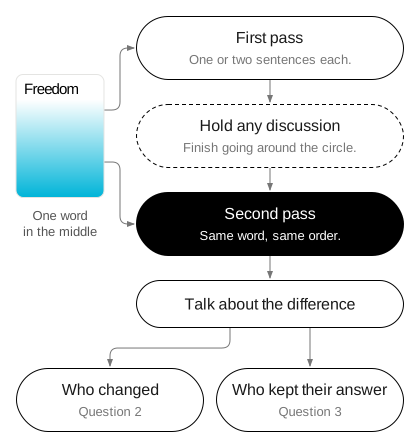
The fixed order in step 5 matters. When the second pass starts with the same person, members can hear their own first answer next to the new one. In Thesis the die moves the same way: “Hand the die to the left.”
Three cards for the lens
A single word gives the group a shared starting point and keeps the round from becoming a list of virtues. These three cards suit a values session, and each has an everyday thing on the back.
Freedom is on the back of Compass. In a recovery group, freedom can mean freedom from a substance, or freedom to make choices that used to be made for you. The compass gives a second way in: someone can talk about a direction they were heading, or a time they had no sense of direction at all. On the second pass, a member may move from one meaning to the other.
Enough is on the back of Photograph. It’s a values word without the usual polish. Asking what counts as enough money, rest, or attention gets a concrete answer quickly. A member can also start with a photograph they keep, and say what it shows about what mattered to them then.
Loyalty is on the back of Camera. Loyalty in a group can point two ways: to people who helped, and to people or habits that cost something. The second pass can bring out that second meaning. The camera side lets someone talk about who took the pictures in their family, and who was left out of them.
Questions for a values session
These questions work for the talk after the second pass, or as the question for both passes in place of a card. Pick two or three for one session.
- What value is most important to you right now?
- Did your answer change between the two rounds? What moved it?
- If you kept your answer, what made it still feel true?
- Which value did you grow up with that you’ve kept?
- Which value did you grow up with that you’ve put down?
- When did you last act on a value when it cost you something?
- Which value did someone else in this circle name that you’d add to yours?
- What value do people around you think you have that you don’t?
- Which value is hardest to keep this month?
- What would a week look like if you lived by your answer?
Question 2 and question 3 belong together. Asking only who changed can sound like changing was the goal. Asking both makes keeping an answer an equal result. The rule card puts it plainly: “There are no right answers.”
A plan for one session
The two passes fit one session in this order:
- Check-in and pass agreement. “Before you start, agree together how passing works.”
- First pass. One word in the middle, one or two sentences each.
- Second pass. Same word, same order.
- Discussion. Questions 2 and 3, then one more from the list.
- Close. Each person names one thing they heard from someone else today.
The close comes from the Thesis rule card’s last round: “each player names one thing they discovered about someone at the table today.” After a values session, it lets members end on what they heard from others, and their own answers can rest.
You know your group, its purpose and its limits, and you decide how far a values round goes in it. Thesis is a conversation format and makes no clinical claims. What is said follows the rule card: “What is said at the table stays at the table.”
Try the round before the session
Open the online table, draw a card, and run both passes on your own: write a first answer, read it, then write a second.
The die has six faces: MEMORIES · BODY · PEOPLE · VALUES · CHILDHOOD · FUTURE. The only instruction is “Look at the word from that side.”
Before the next session, write the two-pass steps on one card and choose the word for the middle. For running the game in a session, see Thesis for therapy groups. The three cards above have their own pages: Freedom, Enough and Loyalty. You can play online for free, see the rules and the box, or read the research behind the deck. For a closing round after the discussion, see check-out questions for group therapy. Related: A boundaries activity for group therapy: one session, one word.