A coworker asks how your weekend was, and you say “Good, thanks” about a weekend you spent arguing on the phone. A friend shows you the haircut, and you say you like it. Neither answer felt like lying when you said it. Later you wonder where your honesty starts, and whether the small answers count.
This guide helps you find your own line. It covers what research says about everyday lies, a way to sort the small ones, ten questions to answer with a story, and one word to talk through with a friend. You can use the Thesis deck, the free online table, or a word written on a napkin.
The short answer
Honesty can mean something different from person to person, and the difference shows in the small cases. A lie told to cheat someone is easy to judge. The harder cases are the haircut, the “Good, thanks,” and the gift you didn’t like.
Your definition of honesty is the set of rules you already follow in those moments. Some of them may have come from home and were never said out loud. Saying them to someone else shows which ones you still agree with.
How often the small lies happen
Everyday lying is common enough to count. Bella DePaulo and colleagues asked people to keep a diary of their social interactions and the lies they told in them. In the first study, 77 college students reported telling two lies a day. In the second, 70 community members reported one a day (DePaulo et al. 1996).
The participants described most of these lies as minor. They rarely planned them and didn’t worry much about being caught. The authors read this as lying being part of routine social life. One finding cuts the other way: interactions with a lie in them were rated less pleasant and less intimate than interactions without one.
That last detail matters for a personal definition. A small lie can keep a conversation smooth and still leave it thinner. If you’ve ever left a chat feeling oddly far from the person, a polite answer you didn’t mean may be part of why.
Who the lie is for
DePaulo’s diaries sorted lies into two kinds: self-centered lies that protect or help the person telling them, and other-oriented lies told for the listener’s sake. Participants told more self-centered lies than other-oriented ones. The exception was conversations between two women, where both kinds came up about equally.
Emma Levine and Maurice Schweitzer looked at how people judge the second kind. They define a prosocial lie as a false statement meant to mislead and to benefit the person who hears it. Across three studies, people who told prosocial lies were judged more moral than people who told the truth. The authors conclude that when honesty and benevolence conflict, benevolence may weigh more in how people judge character (Levine and Schweitzer 2014).
The same paper separates white lies from prosocial ones. A white lie is about something trivial, and it can serve either person. A prosocial lie is told to help the listener, and its stakes can be small or large. “I love the haircut” can be both. “I’m fine” said to end a conversation is a white lie that serves you.
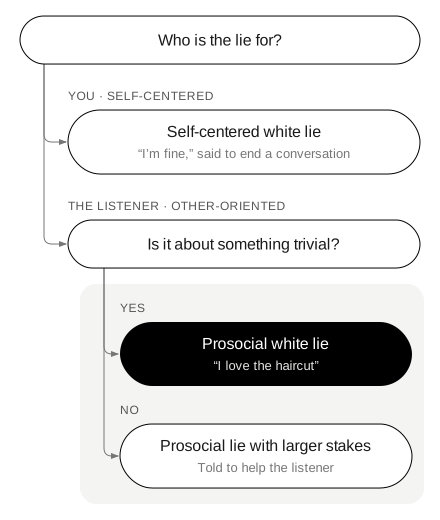
Sorting your own lies this way is a quick test. Write down the last three small lies you remember. Next to each, write who it was for. A list full of lies told for the other person describes an honesty built around care. A list full of lies told for yourself describes an honesty built around comfort. Either list is a place to start the conversation.
Tact is a choice of words
Tact works inside the truth. It picks what to say first, what to leave for later, and which true thing to say at all. “The color suits you” about a haircut you don’t love can be true and kind at the same time. Where that stops being tact and starts being a lie is a line you draw for yourself.
Keeping something private is a different act from lying about it. Saying “I’d rather not talk about it” keeps your weekend to yourself without inventing a better one. You may count that as fully honest. Or you may feel a silence can mislead as much as a sentence. Your answer here is part of your definition.
A hard truth to a friend is a separate question, with its own research. For when and how to say one, see honesty vs kindness: telling a friend a hard truth.
Ten questions to find your answer
These work alone with a pen, or with a friend asking them. Answer with a story where you can: a place, a year, a person.
- What did honesty mean in the house you grew up in?
- When did you first get caught in a lie, and what happened next?
- Which small lie do you tell most often?
- Who in your life tells you the truth without being asked?
- When did a white lie from someone else feel like care?
- When did a polite answer leave you feeling far from someone?
- What do you keep private that you wouldn’t lie about?
- Which compliment have you given that you didn’t mean?
- When were you honest and later glad you had been?
- Has your line on white lies moved in the last ten years?
Look for words that repeat across your answers. A name, a rule, or a place that keeps coming back is part of your definition.
Look at the word from six sides
A second way in is to stay with the word and change the angle. The Thesis die has six faces: MEMORIES · BODY · PEOPLE · VALUES · CHILDHOOD · FUTURE. The only instruction is “Look at the word from that side.”
Honesty has a Radio on its other side. Choose the idea when you want to talk about where your line sits. Choose the Radio when a story is easier: a radio turned up so a conversation in the next room couldn’t be heard, a voice you believed every morning, a song you said you liked to share a car ride. The Radio side can bring up what got said in a family and what got covered.
Trust has a Window on its other side. Honesty is what you give, and Trust is what comes back. The idea side can bring up whose word you take without checking. The Window side brings up what you could see from where you stood, and what someone let you see.
Privacy has a Diary on its other side. It helps with the line between keeping something to yourself and hiding it. The Diary side brings up what you wrote that nobody was meant to read, and what happened if someone did.
Try it with someone
Saying your definition to another person tests it. A friend hears the rule that sounds borrowed and asks about the one that doesn’t. The research on self-disclosure points the same way. A meta-analysis by Nancy Collins and Lynn Miller found three linked effects: people who disclose more intimately tend to be liked more, people disclose more to those they like, and people come to like those they’ve disclosed to (Collins and Miller 1994).
Before you start, agree on passing. The Thesis box says: “Before you start, decide together how passing works. What is said at the table stays there.” Then take turns:
- Draw a card. Pick a side: the idea or the thing.
- Roll the die. Look at the word from that side.
- Say as much or as little as you like. The others ask, gently.
- Hand the die to the left.
The rules give three follow-up questions: What did that feel like? Who else was there? Has it always meant that to you? For Honesty, the third one does the most work. If your rules about lying came from one person, the answer names them. “There are no right answers.” That line matters for Honesty, because each player at the table may draw the line in a different place.
What to do tonight
Write Honesty on a scrap of paper. Under it, write the last small lie you told and who it was for. Tell that story to someone you trust, and let them ask one follow-up. When you’re done, each of you can name one thing you discovered about the other. “Sometimes one word is enough.”
See the rules and the box, or open the free online table. The cards above have their own pages: Honesty, Trust, and Privacy. For playing with a few close people, see Thesis for friends. For the studies behind the deck, see the research page.