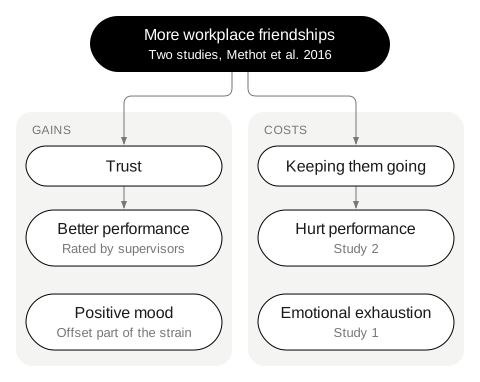
Workplace friendships come with a trade. In two studies of insurance, restaurant and retail employees, people with more friends among their coworkers got better performance ratings from their supervisors. The same friendships also cost them energy, through emotional exhaustion and the work of keeping the friendships going (Methot et al. 2016). This post is for team leads who want to know what the research says before they plan another team lunch. It covers what friends at work bring, what they cost, and a few things to set up so the team keeps the first part.
How common friends at work are
In Gallup’s data, close friends at work are in the minority. Gallup reports that in the U.S., two in 10 employees say they have a best friend at work (Gallup 2022). Fortune, reporting Gallup surveys of more than 10,000 adults, gives the trend for hybrid workers: 22% said they had a “best friend” at work in 2019, and 17% said so in 2022. For fully remote and fully on-site workers, the share fell by one percentage point to 19% over the same period (Fortune 2022).
The word “best” matters here. Gallup asks about a best friend, which is a high bar. Someone can have a coworker they eat lunch with and still answer no. Read the numbers as a floor for close ties. They leave out coworkers who get along well without being best friends.
What friends at work bring
The gains show up in performance, satisfaction and the way people describe their job. In the Methot study, the link to better performance ran partly through trust: friends at work trusted each other more, and that trust went with higher supervisor ratings (Methot et al. 2016). The study also found more positive mood among people with more work friends, which offset part of the strain.
Gallup’s data points the same way. In 2019, 33% of employees with a work best friend were satisfied, against 23% of those without one. In 2022 the gap was 32% against 15% (Fortune 2022). Gallup also links a best friend at work to customer engagement, getting more done in less time, a safer workplace, sharing ideas and having fun at work (Gallup 2022). These are survey links. They don’t prove that the friendship causes the outcome.
What friends at work cost
The costs are quieter and land on the people in the friendship. Methot and colleagues found that more workplace friendships went with more emotional exhaustion in the first study. In the second, they hurt performance through the difficulty of maintaining them (Methot et al. 2016). A friend at work is someone who also needs your attention on a bad day, at the same desk, during the same deadline.
Julianna Pillemer and Nancy Rothbard at Wharton describe why. Friendship is voluntary, informal and built on helping when someone needs it. Work assigns people to each other, runs on roles and on fair exchange. In Pillemer’s words, “The defining features of friendship can be fundamentally in conflict with the defining features of organizational life” (Knowledge at Wharton 2018). Their paper lists where that conflict shows up:
- Decisions. Close friends may hold back from challenging each other in a meeting.
- Strain. A deep friendship can take emotional energy and attention during work hours.
- Cliques. Visible close pairs can leave others feeling outside the group.
- Rank. A friendship between a manager and someone below them can look like favoritism.
- Social media. Online posts make private life and close pairs visible to the whole team.
They also describe a middle zone. In friendships that are friendly but not fully secure, people are more likely to hold back in a disagreement. The closest friendships hold up better.
What a team lead can set up
The research doesn’t argue against friends at work. “We’re not saying you shouldn’t encourage friendship,” Pillemer says in the same article. The suggestions are structural:
- Mix the groups. Assign project teams across functions instead of letting people pick their own. Regular cross-functional lunches do the same job outside projects.
- Make criteria visible. When a manager is friends with someone on the team, write down how decisions on projects and promotions are made.
- Agree on disagreement. Friends can say up front that they’ll challenge each other in meetings. A lead can say the same to the whole team.
- Protect focus time. A scheduled catch-up works better than a stream of interruptions during work.
- Invite past the pair. People in close friendships can make a point of including coworkers they know less.
None of these forces a friendship. They make room for ties to form across the team and keep close pairs from turning into a closed circle. For the conditions that let people disagree in the first place, see how to build psychological safety in teams.
A conversation that gives friendship a start
Friendships at work can grow out of talk that isn’t about tickets and deadlines, and a team may have no format for it. Some teams try a virtual happy hour. One remote worker described a Friday call where everyone felt awkward and talked about work anyway. A short structured round gives people something to talk about besides the sprint, and it keeps the depth in each person’s hands. The Thesis rule card says it in one line: “A short answer is a full answer. You can always ask for more.”
Friendship has Ball on its back. In a team round, Friendship lets people talk about what a friend means to them without naming anyone at the table. Someone might describe a friend from a first job. Someone else might pick the ball and talk about a pickup soccer game on Thursday nights.
Trust has Window on its back. Trust is the part of workplace friendship that the Methot study tied to better work, so it suits a team that wants to talk about it. The window side is the easy way in: an office with no windows, a view from a first apartment, a room where someone does their best thinking.
Boundaries has Shoes on its back. It speaks to the cost side of friends at work: when a lunch friend also sends work late at night Anyone who’d rather not talk about that can take the shoes and describe what they wear to the office.
Questions for a team round
The questions below work at any depth and give no slot for family, money or health details:
- What did a good coworker do for you in your first job?
- What makes a lunch with a coworker go well?
- What’s something a colleague taught you outside their job description?
- How do you know someone at work has your back?
- What’s a habit that keeps work and friendship apart for you?
- What makes it easy to disagree with someone you like?
- What’s a team ritual you’d keep from a past job?
- Who outside your team would you like to know better?
Running it as a card round
With the deck or the online table, each turn has the same steps. Draw a card, choose the idea or the thing, roll the die and look at the word from that side. The die has six plain words: MEMORIES · BODY · PEOPLE · VALUES · CHILDHOOD · FUTURE. The only instruction is “Look at the word from that side.” The others can ask what they’re curious about. The rule card gives three short examples: What did that feel like? Who else was there? Has it always meant that to you?
Before your next team meeting, pick one of the five setups above and try it for a month. The three cards have their own pages: Friendship, Trust and Boundaries. For more on running it at work, see Thesis for teams and classes. For the studies behind the deck, see the research page. See the rules and the box.