The 36 questions come from a 1997 lab study of strangers. The pairs in it weren’t couples, and the study didn’t test whether married partners grow closer by answering the list together. One later study did look at couples. It found the biggest change when two couples did the tasks with each other.
This post is for couples who’ve seen the list, maybe tried it, and want to know what it can do for people who already know each other well. It covers what the research found, where it stops, and a way to use the method on a weeknight with a word instead of a list.
Where the 36 questions come from
Arthur Aron and colleagues wanted a reliable way to create closeness in a lab. Their pairs spent 45 minutes on self-disclosure and relationship-building tasks that grew more personal step by step. In the first study, these pairs felt closer afterward than pairs who did comparable small-talk tasks (Aron et al. 1997).
The same paper reports what didn’t make a difference. In the second and third studies, closeness didn’t change significantly when pairs were matched for agreeing on important attitudes, when they were led to expect they’d like each other, or when getting close was the stated goal (Aron et al. 1997).
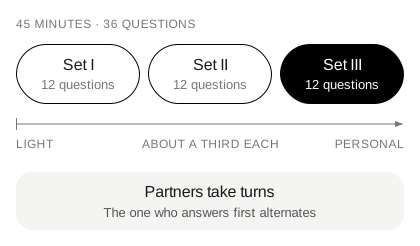
The list itself has 36 questions in three sets of 12. Each set gets about a third of the 45 minutes, and the pair moves on to the next set when that time is up. The instructions say to start Set II even if Set I isn’t finished. Partners take turns, and the one who answers first alternates, so both answer every question (Greater Good in Action).
What happened when couples tried it
Keith Welker, Arthur Aron, Richard Slatcher, and colleagues asked whether the method could raise passionate love inside existing relationships. In two studies with about 150 couples, couples spent 45 minutes on the tasks, moving from light getting-to-know-you questions to personal topics (SPSP summary via ScienceDaily).
The setup had a twist. In the first study, couples who did the high-disclosure tasks with another couple showed larger gains in passionate love than couples who did them on their own or did low-closeness tasks. In the second study, the other couple’s responsiveness explained the effect: the more responsive they were, the bigger the gain (Welker et al. 2014).
So the honest answer to “do the 36 questions work for married couples” has two parts. There’s evidence that the format, done as a double date, can raise passionate love, measured after the session. There’s no study here showing that two partners alone with the list get the same result.
Why the list can fall flat at home
The list was written for strangers, and it shows in the first set. A long-term partner already knows where you grew up and what you’d do with a free Saturday, so the first set can feel like a quiz with known answers.
The time limit causes a second problem. The lab version moves on when a set’s time is up. At home, a good answer to one early question can take the whole evening, and the rest of the list starts to feel like homework.
The research suggests what to keep from the method:
- Escalation. Start light, then go personal. The tasks in the 1997 study grew more intense over time.
- Turn-taking. In a separate study, strangers who alternated disclosure turns reported more attraction than pairs where one person spoke while the other listened, then switched. Feeling liked, enjoyment, and responsiveness helped explain the difference (Sprecher and Treger 2015).
- A good listener. In the couples study, the other side’s responsiveness carried the effect.
Those three parts don’t need 36 fixed questions. They need a starting point both of you haven’t covered yet.
A version for people who know each other
This format keeps the escalation and the turns, and swaps the list for one word.
- Agree how passing works before you start. Either of you can pass without a reason.
- Pick a word. Use a card, the online table, or write one on a napkin.
- Round one, light: each of you says the first memory, object, or place the word brings up.
- Round two, closer: each of you says where the word sits in your life now.
- Round three, personal: each of you says something about the word you haven’t told the other.
- Alternate who goes first in each round. After each answer, the listener asks one follow-up.
The Thesis rule card has three follow-ups that fit any word:
What did that feel like? Who else was there? Has it always meant that to you?
To try the double-date version from the study, invite one other couple and play with four. The rules allow 2–6 players, and “A short answer is a full answer. You can always ask for more.”
Three words with room to go deeper
These three from the Thesis deck work well for the three-round format, because each has an easy first answer and a harder third one.
Trust has Window on its other side. Round one can be a window you looked out of as a child. By round three, it can be the moment you started to trust your partner, or a time you nearly stopped. A long-term couple may know the story of how they met and not know when trust arrived.
Nostalgia has Key on its other side. A key to a first apartment or a grandparent’s house is a light start. Then the word can lead to what each of you misses, and whether any of it is from your life together.
Honesty has Radio on its other side. The radio leads to car rides and kitchens. Honesty, in the third round, can open what each of you finds hard to say out loud, at a pace both of you set.
Questions for when you want a list
If you’d rather start with questions, these are written for couples who already know the basics. They move from light to personal, like the original sets.
- What’s a song that takes you back to a year before we met?
- Which of your childhood rooms would you show me first?
- What’s something you’ve changed your mind about since we got together?
- What do you do when you’re alone that I’ve never seen?
- What did you think of me in the first month that you never said?
- When did you last feel proud of yourself, and did I notice?
- What’s a fear you’ve had for years and don’t talk about?
- What would you want us to still be doing in 20 years?
- What’s one thing I do that makes you feel looked after?
- What’s a question you’ve wanted to ask me and haven’t?
Try it this week
Pick one evening and one word. Trust is a good first one. Do the three rounds, take turns going first, and stop when it feels done. Then end the way a game of Thesis ends: each of you names one thing you found out about the other today.
For a longer list built for long-term couples, see deep questions for couples. The three cards have their own pages: Trust, Nostalgia, and Honesty. For more on playing as a couple, see Thesis for couples. For the studies behind the deck, see the research page. To see the cards and die, read the rules and the box.