Someone at the back of the room says it’s their first meeting. You’re chairing, and the topic you planned was the Seventh Step. A newcomer-friendly topic is one a person on day one can answer from today, without knowing the Steps, the slogans or anyone’s story. One everyday word does that job: Home, Rest, Courage, Enough. Say it in one plain sentence, share on it briefly yourself, and leave the newcomer free to listen.
This guide gives a chair a quick test for any topic, ten words that pass it, and a way to open them. Your group’s format and group conscience come first. If your meeting reads from a book or works a Step each week, keep that. The ideas here fit the open discussion slot.
Why a planned topic can miss the new person
Chairs on recovery forums describe this worry. A topic that suits a room of regulars can go over the head of someone who arrived tonight. Step numbers, sponsor talk and program phrases assume a history the newcomer doesn’t have yet.
A.A.’s own booklet for leaders of beginners meetings names this. It says “it is essential to make all discussions at these meetings as simple and understandable as we can,” and adds that “Many newcomers arrive with no prior knowledge of A.A.” (A.A. World Services, Suggestions for Leading Beginners Meetings). It’s written mainly for beginners meetings, and its points can carry over to any discussion meeting with a new face at the table.
The same booklet also warns about the room itself. It asks the leader to see that the meeting doesn’t turn into a discussion “with the more experienced talkers crowding the newcomer out.” A topic that only old-timers can answer makes that more likely.
A three-check test for any topic
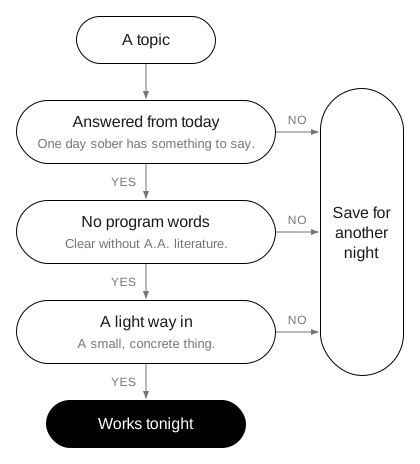
Run a topic through three checks before the meeting. A topic that passes all three works tonight. Save one that fails any check for another night.
- It can be answered from today. A person with one day sober has something to say about it.
- It needs no program words. The topic makes sense to someone who has never read A.A. literature.
- It has a light way in. A speaker can answer with a small, concrete thing, such as a meal, a walk or a chair by the window.
“Working Step Four” fails the first two checks. “Resentment” passes the second and can fail the third on a hard night. “Rest” passes all three. A newcomer can talk about one night’s sleep, and a member with years of sobriety can talk about how their evenings changed.
Ten one-word topics that pass
These ten words come from the 50 cards of the Thesis deck. Each card has an idea on one side and an everyday thing on the other, and the thing is listed in brackets. Each line gives a newcomer-sized angle and a longer one.
- Home (Spoon). Where you slept last night, or the place that feels safe now.
- Rest (Clock). The hour that used to be drinking time, and what fills it today.
- Courage (Bicycle). Walking in the door tonight, or a phone call you made.
- Enough (Photograph). One thing that was enough today.
- Belonging (Headphones). A place where you feel you fit, now or once.
- Kindness (Book). A kind thing someone did for you this week.
- Friendship (Ball). A friend who stayed, or someone you met here.
- Freedom (Compass). One thing you’re free to do this week.
- Play (Laptop). What you did for fun as a kid.
- Gratitude (Fence). One thing that went right since you woke up.
Hold heavier words for a night when the room knows each other. Death, Betrayal and Shame are in the same deck. A chair can keep those cards out on a newcomer night and use the rest.
How to open the topic
Say the word and one sentence of frame, then stop. For example: “Tonight’s topic is Home. Share on it, or on whatever’s on your mind.” The second half of that sentence keeps the floor open for anyone who walked in with something pressing.
Avoid explaining the word with program language. “Home, as in finding a home group” points the topic at people who already have one. The plain word lets the newcomer pick their own meaning.
Home sits on the back of Spoon. For a newcomer, the idea side can stay small: the room they woke up in, or a kitchen where they feel calm. The spoon side gives a way in with no recovery history at all. A speaker might describe a spoon from a parent’s kitchen, or the first meal they cooked sober.
Share first, and keep it short
The booklet lists what experienced leaders say their opening remarks generally cover. One item stands out for a chair on a newcomer night: identification as an alcoholic, “not necessarily events while drinking, but feelings.” A short share about how the word feels today gives the new person something to recognize.
Keep the share to a few minutes and use plain words. Your length can set the length for the room. The Thesis rule card has a line that fits here: “A short answer is a full answer.”
Courage is on the back of Bicycle. On a first night, the courage in the room can be the newcomer’s own: they walked in. A chair can share on a small act of courage without pointing at anyone. The bicycle side opens a lighter memory, like learning to ride or riding somewhere alone for the first time.
Let the newcomer listen
The booklet is direct about this: “The newcomer should feel welcome to participate, but never made to feel ‘on the spot’” by being asked questions. In practice that means no “Would our newcomer like to share?” and no follow-up questions aimed at them. If your format goes around the room, say before the round that anyone can pass.
A newcomer who listens is taking part. Hearing a few regulars answer a plain word can show them what a share can look like when their turn comes.
Enough is on the back of Photograph. It’s a word a person on day one can answer in a sentence: one cup of coffee, one meeting, one day. Members with more time can talk about what “enough” meant before and what it means now. The photograph side lets a speaker describe a picture they keep, which asks for nothing about drinking.
Questions a chair can ask the whole room
Some groups allow questions after a share, and some keep a no-crosstalk custom. Follow yours. If a word lands flat, one of these, asked to the room and never to one person, can open it up:
- Where did this word show up for you today?
- What does this word look like on a quiet evening?
- Who comes to mind when you hear it?
- What’s one small thing that fits this word right now?
- What did this word mean to you a year ago?
- Where were you the last time you felt this?
- What would you tell someone on their first day about this word?
- What’s one thing you’ll do with it before the next meeting?
Groups that allow follow-ups after a share can use the three from the Thesis rule card: What did that feel like? Who else was there? Has it always meant that to you? On a newcomer night, offer them to the regulars and leave the new person out of it.
Try the words before you chair
Open the online table on your phone and draw a few cards. Run each word through the three checks and keep the ones that pass.
The Thesis die has six faces: MEMORIES · BODY · PEOPLE · VALUES · CHILDHOOD · FUTURE. The only instruction is “Look at the word from that side.” In a meeting it’s optional.
Thesis is a conversation format. It makes no clinical claims, and it’s independent of every fellowship. Your group decides what fits its meetings. For running it with a group, see Thesis for therapy groups. The three cards above have their own pages: Home, Courage and Enough. You can play online for free, see the rules and the box, or read the research behind the deck. For a way to pick topics by drawing them from a box, see AA meeting topics for discussion: a chair’s draw-a-word method. For all 50 words sorted by weight, see the recovery group topics list.
Before the next meeting you chair, write three words that pass all three checks on a card and keep it in your pocket. If someone new walks in, start with the first one.