You send the first message. You suggest the dinner, pick the date and book the table. When you stop for a while to see what happens, the chat goes quiet, and the friendship seems to stop with it. Then the friend replies warmly the next time you write, and you’re back where you started.
Here’s the short answer. Starting most of the contact tells you how a friend handles contact. It doesn’t yet tell you how much they value you. Research on reaching out shows people misread how welcome a message is, on both sides of a friendship. This guide covers what the imbalance can and can’t mean, four next steps, and one way to set up a friendship so nobody has to start it each time.
What the imbalance can mean
Feeling like “always the one reaching out” can come from a count: who texted first, who called, who planned. The count is real. What it measures is less clear.
A friend who rarely writes first may be someone who answers fast, shows up on time and stays late. They may wait for an invitation in every friendship they have, including ones with people they’re close to. Some people grew up in families where others did the planning. Some are in a stretch of life with small kids, a new job or a move, where the days fill up before a message gets typed.
Other times the count does match the interest. Replies come late and short, plans get moved, and the friend rarely asks a question back. The difference shows up in what happens once you’re together, more than in who started it.
A few signs point in each direction:
- Warm when you reach them. They reply with questions, say yes to plans and seem glad to see you. The gap sits in starting.
- Present but passive. They come when invited and enjoy it, but don’t remember to suggest the next time.
- Cool on both ends. Short replies, canceled plans, little curiosity about your life. Here the count and the interest line up.
Why both people misjudge a message
The person who reaches out tends to underestimate how much it’s appreciated. In a series of preregistered experiments, Liu and colleagues found that people underestimated how much others valued a brief check-in or a small gift. The gap was larger when the contact was more surprising and when the two people were less close (Liu et al. 2023).
That finding is about senders in general, and your friend is a sender too. If they picture a message from them as less welcome than it would be, that’s one reason a friend can hold back without meaning anything by it. It doesn’t prove that about your friendship. It shows the guess people make about a message can be too low.
A second gap sits under the worry that you like them more than they like you. In studies of strangers in a lab, first-year students getting to know dorm mates and adults at a workshop, people underestimated how much their conversation partners liked them and enjoyed their company. Among the dorm mates, the gap lasted for months (Boothby et al. 2018). So the sense that you care more than they do can come partly from this gap, and partly from the count.
Why the usual advice backfires
One piece of advice is to stop reaching out and see who comes back. The trouble is that silence can mean several things at once. A friend who waits for invitations will read your silence as a busy month, and wait. You read their silence as proof. Both of you end up waiting for the other, and a friendship that had a gap in starting ends over the gap alone.
A test like this also skips the one thing that can change the pattern: telling the friend it’s there.
Four next steps
These four options work on their own or in sequence. Pick the one that fits what you’ve seen when you’re together. If they’re warm when you reach them, say it once or set a standing plan. If they’re present but passive, set a standing plan. If they’re cool on both ends, match their pace or let it rest.
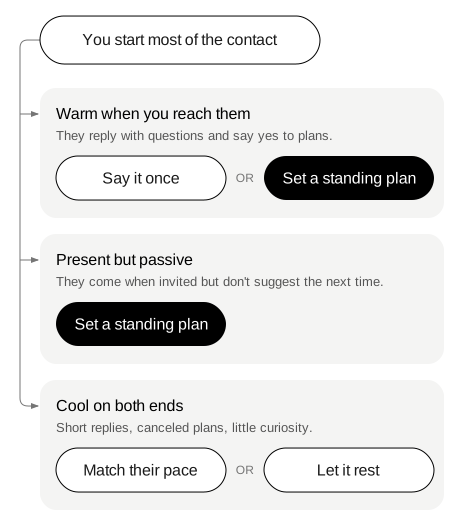
- Say it once, plainly. Name the pattern, not the person. “I’ve noticed I’m usually the one who suggests things. I’d love it if you picked the next one.” A friend who didn’t see the count may change after hearing it. One sentence, at a calm moment, reads as a request. A list of examples reads as a case against them.
- Set a standing plan. A fixed slot removes the question of who starts. The first Sunday of the month, a call every other Thursday, the same bar after the same class. Nobody has to send an invitation. The date sends itself.
- Match their pace. Reach out about as often as they do, or a little more, and see how it feels. It’s a way to stop carrying more than feels fair to you, while the door stays open.
- Let it rest. Some friendships have run their course for now. Letting one go quiet without a final message is a choice too. A short note like “Thinking of you, no need to reply” keeps it open if either of you comes back.
A standing plan with something to do in it
A standing plan holds better when the evening has a shape. A call with one round of a game gives both people something to bring.
One way to do it: open the free online table on a shared screen, or put a deck on the kitchen table. Draw a card, choose the idea or the thing, roll the die and look at the word from that side. The die has six faces: MEMORIES · BODY · PEOPLE · VALUES · CHILDHOOD · FUTURE. The rule is “Look at the word from that side.” It works with a word written on a napkin, too.
The rules leave room for a friend who’s quieter: “A short answer is a full answer. You can always ask for more.” The game ends with a ritual: “each player names one thing they discovered about someone at the table today.” That line gives the next call a starting point, so the person who starts it doesn’t start from nothing.
Three cards for a one-sided friendship
Fairness has Sweater on its other side. The idea side lets you talk about give and take without making it about this friendship: who did the planning in your family, what felt fair in a shared flat. The sweater side goes to hand-me-downs, borrowed clothes and the one somebody never gave back.
Loyalty has Camera on its other side. Loyalty in a friendship can look like showing up, or like starting things, and two people can mean different ones. The camera side brings out photos: who took them, who’s in them, who kept them.
Gratitude has Fence on its other side. Saying what a friend’s company has meant is a kind of reaching out that asks for nothing back. The fence side goes to neighbors, gardens and the line between two yards.
Questions to talk it through
These questions work for a talk about the pattern itself, with the friend or with yourself first. They go from light to deeper:
- Who usually did the planning in your family when you were growing up?
- What does a good month of this friendship look like to you?
- How do you like to be invited: a call, a text, a date in a calendar?
- When did you last want to write to me and didn’t?
- What makes you hold back from sending a message?
- What would make it easier to suggest the next plan?
- What has this friendship given you that you haven’t said out loud?
- What would you like it to look like a year from now?
When a question lands, the follow-ups from the rule card keep it going: What did that feel like? Who else was there? Has it always meant that to you?
One thing to do this week
Pick one friend you’re usually the one to contact. Send one message that suggests a standing plan with a date in it, like the first Sunday of next month. If it’s a friend far away, put the online table on the call.
See the rules and the box, or play on the online table. The cards above have their own pages: Fairness, Loyalty and Gratitude. For more on playing with a group, see Thesis for friends. For the studies behind the deck, see the research page. For the call itself, see how not to run out of things to say with friends. Related: reaching out feels awkward. It’s appreciated more than you think.