You matched, chatted for a few days and met for coffee. It went fine. You talked about work, the neighborhood and where you both grew up. Then the thread went quiet, and a while later it’s a name in your phone. This is where apps to make friends as an adult hand the job back to you.
An app is good at the first meeting. It finds people nearby who also want new friends, and it gives you both a reason to say hello. The part after that, the second and tenth meeting, isn’t something an app can do. This guide covers that part: the message after the coffee, a second meeting with a format, and a standing invitation that new people can join.
What the app does and what the hours do
A friend app answers one question: who else nearby is open to meeting? Answering it alone in your 30s or 40s is slow, so the app saves time. Its work ends at the first hello.
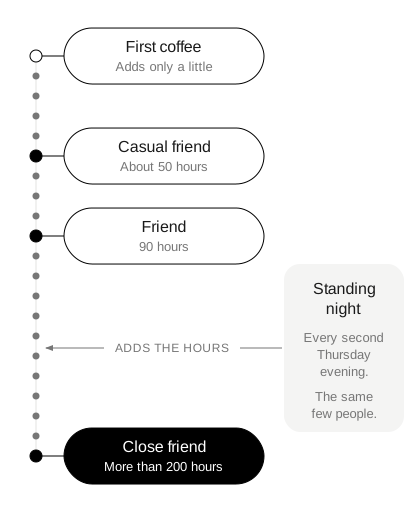
Friendship runs on hours, and the hours come later. In a study by Jeffrey Hall, 355 adults who had moved in the previous six months and were looking for new friends answered questions about the people they’d met. His report puts it at roughly 50 hours together to go from acquaintance to casual friend, 90 hours to become a friend, and more than 200 hours before someone is a close friend. Time spent hanging out and joking around counted toward friendship more than time spent working together (Hall 2018, KU summary).
A first coffee adds only a little to that count. Swiping to a new match each week starts the count again each time. The hours add up only with the same few people, so the useful question after a first meet is how to see this person again, and again after that.
Send the message after the coffee
The second meeting is the one that slips. Both people go home, both wonder if the other one enjoyed it, and both wait. After a while, writing can feel strange.
Research on first conversations points to a reason for the waiting. In studies with strangers in a lab, first-year dorm mates and adults at a workshop, people underestimated how much their conversation partners liked them and enjoyed their company. Among dorm mates, the gap lasted for months (Boothby et al. 2018). So the coffee you rated “fine” may have been better on the other side of the table.
Reaching out also lands better than people expect. In preregistered experiments, people underestimated how much others appreciate being reached out to, and the gap was larger when the message was more of a surprise and when the two people were less close (Liu et al. 2023). Someone you met once through an app is a distant tie, the kind where that gap was larger.
The message itself can be short. Name one thing from the coffee and one plan: “I looked up that bakery you mentioned. Want to try it next Thursday?” A date and a place can be easier to answer than “we should hang out sometime.”
Give the second meeting a format
The first coffee used up the easy questions. Jobs, neighborhoods and hometowns are known now. A second coffee with the same questions can feel like a repeat, and that can be why it doesn’t become a third.
A format gives the second meeting something new to talk about. One way is a single word on the table. Thesis is a deck of 50 double-sided cards for 2–6 players, with an idea on one side and an everyday thing on the other. You fold the die from a card into a six-sided prism and roll it like a pencil. Its faces are MEMORIES · BODY · PEOPLE · VALUES · CHILDHOOD · FUTURE, and the only line is “Look at the word from that side.”
The rules on the box are short. “Say as much or as little as you like. The others ask, gently.” With someone you’ve met once, that’s a fair deal: nobody has to tell their life story, and each turn brings up a story the first coffee didn’t. The rules also say “Before you start, decide together how passing works.” Agree on it before the first card, so a pass is a normal move.
Without a deck, open the free online table on a phone between you. It draws, flips and rolls.
The follow-up questions do the connecting. Three that work for any word: What did that feel like? Who else was there? Has it always meant that to you?
Turn it into a standing invitation
A standing invitation is a fixed slot that people know about without being asked each time. It moves the work from planning each meeting to showing up. The steps below set one up from app matches.
- Pick the slot. Every second Thursday evening, or the first Sunday afternoon of the month. A rule can be easier to keep than a date you agree on each time.
- Pick the place. Your kitchen, a quiet café corner or a park bench in summer. The same place each time.
- Invite two or three people you’ve met once. Ask in the message after the coffee: “A few of us meet every second Thursday. Want to come?”
- Keep the group at 2–6. That fits one table, and everyone gets a turn.
- Bring the format. One word, the deck or the online table, so a mixed group has something in common from the first minute.
- Say the next date before people leave. Then send it the next morning.
The slot keeps going when one person drops out. A new match from the app gets invited into a room that already has a shape, and the people who keep coming add their hours to the same count.
For the version where friends each bring one new person, see how to make friends through friends.
Questions for a second meeting
If you’d rather start with questions, these go past what you covered at the first coffee. They’re sorted from light to deeper:
- What did you do last weekend that you’d do again?
- What’s something you got into in the last year?
- What did you do after school at 12?
- Who in your life would you like me to meet one day?
- What place in this city do you go back to?
- What made you sign up to meet new people?
- Who was your closest friend at 20, and where are they now?
- What would you like to do more of in the next year?
Two or three of these, with follow-ups, can fill an evening.
Three cards for new friends
Each of these cards reads in its own way for people who met through an app.
Courage has Bicycle on its other side. The idea side fits the moment two new friends share: both of you signed up and showed up to meet a stranger. Hearing what that took for the other person is a conversation the first coffee skipped. The bicycle side is lighter: learning to ride, a city crossed on two wheels, a bike that got stolen.
Play has Laptop on its other side. The idea side brings out hobbies, games and old habits that a job question leaves out. The laptop side fits people who met on a screen: a first computer, a game played all night, a job that lives on one.
Community has Mirror on its other side. It’s a good card for a standing night, once a few people come regularly. Each person’s idea of a community can be different: a street, a team, a group chat, a family. The mirror side turns inward: the face in a bathroom mirror at 15, or the mirror in a first flat.
Before the next coffee
Look at your app matches from the last month and pick one person you liked talking to. Send one line that names something from your coffee and a date. Then pick a slot for a standing night and invite them into it.
See the rules and the box, or play on the online table. The cards above have their own pages: Courage, Play and Community. For playing with a group, see Thesis for friends, and for the research behind the deck, see the research page. For the numbers on adult friendship, see adult friendship statistics.