The turkey is carved, the sides are going around, and an uncle mentions the election. Two cousins look at their plates. Your mother asks who wants more gravy, louder than she needs to. If you’re the host, the quickest way to avoid politics at Thanksgiving is to give the table something else to hold before the news arrives: one word, a pass rule everyone agreed on, and a way back to the word when the talk drifts.
This guide is for the person hosting a mixed family table. It covers what to set up before dinner, what to put on the table, what to say when politics comes up anyway, and ten questions for the gap between courses. It works with the Thesis deck, the free online table, or a word written on a place card.
What a political argument costs the table
Researchers matched anonymized smartphone location data with precinct voting records for Thanksgiving 2016. Dinners where guests came from precincts that voted for opposite parties were 30–50 minutes shorter than dinners where everyone came from same-party precincts. The authors estimated that 34 million hours of cross-partisan Thanksgiving conversation were lost that year (Chen and Rohla 2018).
The study measured time spent at the dinner, not what was said. It doesn’t show that people argued. It shows that mixed tables broke up earlier. For a host, that’s the cost worth planning around: the relative who leaves before pie, and the conversation that never happened.
Why “no politics tonight” can fall apart
A ban names the topic and leaves the table with nothing in its place. When the small talk runs out, the most recent shared thing can be the news, and the news comes back. A ban also puts one guest in the role of enforcer, and that guest can end up being the host.
A replacement can hold better. If the table already has a thread, a drifting comment has somewhere to go. The thread has to be open enough that a teenager and a grandparent can both say something about it, and personal enough that nobody needs to know the facts.
Before dinner: agree on passing
The rules of Thesis open with one line: “Before you start, agree together how passing works.” At Thanksgiving, this agreement does double work. It lets a guest skip a word without explaining, and it gives the host a neutral line to use later.
Say it once, early, before anyone has had a second glass: “We’re doing one word per course. Anyone can pass, no reason needed.” Nobody has been singled out. When politics comes up later, you can point back to the agreement instead of at a person.
Put one word on the table
Write one word on a card and set it next to the bread. Family, Tradition, Gratitude, Home. Each guest says what the word brings to mind, and the others ask about it. The word changes with each course, or stays for the whole meal if it keeps going.
The format comes from the Thesis rule card, and it fits a holiday table without changes:
- Whoever suggested the game goes first.
- Draw a card. Choose a side: the idea or the thing.
- Roll the die.
- Look at the word from that side. Say as much or as little as feels right.
- The others ask what they’re curious about, gently, without judging.
- Pass the die to the left.
The die has six faces: MEMORIES · BODY · PEOPLE · VALUES · CHILDHOOD · FUTURE. The only instruction is “Look at the word from that side.” Without a die, write the six words on a napkin and let the youngest guest pick one.
If there’s no deck at the house, open the free table on a phone and put it in the middle. It draws, flips, and rolls.
When politics comes up anyway
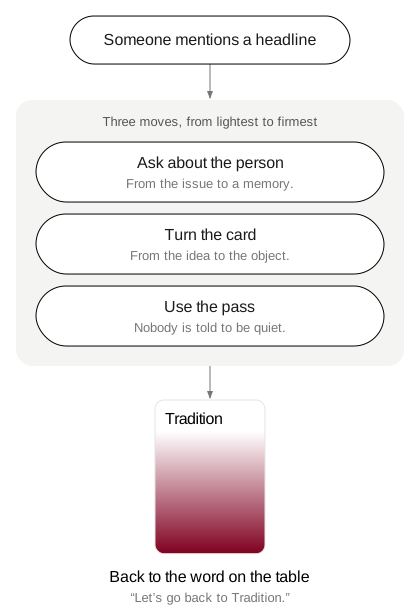
Someone may still mention a headline. Three moves can keep the table together, sorted from lightest to firmest:
- Ask about the person. “When did you first start caring about that?” moves the talk from the issue to a memory. A story about a grandfather’s union job is easier to hear than a position on labor law.
- Turn the card. Every Thesis card has an everyday thing on its other side. Switching from the idea to the object changes the subject without anyone losing the point.
- Use the pass. “We said anyone can pass. I’m passing on that one, let’s go back to Tradition.” The rule does the work, and nobody is told to be quiet.
The first move has research behind it. In three studies of live conversations, people who asked more questions, especially follow-up questions, were better liked by their partners. The same studies found that people didn’t expect asking questions to make them more liked (Huang et al. 2017). A follow-up question at a tense moment can feel risky. To the person answering, it can read as interest.
The other side: it may be less bad than you expect
Some families want to talk politics, and some hosts may avoid it out of dread more than experience. In five studies with 2,455 participants, partisans overestimated how negative they’d feel after hearing or reading views from the other side. The error came partly from underestimating how much they agreed with those views (Dorison et al. 2019).
Those studies didn’t look at family dinners. They don’t say the table will be fine. They suggest that the dread before a conversation can be larger than the conversation. If your family chooses to go there, the rule card has a line for it: “Every view is welcome, especially one that differs from yours.”
Ten questions for between courses
If you’d rather start with questions, these work around one word and are sorted from light to deeper:
- What dish says Thanksgiving to you?
- Who cooked it when you were a kid?
- What’s a tradition this family has that others find strange?
- Which tradition would you drop if nobody minded?
- Where did you spend the holiday the year you remember best?
- What object in your parents’ kitchen do you still picture?
- What did this holiday mean to you at 12?
- Who taught you what family means?
- What are you grateful for that you’ve never said out loud?
- What would you like this dinner to look like in ten years?
Two or three of these, with follow-ups, can carry a course.
Three cards for the Thanksgiving table
These three words fit the holiday, and each has an everyday object that opens a lighter way in.
Family has Bread on its other side. At Thanksgiving the bread is on the table, so the object side needs no explanation. Who baked it, which recipe, whose kitchen. The idea side is the deeper one: guests describe the family they grew up in, which can differ from the one sitting at the table, and that’s where the new stories are.
Tradition has Fridge on its other side. The idea side fits the meal itself: which traditions came from which side of the family, and which ones started by accident. The fridge side is for younger guests and in-laws: magnets, drawings, the leftover containers nobody returns.
Gratitude has Fence on its other side. If your family already goes around the table with thanks, it can feel like a speech. A roll of the die gives it an angle, so the answer becomes a memory or a person. The fence side goes outside: a neighbor over the fence, a yard, a house someone grew up in.
Finish with the last round
When the pie is gone, end the way every game of Thesis ends: “When the group is ready to stop, finish with one last round: each player names one thing they discovered about someone at the table today.” At a family table, that one thing can be about a relative people thought they knew.
Before the holiday, pick your first word and write it on a card. See the rules and the box, or play on the online table. The cards above have their own pages: Family, Tradition, and Gratitude. For groups around a table, see Thesis for friends, and for the studies behind the deck, see the research. For more on the meal itself, see dinner party conversation topics. If the quiet after a hard comment is the part you dread, see a host’s plan for awkward silence.