The main course is on the plates. Everyone has said where they live, what they do and how they know you. Then the table goes quiet, forks scrape, and someone reaches for their phone. You’re the host, so the silence feels like yours to fix.
This is a rescue plan for that moment, in four steps: let the pause sit for a breath, ask one follow-up, put one word on the table, and let the guests take it from there. Nobody has to hear the word “game.” It works with a Thesis card, the free online table, or a word written on the back of a receipt.
Why the silence feels longer to the host
A pause at a full table reads differently from each chair. A guest can take it as a rest between topics. The host can take it as a verdict on the evening.
There’s research on why a short gap lands so hard. In two experiments at the University of Groningen, people either read about a conversation in which a remark was followed by a brief silence, or watched a video of three people talking. In the video version, a 4-second silence interrupted the talk. Viewers who saw it reported less self-assurance and more feelings of rejection than viewers of the same talk without the pause, even though they weren’t aware of the silence (Koudenburg et al. 2011). These participants watched others talk; they weren’t at a dinner. Still, it fits the feeling: a few seconds of quiet can feel like a sign that something went wrong.
That feeling is why the quick fix can backfire. The host fills the gap with the next polite question, “So, any plans for the summer?”, and gets a short answer. A few of those in a row, and the table learns that the talk runs through you.
Step 1: Let the pause sit for a breath
A lull right after the food arrives can mean people are eating. Count a slow breath before you say anything. Sometimes a guest picks up a thread from earlier, and the evening moves on without help.
If the quiet stays, the next move is short and goes to someone else’s last story.
Step 2: Ask one follow-up instead of a new question
A polite question can open a topic and close it in one answer. A follow-up goes back to something a guest already said and asks for more of it. “You said you grew up near the coast. What did that feel like in winter?” picks up a door that’s already open.
In three studies of live conversations, people who asked more questions, especially follow-up questions, were liked more by their partners. The same studies found that people didn’t expect asking questions to make them more liked (Huang et al. 2017). That gap may explain why hosts skip it: a second question about the same thing can feel like prying, while the guest hears it as interest.
The Thesis rule card has three follow-ups that fit nearly any answer:
What did that feel like? Who else was there? Has it always meant that to you?
Aim the follow-up at a quiet guest, about something they mentioned earlier. It gives them the floor without putting them on the spot.
Step 3: Put one word on the table
When follow-ups run dry, change the material instead of the person. Put one card face up next to the bread, or write one word on a napkin. Say what it is in one sentence: “I’ve got this word, and I’m curious what people make of it.”
A word works where a question stalls, because each guest takes it somewhere else. “Tradition” at one table can bring out a grandmother’s holiday menu, a football club, a family rule about shoes, and someone who has no traditions and wants one. Nobody has to answer correctly. The rules say it plainly: “There are no right answers.”
Thesis cards are double-sided: an idea on one side, an everyday thing on the other. The thing side is the lighter way in. A guest who doesn’t want to talk about Silence can talk about a tree they climbed as a kid, and the talk can find its way back.
If someone wants another angle, the die has six faces: MEMORIES · BODY · PEOPLE · VALUES · CHILDHOOD · FUTURE. The only line on it is “Look at the word from that side.” Without the deck, write the six words on a scrap of paper and let a guest pick one.
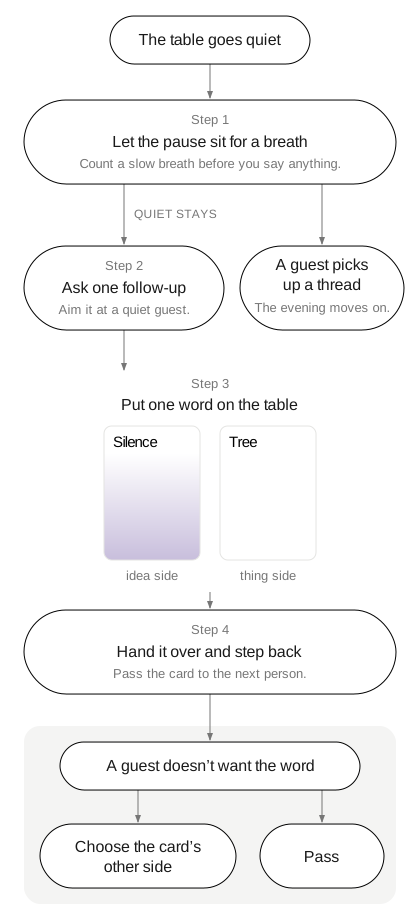
Step 4: Hand it over and step back
The host’s job ends when the first guest starts talking. Pass the card to the next person rather than answering every turn yourself. If the table wants more structure, the rule card has six steps, and the last one is “Pass the die to the left.”
Two lines from the rules keep it easy for everyone. “A short answer is a full answer. You can always ask for more.” And a guest who doesn’t want the word can choose the card’s other side, or pass. If you think a word might land heavy at your table, set the pass rule before the first card. The rules open with “Before you start, agree together how passing works.”
With no deck in the house, the online table on a phone in the middle draws, flips and rolls.
Three cards for a quiet table
Each of these three cards reads in its own way at a quiet table.
Tradition has Fridge on its other side. Tradition fits a dinner because the meal itself can be one: who cooks, what’s always served, who sits where. The fridge side is light: what was always in the fridge at home brings up families, countries and the jar nobody was allowed to touch.
Silence has Tree on its other side. Putting this card down during a lull names the moment out loud. Guests may find out they read quiet differently: one grew up in a loud house, one in a house where dinner was eaten without a word. The tree side goes outdoors, to gardens, parks and summers.
Rest has Clock on its other side. Late in the evening, Rest can bring honest answers about how guests spend a free Sunday, or why they don’t. The clock side brings out a kitchen clock someone grew up with, or the alarm they set every morning.
Questions that restart a quiet table
If you’d rather start with a question, these use the meal in front of you. They’re sorted from light to deeper:
- What’s a dish you only eat at one person’s table?
- What did dinner sound like in the house you grew up in?
- Who cooked when you were 10?
- What’s a food you hated as a kid and like now?
- What’s a rule your family had at the table?
- Which meal from the last year do you still think about?
- Who would you most like to cook for again?
- What would you like your own table to feel like in ten years?
When the talk runs long
A rescue plan can work too well. Once a word gets going, a table can keep at it well past the point where someone wanted to head home. In two studies covering 932 conversations, conversations rarely ended when both people wanted them to, and people had little idea when their partner wanted to stop (Mastroianni et al. 2021). Those were conversations between two people, but a host at a full table can still give the evening a clear last step.
The Thesis rules have one: “Play for as long as it feels good. When the group is ready to stop, finish with one last round: each player names one thing they discovered about someone at the table today.” Guests leave with something to bring up next time, and nobody has to invent an exit.
What to set out before the guests arrive
Put one card, or one word on a folded napkin, next to the salt before the doorbell rings. If the conversation never dies, nobody needs it. If it does, it’s already on the table.
See the rules and the box, or open the online table on a phone. The cards above have their own pages: Tradition, Silence and Rest. For more on playing with a group, see Thesis for friends. For more on the studies, see the research. For friends you see often, see how not to run out of things to say with friends. To turn dinner into a regular evening, see how to host a game night. For a game after dessert, see dinner party games for adults. For a holiday table with relatives, see how to avoid politics at Thanksgiving.