You love your partner. You’d still choose them. But the weeks look the same, the talk at dinner runs on rails, and some evenings you catch yourself thinking that they’ve become predictable. Then comes the guilt for thinking it.
This post is for long-term couples where one or both of you feel bored. It covers what four studies found about relationship boredom, why it can keep itself going, and one small new thing you can try together this week. The short version: researchers treat boredom as a signal worth taking seriously, and the studies point to shared new experiences as the counterweight. They can be small.
What the boredom feels like from inside
On marriage forums, the posts share a shape. One person writes that their partner is starting to bore them and asks what to do, while adding that nothing is wrong. In a long-distance thread, someone describes falling into a routine and reading it as a sign that interest is fading. In both, the trouble is sameness more than conflict.
That’s also how researchers measure it. The boredom question in the study below asks how often, in the past month, your marriage felt like it was in a rut. It’s a question about the pattern of life together.
Four studies, in plain words
Boredom now, less satisfaction later. Tsapelas, Aron, and Orbuch interviewed 123 couples in their seventh year of marriage and again nine years later, at year 16. Greater boredom at year 7 predicted lower satisfaction at year 16. Satisfaction at year 7 didn’t significantly predict less boredom later. The researchers point to closeness as the link: boredom wears down closeness, and lower closeness goes with lower satisfaction (University of Michigan summary of Tsapelas et al. 2009). The study followed couples over time but didn’t change anything in their lives, so it can’t show that boredom causes the drop.
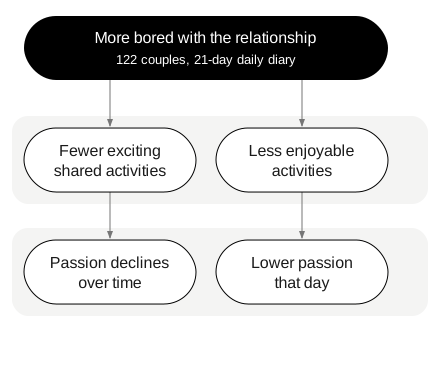
Boredom gets in its own way. Harasymchuk, Lonn, Impett, and Muise followed 122 couples with a 21-day daily diary and checked in again 3 months later. On days when people felt more bored with the relationship, exciting shared activities happened less often and were less enjoyable. Less enjoyable activities went with lower passion that day, and doing fewer of them accounted for declines in passion over time (Harasymchuk et al. 2022).
Seven minutes of something new. Aron and colleagues ran two surveys and three lab experiments. In the surveys, couples who reported more shared exciting activities were more satisfied, and boredom partly explained that link. In the experiments, couples who did a 7-minute novel, arousing task together reported larger gains in relationship quality than couples who did a mundane task (Aron et al. 2000).
A 4-week trial at home. Coulter and Malouff randomly assigned 101 couples to a 4-week online program or a waiting list. Couples in the program got ideas for exciting activities and were asked to do them together for 90 minutes a week. Afterward they reported higher excitement, positive affect, and relationship satisfaction than the waiting-list couples. At a 4-month follow-up, they still scored higher than at the start (Coulter and Malouff 2013).
Why “do something new” is hard advice to follow
A common tip for a bored couple is to plan something new: a trip, a class, a hobby. The diary study suggests why that tip can stall. Boredom lowers the odds that the new thing happens, and it lowers how much you enjoy it when it does. A bored evening is the evening when a big plan feels like the most effort.
Big plans also carry pressure. A weekend away that falls flat can feel like proof that something is wrong. The lab task in the Aron study lasted 7 minutes. The trial asked for 90 minutes a week, spread out. Both are small doses.
A new topic as a small new thing
This next part is an inference. None of the four studies tested conversation.
A new topic may work as a small dose of novelty. Long-term couples know each other’s stories. What may be missing is a new angle on them: what a word meant to your partner at 15, what it means now, and why it changed. Hearing that takes no travel and no booking. It takes a word neither of you picked for the occasion.
A format for one evening:
- Pick a word at random. Use a card, the online table, or a word written on a scrap of paper.
- Agree how passing works before you start. Either of you can pass without a reason.
- One of you says what the word brings up. The other asks one follow-up and listens.
- Swap. The second person takes the same word somewhere new.
- Stop when it feels done. A short round counts.
The Thesis rule card has three follow-up questions that fit any word:
What did that feel like? Who else was there? Has it always meant that to you?
Three words for a couple in a rut
These three cards from the Thesis deck fit a bored stretch. Each has an idea on one side and an everyday thing on the other.
Play has Laptop on its other side. Play can show how differently the two of you relax: what you played as kids, what counts as fun now, and when you last played together. Laptop can be the honest side. It can open a talk about where your evenings go, without blame on either screen.
Curiosity has Sewing machine on its other side. Boredom and curiosity sit close together. Talking about curiosity can surface what each of you still wants to learn, try, or find out about the other. Sewing machine can bring up a parent or grandparent who made things by hand.
Courage has Bicycle on its other side. Trying something new as a couple takes a little nerve, and this word lets you talk about that directly: the last time each of you did something that scared you. Bicycle is a gentler start: learning to ride, a fall, a route you took for years.
Questions about new things
If you’d rather start with a question, these point toward novelty and leave room for a story:
- What’s something you’ve never tried and still think about?
- What did you do for fun at 17 that you stopped doing?
- Which place would you go back to, and which one would you never see again?
- What’s the last thing that surprised you about yourself?
- What’s a skill you’d learn if it took no time?
- When did you last feel a little nervous in a good way?
- What did we do in our first year together that we don’t do now?
- What’s something you’ve changed your mind about since we met?
Use one question per evening. Follow the answer with Has it always meant that to you? and let it run.
Try it this week
Pick one evening. Write Play on a scrap of paper and leave it next to the kettle. After dinner, one of you says what the word brings up, and the other asks one follow-up. End the way a game of Thesis ends: each of you names one thing you found out about the other today.
When the evening opener gets “fine” every time, see what to talk about with your spouse. For a longer evening, there are deep date night questions for couples. The three cards have their own pages: Play, Curiosity, and Courage. For playing as two, see Thesis for couples. For more studies, see the research behind the deck. To see the cards and the die, read the rules and the box. For an evening plan at home, see date night at home ideas.