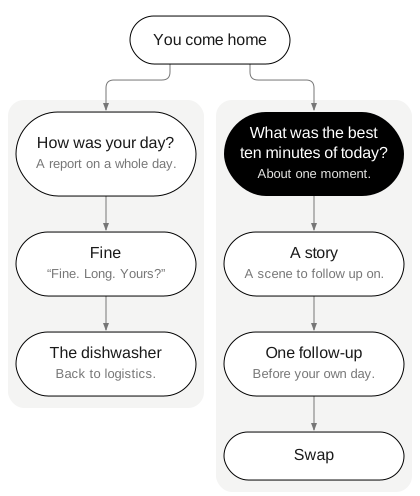
You come home, put the keys down, and ask “How was your day?” Your spouse says “Fine. Long. Yours?” You say “Fine.” Two minutes later the talk has moved to the dishwasher. The same thing happened yesterday, and it’ll happen tomorrow.
This post is for married couples who’ve asked that question for years and now get the same answer. The opener isn’t wrong. It asks for a report on a whole day, and a tired person gives the shortest report there is. Below: why it stalls, smaller questions that get a story instead, and a weeknight format built on one word and one follow-up. You need no app and no deck.
Why the evening opener stalls
“How was your day?” asks someone to sum up a whole day in a sentence. In the evening, after a commute and a pile of email, “fine” is an honest summary. It’s also a closed door: there’s nothing in it to ask about.
The question also repeats. Married couples on forums describe evenings where every talk feels like one they’ve had before. One commenter, 14 years into a relationship, wrote that the standard opener wears out after that long, and that it makes sense it does. Another noticed that even new material burns fast: a chapter of a book or a new song covers a few minutes, and then the talk is back to logistics.
Both points lead to the same place. The opener is too wide to answer well, and the topics are too thin to last. What helps is a smaller question and a better second question.
The second question carries the talk
The first question starts a conversation. The follow-up decides whether it goes anywhere. A follow-up takes what your spouse said a moment ago and asks for more of that, instead of moving on to your own day.
There’s research on this, though not on spouses. In three studies of live conversations, Huang and colleagues found that people who asked more questions, especially follow-up questions, were better liked by the person they talked to. The effect ran through responsiveness: the person asking came across as responsive. In speed-dating data, asking more follow-up questions predicted that the other person agreed to a second date (Huang et al. 2017). None of the studies looked at married couples, so the result doesn’t transfer one to one to a marriage.
How you respond to good news may matter for couples too. Gable and colleagues studied what happens when people tell someone about a good thing that happened to them. Sharing it was linked with better mood beyond the event itself, more so when the listener responded actively and with interest. In their couple studies, partners who usually responded to good news with enthusiasm had relationships with more intimacy and higher daily satisfaction (Gable et al. 2004). These findings are correlational. They can’t say that a better reply at dinner changes a marriage.
Smaller questions that get a story
A question about one moment is easier to answer than a question about a day. It asks for a scene, and a scene has people, places, and feelings in it to follow up on. These ones stay close to the day without asking for a report:
- What was the best ten minutes of today?
- Who did you talk to today that you didn’t expect to?
- What’s one thing someone said that stuck with you?
- When today did you feel most like yourself?
- What did you eat for lunch, and who with?
- What’s a small thing that annoyed you that you haven’t told anyone?
- What did you see on the way home?
- If you could redo one hour of today, which one?
- What are you looking forward to this week?
- What’s on your mind that has nothing to do with work?
Use one per evening. Then, before you answer it yourself, ask one follow-up about what your spouse said.
A short format with one word
Questions about the day still stay inside the day. A single word can take the talk somewhere neither of you planned. This format needs no preparation and works at the table, on a walk, or while one of you cooks.
- One of you picks a word. Write it on a scrap of paper, draw a card, or use the online table.
- Agree how passing works before you start. Either of you can pass without a reason.
- One of you says what the word brings up: a memory, a person, a place, a thing. Say as much or as little as feels right.
- The other asks one follow-up, then listens.
- Swap. The second person takes the same word somewhere else.
- Stop when it feels done.
The Thesis rule card has three follow-ups that fit any word:
What did that feel like? Who else was there? Has it always meant that to you?
The first one works best after a story about the day. “My boss moved the deadline” becomes something you can talk about once one of you asks what that felt like.
Three words for a weeknight
A weeknight word should start close to the day you both had and leave room to go further. These three from the Thesis deck do that.
Work has Stone on its other side. Work is where “How was your day?” usually goes, so it’s a familiar start. The word pulls further back than today’s meetings: the first job, a parent’s work, what each of you thought work would be at 18. Stone is the low-energy side: a stone from a beach, a wall, a garden someone built.
Rest has Clock on its other side. At the end of a long day, rest is the thing both of you want and may define differently. One of you rests on the sofa with a screen, the other on a walk alone. The word can show that without an argument. Clock leads to stories about time: a kitchen clock from childhood, an alarm, a day that went too slowly.
Joy has Chair on its other side. It’s the word for the good-news half of the evening, the part Gable’s research points to. Talking about what brought each of you joy this week gives the other something to respond to with interest. Chair is easy to start with: a favorite chair, a seat at a family table, the one nobody else was allowed to sit in.
Thesis also has a six-sided die for any word: MEMORIES · BODY · PEOPLE · VALUES · CHILDHOOD · FUTURE. Roll it and look at the word from that side. It moves Work out of the office and into childhood or the future without a new question.
When the talk lands somewhere heavy
A light word can open a hard topic. Work can bring up a job one of you lost, or money worries. The pass agreement from step 2 covers it. Either of you can stop, or turn the card to the object side. The rule card says: “A short answer is a full answer. You can always ask for more.”
If a word opens a disagreement you don’t want to have late in the evening, name it and agree on a time to come back to it. Money talks often need their own evening; there’s a post on how to talk about money with your partner.
Tonight
Swap tonight’s “How was your day?” for “What was the best ten minutes of today?” When your spouse answers, ask What did that feel like? before you say anything about your own day. If the talk keeps going, write Rest on a scrap of paper and take turns with it.
The three cards have their own pages: Work, Rest, and Joy. For playing as two, see Thesis for couples. The studies behind the deck are on the research page, and the cards and die are in the rules and the box. For an evening with more time, see deep questions for couples. For the research on asking the second question, see follow-up questions.