A friend tells you about her weekend. You say “Oh nice,” and then you tell her about yours. Later you know you talked, and you can’t remember a single thing she said. The missing piece is one question about her weekend before yours comes in.
This guide is about that question. It covers what research found about follow-up questions, three directions that work after almost any answer, and a way to practice with a word on a card. You can use the Thesis deck, the free online table, or a word written on a napkin.
The short answer
A follow-up question picks up something the other person said a moment ago and asks for more of it. It shows you heard the last sentence, and it hands the turn back. One follow-up after an answer can be enough.
The habit is small, and it’s easy to skip. The next sections explain why it matters, why it gets skipped, and how to find the next question when your mind goes blank.
What the research found
Karen Huang and colleagues studied question-asking in live conversations between two people. Across three studies, people who asked more questions, “particularly follow-up questions,” were better liked by their conversation partners (Huang et al. 2017).
The researchers also looked at why. When people were told to ask more questions, their partners saw them as more responsive. The authors define responsiveness as listening, understanding, validation, and care. They counted follow-up questions as one way to measure it, and responsiveness explained the effect of questions on liking.
The team also trained a program to spot follow-up questions in transcripts of face-to-face speed dates. Speed daters who asked more follow-up questions were more likely to get a yes for a second date. A second date is a behavior, so this result goes beyond a rating on a form.
One more finding may help explain why the habit gets skipped. The people in these studies didn’t expect that asking questions would make others like them more. If asking doesn’t seem like it would change anything, it’s easy to skip.
Why the next question doesn’t come
The next question is hard to find for a few ordinary reasons. Knowing them makes them easier to work around.
- Your own story is loading. While the other person talks, part of your attention can go to what you’ll say next. A related story feels like a good reply, and it moves the topic to you.
- Asking feels like prying. A second question about a hard week can seem nosy, so you change the subject to be polite.
- The answer sounded finished. A short answer can feel like a closed door. It can be a first draft, and the person may be checking if you want more.
- You’re hunting for a clever question. A search for the best possible question takes long enough that the moment passes.
All four have the same fix: listen for one detail, then ask about that detail. The question doesn’t need to be clever. It needs to come from what they said.
Three directions for the next question
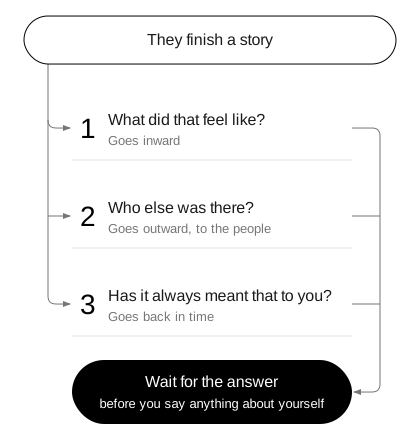
After any answer, three directions are open. Each one points at something already in the story, so you don’t have to invent a topic. The Thesis rule card gives one short question for each:
- What did that feel like?
- Who else was there?
- Has it always meant that to you?
The first goes inward. It asks about the experience behind the facts, and it can get the part of the story the speaker skipped. The second goes outward, to the people in the scene. Names and relationships bring up new stories without changing the subject. The third goes back in time. It asks how a view or habit formed, and the answer can be the most personal one in the conversation.
The rule card puts it plainly: “Good questions are short and open.” A short question leaves room for a long answer. A yes-or-no question can stop the story, so these three all ask for more than one word.
How to ask follow-up questions without it feeling like an interview
A follow-up works when it’s paced. Question after question with no reply of your own can feel like an interview. A few habits keep it a conversation.
Ask one, then wait. Leave a few seconds of quiet after the answer. A pause gives the person room to add more.
Use their words. If a friend says the trip was “a lot,” ask about “a lot.” Repeating a word shows you heard it, and the speaker gets to define it.
Take a turn too. After a follow-up or two, share something of your own. Responsiveness is listening and care, and a conversation where only one person speaks doesn’t feel like care to either side.
Accept a short answer. The Thesis rule card says, “A short answer is a full answer. You can always ask for more.” A short reply can mean the person wants to stop there. Let it stand, and come back later if they open it again.
Practice with one word
Follow-up questions are easier to practice when the topic is set for you. A word on a card does that. One person talks about the word, the others ask follow-ups, and nobody has to think of an opener.
Curiosity has a Sewing machine on its other side. Choose the idea when you want to talk about what you’re curious about, and what you stopped asking about as you got older. Choose the Sewing machine when a story is easier: a grandparent’s machine, a hem that came undone, something you made by hand. Either side gives the listeners plenty of details to follow up on.
Kindness has a Book on its other side. Stories about kindness can come with a person in them, so Who else was there? fits well here. The Book side can bring up a book someone gave you, or one that was read aloud to you as a child.
Respect has a Blanket on its other side. Choose the idea to talk about who taught you what respect is, and where you learned it. That makes Has it always meant that to you? useful: it asks how the meaning changed from childhood to now. The Blanket side is gentler: a blanket from a childhood bed, or one kept on a couch for guests.
The Thesis die adds an angle to each word. Its six faces are MEMORIES · BODY · PEOPLE · VALUES · CHILDHOOD · FUTURE. The only instruction is “Look at the word from that side.” A new angle gives the listeners a new story to follow up on.
At the table, the turn is simple. Draw a card and choose a side: the idea or the thing. Roll the die. “Look at the word from that side. Say as much or as little as feels right.” Then “the others ask what they’re curious about, gently, without judging.” That step is the follow-up question, written into the rules.
Before you start, agree how passing works. The rules open with “Before you start, agree together how passing works.” A pass is a short answer too, and it counts as a full one. For how to set this up with a group, see the right to pass in groups.
Try it in your next conversation
Pick one of the three directions before your next coffee with a friend. When they finish a story, ask that one question and wait for the answer before you say anything about yourself. Count how many follow-ups you ask in the whole conversation. One is a start.
For an evening built around this, end the way a game of Thesis ends: each person names one thing they discovered about someone at the table today. That round only works if somebody asked.
See the rules and the box, or open the free online table. The cards above have their own pages: Curiosity, Kindness and Respect. For playing with a few close people, see Thesis for friends. For the studies behind the deck, see research. If your conversations with friends keep running dry, see how to never run out of things to say with friends. For the evening version at home, see what to talk about with your spouse. For harder topics, see asking sensitive questions.