You open the circle and say, “You can pass, of course.” Then nobody passes. Or one person does, the room goes quiet, and the next speaker rushes to fill the gap. In both cases the rule exists on paper and goes unused in the room. A pass gets used when it’s agreed before the first turn, has a clear shape, is shown by the host, and costs the person nothing. This guide walks through that setup step by step, for support groups, workshops, classes and any table where people share in turns.
The steps work with any prompt. The examples use the Thesis card deck, because its rules start with the pass. A word written on an index card works the same way.
Why a stated pass goes unused
Saying “pass” in a circle is a small public act. Everyone sees it, and the speaker can’t tell how the room will read it. A host’s offer said once, in passing, doesn’t answer that question. So people talk when they’d rather not, or stay quiet in the session after.
People in support groups describe the same pattern in their own words. Some say pressure to speak made them pull back. Others say the group felt manageable because they could listen first and join when they were ready. The pass is the part of the format that makes listening a legitimate way to take part.
There’s also a gap between what speakers expect and what listeners feel. In experiments by Kardas, Kumar and Epley, participants expected others to care less about their disclosures than the others did (Kardas et al. 2021). A person who passes may be guessing the room isn’t interested. A pass rule with a way back in leaves room for that guess to change during the session.
Step 1: Agree on it before the first turn
The Thesis rule card opens with one line: “Before you start, agree together how passing works.” It gives no list of options. The group picks its own version, out loud, before anyone draws a card.
An agreement made together carries more weight than a rule read out by the host. It also tells everyone that passing is an expected part of play. CTIPP’s guide to trauma-informed meetings words it as “Inviting everyone to participate while allowing everyone the right to pass” (CTIPP). Both halves matter. The invitation stays open, and so does the exit.
These questions help a group settle its pass agreement in a few minutes:
- Does a person give a reason when they pass?
- What word or gesture means “pass” here?
- Can someone pass on the whole turn, or only on a follow-up question?
- Can a person swap the prompt instead of passing?
- Does the turn come back to them later in the round?
- Can someone listen for a whole round without speaking?
- What do the rest of us do right after a pass?
- Can the host pass too?
- How do we remind each other of this agreement mid-game?
Write the answers on a card and put it in the middle of the table. A visible agreement is easier to use than a remembered one.
Step 2: Give the pass a shape
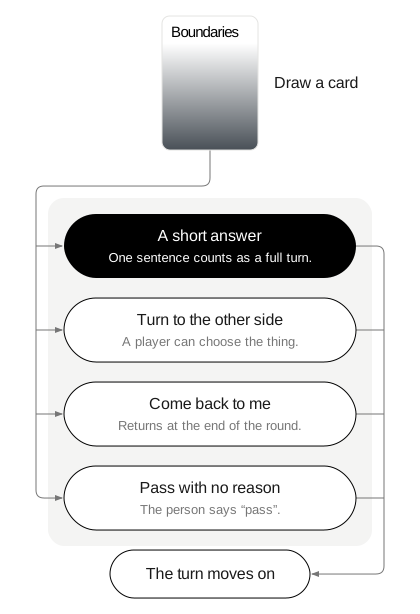
Several forms of pass give a player more ways to step back than a bare “pass”. Each form lowers the cost a little. Groups often choose from these:
- Pass with no reason. The person says “pass” and the turn moves on.
- Turn to the other side. In Thesis, every card has an idea on one side and an everyday thing on the other. A player can choose the thing.
- Come back to me. The turn skips ahead and returns at the end of the round.
- A short answer. One sentence counts as a full turn.
The last one is on the Thesis table card: “A short answer is a full answer. You can always ask for more.” It sits between speaking and passing, and it’s an easy first option to try.
Step 3: Model it in the first round
People copy what the host does more than what the host says. In Thesis, “Whoever suggested the game goes first.” That’s usually you, the host.
Use that first turn to show a low-cost option. Choose the everyday side of the card, or give a two-sentence answer and stop. If the card doesn’t fit you today, say “pass” in a plain voice and move on. A visible pass from the host shows the group the rule is real.
Boundaries sits on the back of Shoes. It suits a group’s first session, because the word itself names what the pass agreement protects. A player can talk about a limit they learned to set, or about a pair of shoes they wore until they fell apart. Both are complete turns.
Step 4: Decide what happens after a pass
The moment right after a pass decides whether the next person feels free to use it. Agree on the response in advance: a nod, a “thanks”, and the next turn. No “are you sure”, no joke to fill the silence, no follow-up question.
The same applies to the questions in step 5 of the rules: “The others ask what they’re curious about, gently, without judging.” A follow-up is an offer. The speaker can answer it, shorten it or pass on it, and the asker lets it go.
Privacy is on the back of Diary. In a group it can open a conversation about what people keep to themselves and why. It’s also a useful card for the host to watch. When it comes up, a short reminder of the pass agreement before the player answers makes the choice easy to see.
Step 5: Offer a way back in
A pass covers one turn. The session goes on. At the end of each round, ask once: “Does anyone want to come back to theirs?” Then move on, whatever the answer.
Thesis ends with a closing round that gives everyone another way in: “each player names one thing they discovered about someone at the table today.” A person who passed every turn can still take part here. They talk about what they heard, which asks for nothing about themselves.
Silence is on the back of Tree. It’s a word that can make a quiet round feel ordinary. A player might describe a silence that felt safe, or a tree they used to sit under. After a turn on silence, a quiet moment at the table has a name.
Step 6: Keep the agreement visible
An agreement fades as a session warms up. Bring it back at three points: before a heavy word, when a new person joins, and at the start of each new session. Keep it to one sentence, such as “Same agreement: you can pass or take the other side.”
You know your group, its purpose and its limits, and you decide how far a game format goes in it. Thesis is a conversation format and makes no clinical claims. What is said at the table follows the rule card: “What is said at the table stays at the table.” Link that line to the confidentiality agreement your group already uses.
Try it with your group
The fastest way to test a pass agreement is one round. Open the online table on a shared screen, agree on passing, and play one turn each.
The die has six faces: MEMORIES · BODY · PEOPLE · VALUES · CHILDHOOD · FUTURE. The only instruction is “Look at the word from that side.” A player who rolls a side they don’t want can pass on it like any other prompt.
Before your next session, write your group’s pass agreement on one index card. Read it out before the first turn, then go first and use it yourself.
For more on running the game in a session, see Thesis for therapy groups and group therapy icebreakers for adults. The three cards above have their own pages: Boundaries, Privacy and Silence. You can play online for free, see the rules and the box, or read the research behind the deck. When one person takes most of the turns, see how to handle someone dominating a group discussion.