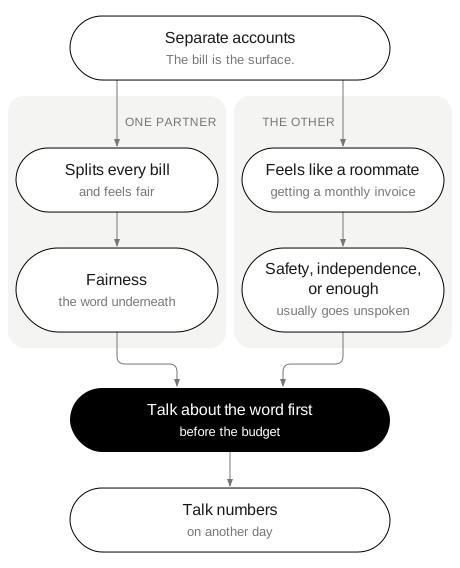
A money talk between partners often starts with one purchase and ends an hour later at the same place as last time. Talk about the word first, before the budget. Ask what “money” meant in the house each of you grew up in, what “enough” looks like, and what “my money” protects. Then talk numbers on another day.
This guide is for couples who share a life and keep circling the same money question. It gives six steps, a list of questions, and a way to use one word on a card as the opening. You can use the Thesis deck, the free online table, or a word on a napkin. It’s about the conversation. It isn’t financial advice.
Why the same money talk keeps coming back
Money talks loop for a reason that shows up in research. In a diary study, 100 married couples recorded each conflict at home over 15 days. Money wasn’t the most frequent topic. Children came first. But money conflicts were rated as more important, came back more often in husbands’ reports, and were more often left open for later, even with more attempts at problem solving (Papp et al. 2009).
The authors describe a self-defeating cycle. Couples try to solve the money problem, it stays open, and it comes back. A second study, of 4,574 US couples, found that financial disagreements predicted divorce more strongly than other common disagreements. How the couple argued and how satisfied they were explained that link (Dew et al. 2012). The talk itself carries a lot of the weight.
So a money talk that opens with a bill is two talks at once. One is about the number. The other is about what money means to each of you, and that one usually goes unspoken.
The same word, two meanings
Couples who disagree about money often agree on the facts. They read the facts through different words. Some situations couples describe online show how this works:
- Separate accounts. One partner splits every bill and feels fair. The other feels like a roommate getting a monthly invoice.
- Merging savings. One partner worked for years to build savings. Putting it in a shared account feels like losing something, even inside a happy marriage.
- Spending alone. One partner keeps a private account so no one asks about each purchase. For them, money means not having to explain.
- Long-term plans. An engaged couple finds out late that their plans for the next 20 years differ, because no one ever asked.
In each case, the bill is the surface. Underneath sits a word like fairness, safety, independence, or enough. Two people can share an account for years without saying what that word means to them.
A money conversation in six steps
These steps are about how to talk. They don’t tell you what to decide. Do them on a calm evening, on a day no bill came in.
- Pick a time with no decision attached. Agree that tonight you’re only talking. Numbers and plans get their own day. This takes the pressure off both sides.
- Agree on passing. The Thesis rules open with “Before you start, agree together how passing works.” Either of you can pass without a reason. A pass means only that.
- Start from one word. Write “Money” on a piece of paper, or draw a card. Each of you says what the word brings up. Start with a memory: the first thing you bought with your own money, or how money was talked about at home.
- Listen to the whole answer. One person talks, the other listens to the end. “A short answer is a full answer. You can always ask for more.”
- Ask one follow-up. Ask one short, open question. The rule card gives three: What did that feel like? Who else was there? Has it always meant that to you?
- Name one thing you learned. End the way a Thesis game ends: each of you names one thing you discovered about the other tonight.
Step 1 is the one couples skip. A money talk with a decision on the line turns into a negotiation. Each person defends a position and stops hearing the other’s story. Without a decision, there’s nothing to win.
Questions about money to ask your partner
The questions below ask about meanings and memories, not accounts. Take one or two per evening, and let the follow-ups do the rest.
- What did money mean in the house you grew up in?
- Who talked about money at home, and who stayed quiet?
- What’s the first thing you remember buying with your own money?
- What does “enough” look like to you?
- When did you feel safest with money?
- When did money make you feel small?
- What does “my money” protect for you?
- Which purchase feels good every time you make it?
- What would you do with a year off work?
- What did you learn about money that you’d like to unlearn?
Answer the question yourself before you ask it. It shows that the question is a trade, and it keeps the evening level.
One word, read two ways
The Thesis deck has 50 cards. Each holds an idea on one side and an everyday thing on the other. Three of them fit a money conversation.
Money has Backpack on its other side. Pick the idea when you want to talk about money directly. Pick the thing when the word feels too loaded: a school backpack, what you carried to a first job, what you’d pack if you left. Stories about a backpack often end up at money anyway, by a quieter road.
Enough has Photograph on its other side. Enough is the word under a lot of money arguments. For one partner, it’s a number in savings. For the other, it’s a feeling at the end of the month. A photograph can open the same topic through a picture of a home, a holiday, or a parent at work.
Independence has Mug on its other side. It fits couples who argue about separate and shared accounts. Each of you can say where independence started for you, before money comes into it. The mug side opens a smaller story: a first apartment, a morning routine you kept for yourself.
Using the deck as a couple
The deck comes with a die you fold from a card into a six-sided prism and roll like a pencil. It has six words: MEMORIES · BODY · PEOPLE · VALUES · CHILDHOOD · FUTURE. The only instruction is “Look at the word from that side.” With Money, each roll moves the same word to a different place in your life.
The game is made for 2–6 players, so two is a full game. If you don’t have a deck, open the online table on a phone between you. It draws, flips, and rolls.
Mix the money cards with others. A round of Money followed by a lighter word keeps the evening from becoming a meeting. “Play for as long as it feels good.” Some evenings one card is the whole conversation.
When the talk turns into the old argument
Sometimes a word opens the familiar fight. Stop at that point, and agree when you’ll come back to the practical side. Keep the rule from the table card in view: “Every view is welcome, especially one that differs from yours.” The aim of the first talk is to hear the other’s word, not to settle the account.
On the day you talk numbers, start with what you learned in the word talk. “You said money meant not having to explain” is a better first line than the bank balance. It reminds both of you why the number matters.
Tonight, write one word on a piece of paper: Money, Enough or Independence. Each of you says the first memory it brings up. Stop after one round.
See the rules and the box. The cards above have their own pages: Money, Enough and Independence. For more on playing as a couple, see Thesis for couples. The research behind the deck explains where the words came from. For a full evening with more words, see deep date night questions for couples.