You’re both on the sofa. One of you reads, the other scrolls, and nobody has said a word in a long while. It feels fine. Then a thought arrives: is this what drifting apart looks like?
Researchers who studied silence between partners found that the reason behind it matters. Quiet chosen because it’s pleasant goes with calm and closeness. Quiet that holds something back goes with distance. This post walks through that research, gives you a short check you can run on your own evening, and ends with a way to talk about the quiet itself, using one word.
What four studies of couples’ silence found
In 2024, Netta Weinstein and three colleagues published four studies on silence between romantic partners, with participants from the US and Britain (Weinstein et al. 2024). They used a survey of 121 adults in relationships, a 14-day diary kept by 107 students, and two experiments. In one experiment, 173 adults in relationships of at least a year recalled a specific quiet moment with their partner.
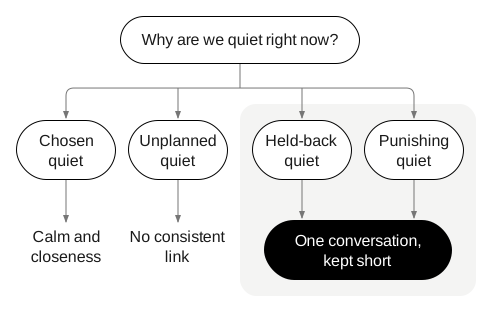
The researchers sorted silence by its reason. Silence that partners chose because it was enjoyable came with more positive feelings, fewer negative ones, and a stronger sense of closeness in that moment. Silence that came from holding back, or from wanting to punish, was more often tied to negative feelings and less closeness. In a second experiment, people asked to recall those two kinds said the silence had added something negative to their relationship, compared with people who recalled the enjoyable kind.
Two more findings matter for a quiet couple. Across the studies, silence was felt most often as calm, relaxed, and at ease, more than as excitement. The authors describe the benefit of silence with a partner as “shared calm.” Silence with no particular reason behind it showed no consistent link to how people felt. In the survey and the diary, the pleasant and the unplanned kinds came up more often than the other two.
The studies have limits the authors name. They asked one partner at a time, so they can’t say whether both people read the same silence the same way. Most data came from people remembering silences. The authors also call for studies of couples who’ve been together a long time, where habits are more settled.
Four reasons a quiet evening happens
The questionnaire in the study gives a useful map. Each kind of silence is described by the reasons people gave for it.
- Chosen quiet. You enjoy it. You value being next to your partner without speaking. One item reads: “I didn’t need to speak for my partner to get me.”
- Unplanned quiet. There’s no specific reason. It happened that way, and nobody paid attention to why.
- Held-back quiet. You felt inhibited, unsure what to say, or afraid your partner would be upset. One item in this group is “I felt disengaged and distant.”
- Punishing quiet. You stayed silent to make your partner feel bad, or because they wanted you to be silent.
Drifting apart, in these terms, sounds like the third kind. The words go unsaid because saying them feels risky or pointless. Comfortable silence sounds like the first two.
A check you can run tonight
The next time a quiet stretch comes, ask yourself one thing: why are we quiet right now? These questions follow the four reasons above. Answer them for yourself first.
- Was I enjoying the quiet, or waiting for it to end?
- Was there something I wanted to say and didn’t?
- If I held it back, was it because I was tired, or because I expected it to go badly?
- Did I feel close to my partner during it, or alone next to them?
- Was the silence a message: that I was hurt, angry, or keeping score?
If the answers lean toward enjoying it and feeling close, the quiet is doing its job. Talking more may not add anything. If the answers lean toward holding back or feeling alone, the silence is carrying something. That’s worth one conversation, kept short.
When you each read the quiet differently
The studies asked one partner at a time, and that gap is where a quiet couple can get stuck. One of you can sit in chosen quiet while the other sits in held-back quiet on the same sofa. Neither can tell from the outside.
On marriage forums, this split shows up in the same thread. One person worries that their talk has shrunk to meals and chores. Someone in the comments answers that not having to come up with topics is the best part of a long relationship. Both describe real evenings. The difference is in what each person feels during the quiet, and asking is how you find out.
Talk about the quiet, once
A talk about silence can be short and light. The goal is to learn how each of you reads the quiet. A word on a card or on a scrap of paper is enough to start.
- Pick a time that isn’t already quiet, such as a walk or a drive.
- Before you start, agree together how passing works.
- Put the word Silence on the table. Use a card, the online table, or a written word.
- One of you says what the word brings up: a quiet evening from childhood, a long drive, a silence that felt good or bad.
- The other asks one follow-up, then listens. Swap.
- If you have the die, roll it. Look at the word from that side. The faces are MEMORIES, BODY, PEOPLE, VALUES, CHILDHOOD, and FUTURE.
- Stop when it feels done. “Play for as long as it feels good.”
The follow-ups on the Thesis rule card fit this talk well: What did that feel like? Who else was there? Has it always meant that to you? The third one can open the difference. One of you may have grown up where quiet meant peace, the other where quiet meant someone was angry.
Three words for a talk about quiet
These three cards from the Thesis deck each open the topic from a different side. Pick one per talk.
Silence has Tree on its other side. The word goes straight to the question of this post: what does quiet mean to each of you? Tree is the softer way in if the word feels too direct. A tree outside a bedroom window, a park bench under one, a walk where nobody talked.
Rest has Clock on its other side. Quiet evenings are how some couples rest after work. This card opens the question of what rest looks like for each of you, and whether it means being alone, together, or both. Clock brings up time: the hour you each wind down, or the evening routine you grew up with.
Loneliness has Perfume on its other side. This one is for the partner who feels alone in the quiet and finds it hard to say. The word gives them a way to bring it up without an accusation. Perfume is a gentle start: a scent that belongs to someone, or one that brings back a place.
When the quiet is holding something
Sometimes the check turns up the third or fourth kind of silence. A topic got dropped because the last time it came up, it went badly. Or one of you went quiet after a fight and stayed there. In that case, the quiet is standing in for a conversation that didn’t happen.
A word can help there too, but keep it small. Name the topic, agree on a time to come back to it, and use the pass rule. The rule card puts the pace this way: “A short answer is a full answer. You can always ask for more.” If the same silence returns after several tries, a couples counselor is one option for hard conversations that stall at home.
Try it this week
Write Silence on a scrap of paper and leave it where you both eat. On your next walk or drive, each of you answers one thing: a quiet that felt good, and when. Then ask Has it always meant that to you? End the way a game of Thesis ends: each of you names one thing you found out about the other.
If the quiet feels more like sameness than silence, see bored in a relationship. The three cards have their own pages: Silence, Rest, and Loneliness. For more on playing as two, see Thesis for couples. For the studies behind the deck, see the research page. To see the cards and die, read the rules and the box.