Search for questions about forgiveness and you’ll find study guides with a verse next to each question. That’s useful for a church group. It doesn’t help much at a kitchen table with a friend who wants to talk about a brother, an ex, or a boss, with no scripture involved.
This guide gives you ten questions that start small and get bigger. The first ones are about a friend who was late or a borrowed thing that came back broken. The last ones are about the person you still haven’t forgiven. You can use them alone with a pen, with one person you trust, or with the Thesis deck and its card Forgiveness. A word written on a napkin works too.
The short answer
A deep question about forgiveness asks about a specific person and a specific day. “Do you believe in forgiveness?” gets an opinion. “Who was the first person you remember forgiving?” gets a story, and the story says more about where the person stands.
Order matters too. A question about a lifelong hurt asked first can close a conversation fast. Asked after a few small stories, the same question meets someone who has already warmed up and seen that the others at the table listen. That’s why the list below runs from small to big.
Why forgiveness talk stalls
Forgiveness talk can stall on a yes-or-no. Did you forgive them or not? A real answer can sit somewhere in between, and they move over time. A question that demands a verdict pushes people to defend a position they don’t fully hold.
Research supports treating forgiveness as something that changes. Michael McCullough, Frank Fincham and Jo-Ann Tsang followed people’s motivations after a hurt in two studies. They described three separate parts: holding back from revenge and avoidance at the start, a slow change over time, and short-lived ups and downs (McCullough et al. 2003). The authors concluded that forgiveness needs to be studied over time. A conversation can borrow that idea and ask “where are you with it now?” instead of “have you forgiven?”
The circumstances of the hurt also count. Ryan Fehr, Michele Gelfand and Monisha Nag pooled 175 studies with 26,006 participants. Forgiveness went along with the victim’s empathy (r = .51) and with an apology (r = .42). It was lower when the harm seemed intentional (r = −.49) and when the victim felt angry (r = −.41). Features of the situation explained more of the differences than the victim’s personality (Fehr et al. 2010). These are correlations, so they don’t say what causes what. They do suggest good questions: was it meant, was there an apology, how angry are you still.
Ten deep questions about forgiveness
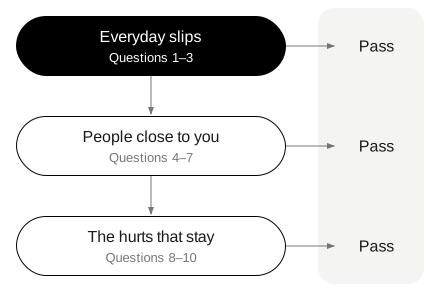
These questions go from small to big. Questions 1–3 are about everyday slips, 4–7 about people close to you, and 8–10 about the hurts that stay. Answer with a scene where you can: a year, a room, a name. A short answer counts, and so does a pass.
- What’s something small you forgave this week without thinking about it?
- Who was the first person you remember forgiving, and what for?
- What did your family do after an argument: talk, go quiet, or act as if nothing happened?
- Which apology meant the most to you, and what made it work?
- When did you forgive someone who never said sorry?
- Is there a friendship that ended over something you’d forgive today?
- When did someone forgive you, and how did you find out?
- Where are you now with the person you’ve found hardest to forgive?
- What would that person have to say or do for things to move?
- What would change for you if you forgave them, and what would stay the same?
Questions 4 and 9 lead to the apology part of Fehr’s review. Question 8 borrows the “where are you now” idea from the research on time. If question 8 feels like too much on the first try, stop at 7 and come back another evening.
Look at the word from six sides
A second way in is to keep one word and change the angle. The Thesis die has six faces: MEMORIES · BODY · PEOPLE · VALUES · CHILDHOOD · FUTURE. The only instruction is “Look at the word from that side.”
Roll it, or pick a face, and say what Forgiveness brings up from there. The same word can lead to a childhood fight over a toy one turn and to a parent the next.
Forgiveness has a Door on its other side. Choose the idea when there’s a person you’re ready to name. Choose the Door when the word feels too heavy: a door someone slammed, a door left open after a fight, a door you knocked on to say sorry. The object gives you a way into the story that doesn’t start with the hurt itself.
Try it with someone
Forgiveness is easier to talk about with a listener who doesn’t take sides. One or two people after dinner is enough. A friend who asks “who else was there?” can turn “my family” into one evening and one argument.
The Thesis rules open with “Before you start, agree together how passing works.” With a word like Forgiveness, that agreement matters, because some stories aren’t ready to be told. Then take turns:
- Whoever suggested the game goes first.
- Draw a card. Choose a side: the idea or the thing.
- Roll the die.
- Look at the word from that side. Say as much or as little as feels right.
- The others ask what they’re curious about, gently, without judging.
- Hand the die to the left.
The rule card gives three follow-up questions that fit every word: What did that feel like? Who else was there? Has it always meant that to you? For Forgiveness, the third one does most of the work. It asks how the answer has moved, which fits what McCullough and colleagues found about forgiveness changing over time.
“What is said at the table stays at the table.” When someone talks about a person the others may know, that line keeps the story inside the room.
Two words close to Forgiveness
Forgiveness sits near other words in the deck. Two of them open sides of the topic that the questions above only touch.
Respect has a Blanket on its other side. You can forgive someone and still not respect what they did, or respect a person and not forgive them. Talking about Respect next to Forgiveness can separate the two. The Blanket side brings up who looked after you when you were ill or cold, which can lead to someone you’ve forgiven a lot.
Regret has a Lamp on its other side. Regret looks at forgiveness from the other chair: the things you did and still think about. It pairs with question 7 on the list. If the word lands too close, choose the Lamp side, or pass.
What to do this week
Pick one question from 1–3 and answer it out loud to one person. If that goes well, try one from 4–7. Keep 8–10 for when you both want to go further, and remember that “A short answer is a full answer. You can always ask for more.”
If you play, end the way every game of Thesis ends: each player names one thing they discovered about someone at the table today. “Sometimes one word is enough.”
See the rules and the box, or open the free online table. The cards above have their own pages: Forgiveness, Respect and Regret. For playing with a few close people, see Thesis for friends. For the studies behind the deck, see the research page. For questions that go wider than one word, see deep questions about life. Related: the space between small talk and deep conversation.