You lend a friend your keys without thinking. You check a contract three times. You leave your bike without a lock in one town and lock it twice in another. Trust shows up in all of these, and you may never have talked about any of them.
This guide is for friends, siblings, or a small group who want a longer conversation about trust: in people, in places, in the institutions you depend on, and in yourself. It has ten questions, three research findings on how trust works, and one word to put on the table. A word on a napkin works as well as the Thesis deck.
The short answer
Deep questions about trust work best when they ask for a moment in time. “Do you trust people?” gets a yes or a no. “Who was the first adult you trusted with a secret?” gets a story with a name, a room, and a year in it. The stories show where your trust comes from and where it stops.
Trust also has more than one object. A person can trust friends easily and doctors hardly at all, or trust a city and doubt their own judgment. Asking about each kind separately shows the shape of it.
What research says about how trust grows
Three studies help explain why trust is easier to talk about through stories, and why it can run lower than it needs to.
People expect less than they get. Detlef Fetchenhauer and David Dunning showed participants short videos of other people and asked them to decide whether to trust each one in an economic game. Participants underestimated how trustworthy the people in the videos were, even when they were paid for accurate estimates. Those who got feedback on every person, whether they had trusted them or not, became less cynical. Those who got no feedback, or learned the outcome only after trusting someone, stayed more cynical (Fetchenhauer and Dunning 2010). The authors’ explanation is an asymmetry. When you trust, you find out whether the other person kept their word or broke it. When you hold back, you never find out whether they would have kept it.
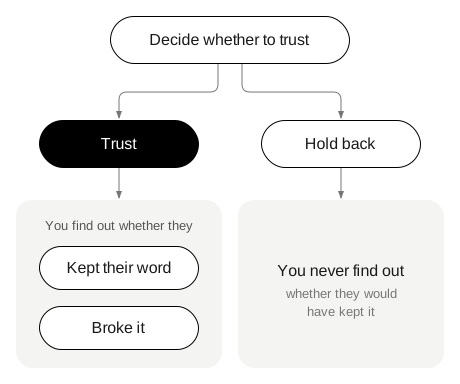
Trust is partly a matter of respect. David Dunning and colleagues ran six studies on trust between strangers in the same kind of game. People trusted strangers more than their tolerance for risk and their private views of others would predict. The studies pointed to a norm: trusting someone shows respect for their character. When that respect stopped being at stake, trust rates collapsed (Dunning et al. 2014). So trust is also something people feel they owe each other.
Telling builds liking both ways. Nancy Collins and Lynn Miller combined studies on self-disclosure. They found three links. People who share more personal things tend to be liked more. People share more with those they already like. And people come to like the person they’ve shared with (Collins and Miller 1994). A conversation about trust is itself a small act of trust, and it can move a friendship along.
Ten deep questions about trust
These questions cover four kinds of trust. Pick two or three for an evening. Answer with a specific person, place, or moment where you can.
- Who was the first person you trusted with a secret, and what happened to it?
- Which friend would you call in the middle of the night, and how did they earn that?
- When did someone trust you more than you expected?
- What does a person have to do once for you to stop trusting them?
- Which place made you feel safe the first time you walked into it?
- Where have you lived that you trusted less, and what changed your mind?
- Which job or institution do you trust without checking, like a pharmacist or a train timetable?
- Who in your family taught you whom to trust and whom to doubt?
- When did you trust your own judgment against everyone else’s advice?
- What would it take for you to trust yourself a little more this year?
Watch for the questions that slow someone down. A pause before question 9 or 10 can say more than the answer.
Look at the word from six sides
Another way in is to keep one word and change the angle. The Thesis die has six faces: MEMORIES · BODY · PEOPLE · VALUES · CHILDHOOD · FUTURE. The only instruction is “Look at the word from that side.”
Trust read from different faces gives different stories. One roll might bring a friend’s name, the next a street you grew up on, the next a decision you made alone. Six stories about one word cover the four kinds of trust better than a list can.
Trust has a Window on its other side. Choose the idea when there’s a person or a place you want to talk about. Choose the Window when a picture is easier: the window you looked out of as a child, a window left open at night, a neighbor you could see from yours. A window is about what you let others see and what you let in, which brings trust back without naming it.
Try it with friends
Trust is easier to talk about with people you already trust a little. Two to six people at a kitchen table or on a video call is enough.
Start with the rule that opens the game: “Before you start, agree together how passing works.” For a word like Trust, that agreement matters. Then take turns:
- Draw a card. Choose a side: the idea or the thing.
- Roll the die.
- Look at the word from that side. Say as much or as little as feels right.
- The others ask what they’re curious about, gently, without judging.
- Hand the die to the left.
The rule card gives three follow-up questions: What did that feel like? Who else was there? Has it always meant that to you? For Trust, the third one shows how trust in a person or place moved over the years.
One rule from the card holds the evening together: “What is said at the table stays at the table.” Saying it out loud before a talk about trust can make the first story easier to tell.
Two words close to Trust
Two other cards pull a conversation about trust toward its edges.
Honesty has a Radio on its other side. Trust and honesty get talked about as one thing, and the gap between them is worth a round. You can trust a friend who doesn’t tell you everything. The Radio side brings up the voice of a news program, a station a parent played, a song that meant someone was home.
Privacy has a Diary on its other side. Privacy is the part of you that trust doesn’t reach yet, or doesn’t need to. The Diary side can bring up a diary someone read, or one you kept hidden. If the word lands too close, choose the Diary side, or pass.
What to do this week
Pick one question from the list, the one about a place or the one about yourself. Ask it to one friend over coffee and answer it yourself first. “A short answer is a full answer. You can always ask for more.”
If you play a full game, end the way Thesis ends: each player names one thing they discovered about someone at the table today. “Sometimes one word is enough.”
See the rules and the box, or open the free online table. The cards above have their own pages: Trust, Honesty and Privacy. For playing with a few close people, see Thesis for friends. The research behind the deck explains where the words came from. For questions on a wider theme, see deep questions about life. Related: what does loyalty mean to you? To people, places and yourself. Related: being honest with friends about yourself.