You’re on the bus home after a dinner. You remember your story about the move, the landlord, and the broken boiler. You told it well. Then you try to remember what your friend said about her new job, and there’s almost nothing there.
That gap is a useful test. This post gives three cues to watch for while you talk, one question for the way home, and a simple rule for sharing the turn. It works at a party, at a meetup, and at a dinner with old friends.
Why talking about yourself is hard to stop
Talking about yourself feels good, and that’s measurable. Tamir and Mitchell let people choose between answering questions about their own opinions and questions about someone else. In one experiment, people gave up an average of 17% of the money they could have earned to talk about themselves (Tamir and Mitchell 2012). The same paper notes that 30–40% of speech goes to telling others about one’s own experience.
So a long turn can come from a pleasant feeling with no stop button. The stop button has to come from outside: from the other person’s face.
Three cues on the listener’s face
Conversation runs on fast signals. In the CANDOR corpus, a set of 1,656 recorded conversations between strangers, the median time between one speaker stopping and the next starting was 80 milliseconds (Reece et al. 2023). Turns change hands fast, so the signals that someone wants the floor show up while you’re still talking. They’re easy to miss when you’re inside your own story.
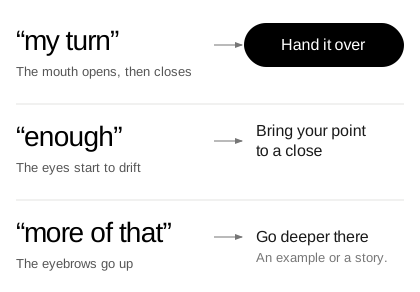
Behavioral researcher Vanessa Van Edwards suggests watching for three of them (interview):
- The mouth opens, then closes. The other person wanted the turn and held back. Stop at the end of your sentence and hand it over.
- The eyes start to drift. They look at the room, the bar, their glass. That’s a sign to bring your point to a close.
- The eyebrows go up. Something you said caught them. Go deeper there, with an example or a story.
The first two mean “my turn” and “enough”. The third one means “more of that”. Talking too much can look like missing the first two while waiting for the third.
Listening has its own signals too. In the same CANDOR data, people their partners rated as good conversationalists nodded more while listening, and they also shook their heads more (Reece et al. 2023). A listener who reacts is in the conversation. A listener who stays still may be waiting for a gap.
The question for the way home
The cues work in the moment. Another check comes after. On the way home, ask yourself one thing: what did I learn about them tonight?
If you can name a detail, a worry, or a plan, the conversation went both ways. If you can only name things you said, you held the floor. A few more questions sharpen the picture:
- What is one thing they’re looking forward to?
- What did they say when I asked how they’re doing?
- Did I ask anything that started with “how” or “why”?
- Did I ask a second question about the same thing?
- Who changed the topic, and how often?
- Did they finish their last story, or did I start mine?
- Did anyone else at the table get a long turn?
- What would they say they learned about me?
The second-question test has research behind it. Huang and colleagues found that people who asked more questions in a conversation, especially follow-up questions, were liked more by their partners. Speed daters who asked more follow-up questions were more likely to get a second date (Huang et al. 2017). The participants didn’t expect asking questions to make them more liked.
A rule for sharing the turn
Turn-taking helps here. You tell something, then you ask something, and you leave space for the answer. When the other person finishes, ask one more question about what they said before you bring up your own story. The guide to follow-up questions has more on that second question.
A card game makes the rule visible. In Thesis, one person draws a word, looks at it from one side, and talks. Then the others ask, and the die moves on. The rules say: “Say as much or as little as feels right.” The next line hands the turn over: “The others ask what they’re curious about, gently, without judging.”
You can try it on the free online table with friends, or write one word on a napkin at a bar.
The die gives every turn an angle. Its six faces are MEMORIES · BODY · PEOPLE · VALUES · CHILDHOOD · FUTURE. Roll, then look at the word from that side.
Balance has Watch on its other side. For someone who worries about talking too much, the watch is a quiet reminder of time. The idea side opens a different talk: the balance between giving and taking in a friendship, and who usually does more of each.
Silence has Tree on its other side. A short pause after someone finishes can be where their next thought arrives. This card lets the table talk about pauses: who likes them, who fills them, and what happens when nobody does. The tree side is lighter: a tree someone remembers from where they grew up.
Curiosity has Sewing machine on its other side. Curiosity is the habit that turns a listener into the person who asks the second question. The sewing machine side gives a lighter story: who in your family made things by hand.
If you’re the one being talked at
Sometimes the long turns come from the other side. You can ask for your turn plainly and kindly: “Can I tell you mine?” Said with a smile, it hands the turn back without a scene. It also tells the other person that you want to share, too.
What to do at the next conversation
Pick one cue to watch: the mouth that opens and closes. When you see it, finish your sentence and stop. Then, on the way home, name one thing you learned about the other person.
For a game night with people you know, see Thesis for friends. The cards above have their own pages: Balance, Silence and Curiosity. See the rules and the box, and the research behind the deck.