The short answer is yes, on average, and the effects are modest. Couples who take a relationship or premarital course tend to communicate better afterward. In one randomized trial, fewer of them split up within three years. The effects on how satisfied couples feel are smaller and less certain, and few studies follow couples for long.
This post is for engaged couples, or couples a few years in, deciding whether a course is worth several evenings. It walks through five studies, what each one measured, and where each one stops. At the end there’s a way to start the main conversation at home. You need no course and no deck for it. A word written on a scrap of paper works.
The question behind the question
Couples on relationship forums describe a familiar gap. They’ve been together for years and talk easily about trips, friends, and the week ahead. The one conversation they keep putting off is the future: marriage, kids, where to live. A course looks like a way to make that talk happen on a schedule, with someone else setting the agenda. Two questions follow: does a course make a relationship better, and does it get the hard talk started?
The largest meta-analysis: moderate effects in experiments
Hawkins, Blanchard, Baldwin, and Fawcett pooled 117 studies of marriage and relationship education from 86 reports (Hawkins et al. 2008). In experimental studies, programs had moderate effects on relationship quality and on communication skills. The effects on communication were a little larger. Programs with a moderate number of hours did better than short ones. The authors flagged two gaps. The samples had little racial, ethnic, and economic diversity, and few studies measured whether couples stayed together.
Premarital courses alone: communication yes, satisfaction unclear
A second meta-analysis by Fawcett, Hawkins, Blanchard, and Carroll looked only at premarital programs. It coded 47 studies, published and unpublished (Fawcett et al. 2010). Once the unpublished studies were included, the programs showed no improvement in relationship quality or satisfaction. Communication was the exception. Couples talked to each other better after a program, and studies that observed couples directly found large effects. The authors note that studies following couples past the honeymoon stage are rare, and call the overall results mixed and modest.
The same split shows up in all three meta-analyses. The clearest effect of a course is on how a couple talks. Whether that makes the couple happier years later is the part with the least evidence.
Couples with lower incomes: small effects in strict designs
Hawkins and Erickson reviewed 38 studies with 47 samples in which more than two-thirds of participants had incomes below twice the poverty line (Hawkins and Erickson 2015). In studies with a control group, the overall effect was small and positive, an effect size of 0.061. The effects were strongest for self-reported relationship quality, communication, and aggression. Studies without a control group showed a larger effect of 0.352.
The gap between those two numbers is a lesson in reading studies. A before-and-after study has no comparison group. It can’t separate what the course did from what would have happened to those couples anyway.
One trial that counted breakups
Rogge, Cobb, Lawrence, Johnson, and Bradbury randomly assigned 174 engaged and newlywed couples to four groups (Rogge et al. 2013). Two groups took a skills program: one on conflict management and problem solving, the other on acceptance, support, and empathy. A third group had a single session on relationship awareness, with no skills training. The fourth had no program. After three years, 24% of the couples with no program had ended their relationship. In the three program groups the figure was about 11%, and the three groups didn’t differ from each other.
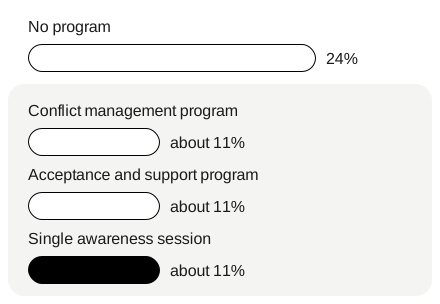
The authors suggest that low-cost awareness formats may be valuable. They also question whether skills training adds a benefit of its own for preventing relationship problems. One session that made couples look at their relationship did as well on breakups as the longer skills programs.
A survey: good news with a caveat
Stanley, Amato, Johnson, and Markman used a random household survey in four US states (Stanley et al. 2006). People who’d had premarital education reported higher satisfaction and commitment, less conflict, and lower odds of divorce. The links held across race, income, and education levels. The survey is correlational. Couples who sign up for a course may already differ from couples who don’t, so the survey can’t show that the course caused the difference.
How to read the five studies as a couple
Together, the studies add up to a careful yes. Courses tend to improve how couples communicate. The effects on satisfaction are small, smaller in strict designs, and long follow-ups are rare. In the one trial that counted breakups, a single awareness session matched the longer programs.
Three questions can help you decide whether a course fits:
- Is there a specific skill you want, such as arguing without the argument spiraling?
- Can you both commit to several sessions, or is one evening more realistic?
- Are you mainly looking for a structure to start a talk you’ve avoided?
If the first answer is yes, a course is where the evidence is strongest. If the third answer is yes, a planned evening at home is another way in, and it costs nothing to try first. None of the five studies tested a home format, so this post makes no research claim for one.
A home evening for the talk you’ve put off
This format needs one word and two chairs. It starts with a story and gets to plans later.
- Pick one word that sits near the topic you’ve avoided. Family, Money, and Trust work well.
- Agree how passing works before you start. Either of you can pass, no reason needed.
- One of you says what the word brings up: a memory, a person, a place, an object.
- The other asks one follow-up, then listens.
- Swap. The second person takes the same word somewhere else.
- Stop when it feels done, and pick the next word for another evening.
The Thesis rule card has three follow-up questions that fit any word:
What did that feel like? Who else was there? Has it always meant that to you?
The deck adds a die with six faces: MEMORIES, BODY, PEOPLE, VALUES, CHILDHOOD, FUTURE. The rule is one line: “Look at the word from that side.” To try it with a random word, use the online table below.
Three words for the future talk
These three cards from the Thesis deck sit close to the topics this post started with: marriage, kids, and where to live. Each has an idea on one side and an everyday thing on the other.
Family has Bread on its other side. Family is the word under questions about kids, holidays, and in-laws. Starting with the family you grew up in can be gentler than starting with the one you might have. Bread is a light way in: who baked it, who bought it, who sat where at the table.
Money has Backpack on its other side. Money talk can turn into numbers and positions quickly. A story about how money worked in your childhood home gives the other person something to ask about. Backpack can lead to a first trip, a first job, or what you carried when you moved out.
Trust has Window on its other side. Trust is the word under some future questions: whether a plan will hold, whether a promise will be kept. Window is an easier start on a tired evening: a window you looked out of as a child, or the view from a first apartment.
Try one word this week
Write Family on a scrap of paper and leave it on the kitchen table. After dinner, one of you says what it brings up, and the other asks Has it always meant that to you? End the way a game of Thesis ends: each of you names one thing you found out about the other. If the same disagreement keeps coming back after a few evenings, that’s the point where a course has the most evidence behind it: practice in how you talk when you disagree.
The three words have their own pages: Family, Money, and Trust. More on playing as two is on Thesis for couples, and you can play online with a random word. The research behind the deck covers the studies it draws on. To see the cards and die, read the rules and the box. When the hard topic is the families you come from, see family in a relationship.