You write “Travel” on the board, and the class answers in one sentence each. “I like Spain.” “I went to Rome.” Then the room goes quiet. A topic gets real answers from adults when each student has something of their own in it: a choice they made, a thing they own, a habit they’d defend. This page gives you ten topics built that way, each one an idea paired with an everyday object, plus ways to move them up or down a level. You can use them with a marker and a board, or with word cards on the table.
Why a topic falls flat
A flat topic can fail for one of two reasons. It’s too abstract for the level, so a B1 student can’t find the words. Or it’s too general, so nobody has anything at stake, and the answer is the safe sentence from the textbook. A topic like “technology in modern life” has both problems at once.
Vocabulary alone doesn’t decide who speaks. MacIntyre and colleagues built a model of willingness to communicate in a second language. It starts from the observation that some learners with high language skill still avoid speaking, and it proposes that the choice to speak depends on the situation, the people present, and the learner’s confidence in that moment (MacIntyre et al. 1998). So the same B2 student can go quiet on one topic and talk at length on the next. The topic changed, and the level didn’t.
The room matters as much as the topic. Dewaele and MacIntyre surveyed 1,746 foreign language learners. They reported more enjoyment than anxiety in class, and they linked enjoyable moments to their teachers’ skills and to a supportive peer group (Dewaele and MacIntyre 2014). A topic that gets classmates curious about each other can help build that kind of group. A topic with one correct answer turns the lesson into a test.
An idea and an object: how the pairing works
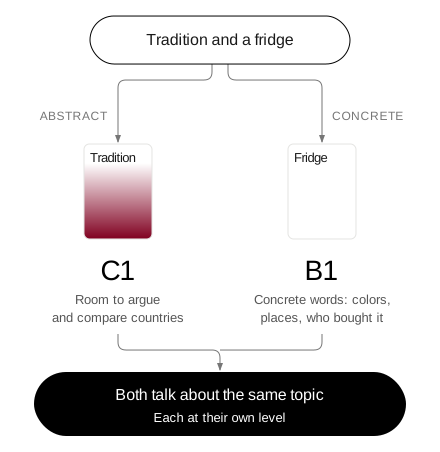
Each topic below has two parts. The idea is abstract: money, tradition, freedom. The object is something every student has seen: a backpack, a fridge, a compass. The object gives a B1 student a way in with concrete words, such as colors, places, and who bought it. The idea gives a C1 student room to argue and compare countries. In a mixed-level class, both students talk about the same topic at their own level.
The pairing also gives a stake. A question about money in general invites a news headline. A question about what’s in your backpack gets a list, and the list has a story in it: the keys to a flat in a new city, a photo, a charger for a phone that’s always low. Students pick what to say, and they own the answer.
Ten topics with one question each
The questions below are a starting point for each topic. Each pairs an idea with an object, and each asks about the student’s own life, so there’s no right answer to check.
- Money and a backpack: What’s always in your bag, and which thing in it would you replace first if you lost it?
- Tradition and a fridge: What food is always in your fridge that a visitor from another country might find strange?
- Freedom and a compass: When did you last go somewhere without a plan, and how did it go?
- Work and a stone: What job did someone in your family do with their hands?
- Rest and a clock: What does a slow morning look like for you?
- Nostalgia and a key: Do you still have a key to a place you don’t live in anymore?
- Kindness and a book: Who gave you a book you remember, and why that book?
- Courage and a bicycle: What’s something you learned to do as an adult that others learned as children?
- Curiosity and a sewing machine: What’s something you’d like to know how to fix or make?
- Fairness and a sweater: Who did you share clothes with growing up, and was it fair?
Question 8 suits adult classes in particular. Every student in the room is learning a language as an adult, so each one has an answer. Question 2 works well in a class with several countries, because each answer teaches the others a word for a food.
Moving a topic up or down a level
The same topic can fit B1 or C1 with one change to the question. To move it down, anchor it to the object and to the past: “Describe the fridge in the house you grew up in.” To move it up, ask for a decision or a comparison: “Should families keep the food traditions of the country they left, or take on new ones?”
Two more moves help when a topic stalls. Ask for a number: “Name three things in your bag and rank them.” Or ask for a choice: “You can keep one of those three. Which one?” A ranking and a choice both give the student a reason to explain, and the explanation is where the longer sentences come from.
Three cards for these topics
Thesis has 50 double-sided cards: an idea on one side, an everyday thing on the other. The topics above come from the deck, and three of them fit a first lesson well.
Money has Backpack on its other side. A B1 student can empty a bag on the table, in words, and name each thing. A C1 student can take Money and talk about prices in two countries, saving, or who in the family decides. The Backpack side is the safer one for a student who’d rather not talk about income.
Tradition pairs with Fridge. This card works in a class where students come from different places. A fridge holds the food a family keeps buying for years, so a description of one can be a description of a tradition. Students who’ve moved can compare the fridge they have now with the one they grew up with.
Freedom sits behind Compass. Freedom is a hard word to start with in a second language, and the compass gives a concrete route to it: getting lost, finding the way, moving to a new country without knowing the streets. Adult ESL students who’ve moved countries may have that last story.
Running a topic as a card round
The steps below run in the order of a lesson. Each takes a few minutes, and the whole round fits in one class period.
- Words first. Write the idea and the object on the board. Students say which word they know in English and which one they’d look up.
- Pick a side. Each student picks the idea or the object. Nobody has to explain the choice.
- One question in pairs. Use the question from the list above, or let the pair make their own.
- Report back. Each student tells the class one sentence about their partner’s answer.
- Last round. Each student names one thing they discovered about a classmate today.
For more angles, the deck has a die with six words: MEMORIES · BODY · PEOPLE · VALUES · CHILDHOOD · FUTURE. The only instruction is “Look at the word from that side.” The rule card adds three short follow-up questions, simple enough for a B1 student to ask a partner: What did that feel like? Who else was there? Has it always meant that to you?
Agree on passing before the first turn. The Thesis rules open with “Before you start, agree together how passing works.” For adults speaking a second language in front of classmates, a free pass can be what makes the first answer possible. Another rule card says: “A short answer is a full answer. You can always ask for more.”
For an online class, share your screen with the online table and draw a card together.
For your next class
Pick one topic from the list and write both words on the board, the idea and the object. Start with the object question in pairs, then open the idea to the whole class once everyone has said something. Keep the ranking move ready in case the room goes quiet.
The three cards above have their own pages: Money, Tradition, and Freedom. For more on running it in a classroom, see Thesis for teams and classes, and for the studies behind the deck, see the research page. See the rules and the box. For a lesson built on two linked words, see ESL questions about success and failure. For topics that work with adults you don’t know well yet, see conversation topics for people you’re still getting to know.