One of you says it on a Sunday evening, half as a joke: “Sometimes I miss my freedom.” The other laughs, then lies awake wondering what it means. Is it the relationship? The apartment? Them?
This post is for couples who’ve been together a few years and have heard that sentence, or said it. It helps you find out which freedom is missing, because the word covers several different things. Below are three readings, one evening’s format built on a single word, and ten questions. You need no deck. A word written on a napkin works.
Three freedoms behind one sentence
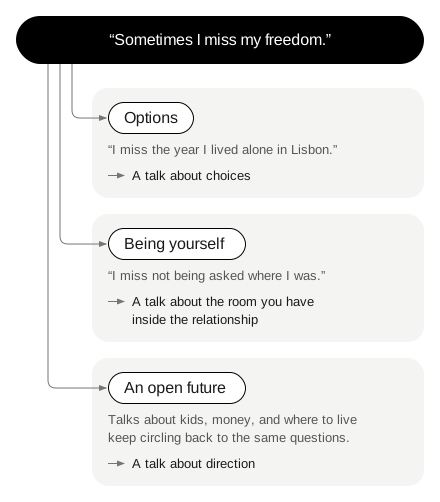
“I miss my freedom” sounds like one complaint, but it can point to at least three things. Each one asks for a different answer, so guessing the wrong one makes the talk worse.
- Freedom as options. The life before felt open: you could move cities, take a job abroad, spend a month’s savings on a trip. Now plans are shared, and some doors feel closed.
- Freedom as being yourself. At home you feel watched. A habit gets a comment, a purchase gets a look, an opinion gets corrected. You miss saying things without checking first.
- Freedom as an open future. The talks about kids, money, and where to live keep circling back to the same questions. The future starts to feel fixed before anyone decided it.
The first is about choices. The second is about the room you have inside the relationship. The third is about direction. A partner who hears “I miss my freedom” may pick one of the three and answer it. If they pick the wrong one, both of you end up defending positions nobody holds.
Why the talk stalls
One response is reassurance or a deal. “You can still travel.” “Go out with your friends more.” Those answers fit the first reading and miss the other two. A partner who feels watched doesn’t want a free Saturday. They want fewer comments on Tuesday.
Another response is silence. The sentence lands as a verdict, so the listener avoids the topic. One married couple on a forum described a related loop: they kept asking each other the same big questions about kids and money, and each talk ended where it started. Asking the question again leaves out what the question means to each person.
There’s also a reason to take the feeling seriously without hearing it as a threat. In three studies, La Guardia and colleagues found that how secure a person feels varies from one close relationship to another: with a mother, a father, a romantic partner, and a best friend. In each relationship, the more a person felt their needs for autonomy, competence, and relatedness were met, the more secure they felt with that particular person (La Guardia et al. 2000). The study is correlational. It doesn’t say that more freedom fixes a couple. It does suggest that feeling free with someone and feeling close to them can go together.
One evening on one word
This format lets each of you say what freedom means before anyone asks for a change. It works at the kitchen table, on a walk, or in the car.
- Write the word Freedom on a scrap of paper, use a card, or open the online table.
- Agree how passing works before you start. Either of you can pass without a reason.
- The partner who said “I miss my freedom” goes first. Say what the word brings up: a place, a year, a person, an object. No requests yet.
- The other asks one follow-up question, then listens to the end of the answer.
- Swap. The second person takes the same word somewhere else.
- After both turns, each of you names which of the three freedoms came up in your own story: options, being yourself, or an open future.
- Stop when it feels done. One small change can wait for another evening.
Step 6 turns a vague sentence into something you can talk about. “I miss the year I lived alone in Lisbon” points to options. “I miss not being asked where I was” points to being yourself. Those lead to two different conversations.
The Thesis rules suggest three follow-up questions that fit any word:
What did that feel like? Who else was there? Has it always meant that to you?
The third one matters most here. Freedom at 22 can mean a backpack and a one-way ticket. At 34 it can mean an hour where nobody needs an answer from you.
Three words for this talk
Freedom is the obvious start. Two other words from the Thesis deck come at the same feeling from the side, which helps when the main word feels too loaded.
Freedom has Compass on its other side. The word side can lead to a time one of you felt most free, or most trapped. The Compass fits the third reading, an open future: where each of you would go if direction were the only question, and which directions you’d want to take together.
Privacy has Diary on its other side. It fits the second reading, being yourself. Privacy can open what each of you keeps to yourself and whether there’s room for that at home. The Diary is a gentler door: a diary someone read, one you kept as a teenager, a notebook nobody else opens.
Courage has Bicycle on its other side. Some of the freedom people miss is the courage they had before: a move, a risk, a job they quit. Courage can show whether that boldness is gone or waiting. The Bicycle can lead to a first ride without help, and who let go of the seat.
The die adds another way in. Its six faces are MEMORIES · BODY · PEOPLE · VALUES · CHILDHOOD · FUTURE. Look at the word from that side.
Ten questions about freedom in a relationship
If you’d rather start with a question than a word, these ask about the picture behind the sentence:
- When did you feel most free, and where were you?
- What’s one thing you did before we met that you’d like to do again?
- Is there anything you stopped saying at home because of how it lands?
- What did freedom look like in your parents’ relationship?
- Which of our shared plans feels like yours, and which feels like mine?
- When you were a kid, what was the first thing you were allowed to do alone?
- What’s a decision you’d like to make without asking first?
- Which future feels closed to you right now, and does it bother you?
- When I say “I miss my freedom,” what do you hear?
- What would one free day look like if nothing needed doing?
Take one or two per evening. After each answer, use one of the three follow-ups and let the story run before you add your own.
When the word lands somewhere hard
Freedom can touch something old: a past partner who checked every message, a family that decided everything. If that comes up, the pass agreement covers it. Either of you can stop, or turn the card to the object side. The rules put it this way: “A short answer is a full answer. You can always ask for more.”
If the talk shows a real disagreement, for example about kids or a move, name it and agree on a day to come back to it. “Every view is welcome, especially one that differs from yours.” Knowing which freedom is at stake makes that later talk shorter.
Try it this week
Pick an evening when neither of you is asking for anything. Write Freedom on a scrap of paper and put it between you. The one who said “I miss my freedom” goes first, the other asks Has it always meant that to you?, and then you swap. End the way a game of Thesis ends: each of you names one thing you discovered about the other today.
The three cards have their own pages: Freedom, Privacy, and Courage. For more on playing as two, see Thesis for couples. For the studies, see the research behind the deck. To see the cards and die, read the rules and the box. For a longer evening of questions, see the 36 questions for couples. Related: passion in a relationship: finding out what each of you cares about now.