“Game night soon?” gets a few hearts and a “yes, let’s.” Weeks later nobody has picked a date, and the idea fades out of the chat. The message did its job as a mood. It didn’t do its job as an invite, because it gave nobody anything to say yes to.
A game night invite message gets a yes when it can be answered with one word. That means a day, a start time, an end time, a place and a deadline for replies, all in the first text. Below are eight messages you can copy and change, sorted by the moment you’d send them: the first invite, the one-to-one follow-up, the reminder, and the text that sets the next date. They work for a Thesis evening, any other game, or a word on a napkin.
What every invite answers
One forum thread was about having no energy left to make plans. A vague invite hands that planning to every guest. Each open question in a message is a small task: which day, how late, what to bring, is it still on. The texts below close those questions before anyone has to ask. For the evening itself, see how to host a game night.
Each message carries the same five parts:
- A day and a start time. “Thursday the 6th, 7:30.”
- An end time. “Done by 10:30.” Friends with an early start plan around it.
- A place. An address, or “on a call, link below.”
- The plan in one line. “One easy game, soup.”
- A reply deadline. “Tell me by Tuesday.”
The end time does more work than it looks. A guest with an early start can say yes to an evening with a clear end. An open-ended evening asks them to guess, and guessing is easier to skip.
Text 1: The first group chat invite
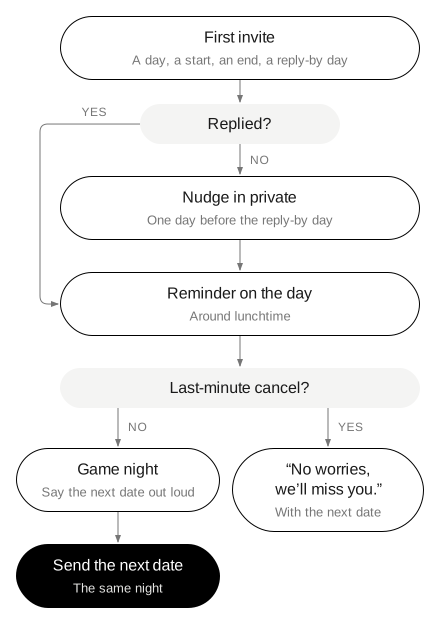
This is the opener. Send it a week ahead, so the reply deadline still leaves a few days.
Game night at mine, Thursday the 6th, 7:30–10:30. One easy game, plus soup. 2–6 of us is enough. Can you tell me by Tuesday?
The line “2–6 of us is enough” matters for hosts whose group has a history of last-minute cancellations. It tells everyone the night happens even if two people drop out, so nobody’s yes depends on someone else’s.
Text 2: The poll for a new group
A group that hasn’t met as a group yet may struggle to agree on a date by discussion. Give two options and ask for one answer.
Trying a game night. Thursday the 6th or Sunday the 9th, 7:30–10:30, at my place. Reply 1 or 2 and I’ll lock in whichever gets more by Tuesday.
Two options are enough. Five dates turn into a scheduling thread, and the thread becomes the evening’s only event.
Text 3: The one-to-one follow-up
A group chat spreads the ask across everyone, so each person can leave it for someone else. A direct message has one person on the other end. After the group invite, send a short private text to anyone who hasn’t answered, the day before the reply deadline.
Hey, game night Thursday, 7:30–10:30. Would be good to have you there. Yes or no is fine, I’m counting chairs.
“Yes or no is fine” gives a clean way to decline. A friend who can say no without explaining has an easy reply to send, and a clear no helps the host more than a silent maybe.
Text 4: The friend you haven’t asked in a while
Some names in the group chat haven’t come in a long time. Writing to them can feel like intruding. In a series of preregistered experiments, people underestimated how much others appreciated being reached out to, and the gap was larger when the contact was more surprising or the two people were less close (Liu et al. 2023). That describes the friend nobody has asked in a while.
Hi, I’m starting a monthly game night, first Thursday, 7:30–10:30. I thought of you. No pressure to come to the first one, but you’re on the list.
“You’re on the list” makes the invite standing. They can skip this month and still have a door open for the next.
Text 5: The reminder on the day
A reminder can save the night from the late-afternoon slump, when people are tired and a cozy sofa sounds better. Send it around lunch, with one concrete detail about the evening.
Still on for tonight, 7:30. Soup’s on, the buzzer is the top one, done by 10:30.
A detail like the buzzer or the soup makes the evening real. A message with only “still on?” invites a “maybe skip” in reply.
Text 6: When only two can come
Low turnout can tempt hosts to cancel, and a cancellation can teach the group that the night is optional. A game that plays with two keeps the date.
Small one tonight, it’s me and Sam. Still on, 7:30. If anyone frees up, there’s room.
A last-minute cancel gets the same calm reply: “No worries, we’ll miss you,” plus the next date. The friend who dropped out still has a date to say yes to.
Thesis plays with 2–6 players, so two people at a kitchen table is a full game. The online table works for a friend who’s home with a sick kid and wants to join on a call.
Text 7: For friends in another city
The invite is the same, with a link in place of an address and a time that works in both places.
Game night on a call, Thursday 8pm my time, 2pm yours. 90 minutes. I’ll send the link, you need a browser and a drink. Tell me by Tuesday?
For the full setup of a remote evening, see online game night with friends.
Text 8: The next date, sent before anyone leaves
The easiest invite is the one sent at the table. Before people put their coats on, pick the next date out loud, then text it to the group the same night so the date sits in the chat.
Next one: Thursday the 4th, same time, same soup. Tell me if that date’s bad and we’ll move it.
Once a night repeats on a fixed day, the invite turns into a reminder. Text 1 gets sent once, and from then on Text 8 does the work.
What to say the game is
Friends who don’t play games may hesitate at “game night,” picturing a long rules explanation. One line in the invite fixes that, and it works best when it describes the game in plain facts. For Thesis, that line can be: “Cards with one word each, a die, and you talk about the word. How to play fits on one card.”
The facts behind that line are short. 50 double-sided cards, an idea on one side and an everyday thing on the other. A die you fold from a card into a six-sided prism and roll like a pencil. Its faces read MEMORIES · BODY · PEOPLE · VALUES · CHILDHOOD · FUTURE, and the only instruction is “Look at the word from that side.” The rule card starts with “Before you start, agree together how passing works,” so a guest who’s nervous about talking knows there’s a way out.
Three cards for a night that repeats
These three words fit a group that’s trying to turn a one-off evening into a regular one.
Tradition has Fridge on its other side. A repeating game night becomes a small tradition of its own, and this card lets the group talk about the ones they grew up with. The fridge side is lighter: magnets, notes, the thing that was always on the top shelf.
Duty has Ticket on its other side. Busy friends juggle a lot of things they have to show up for, and the idea side opens that up without blame. The ticket side brings out concerts, trains and trips, the plans people did keep.
Rest has Clock on its other side. It suits a group where everyone arrives tired, which is the reason the invite has an end time. The clock side goes to alarms, kitchen clocks and the hour someone always leaves.
Send the first text today
Pick a Thursday two weeks out, copy Text 1, and change the food and the address. Then send Text 3 to the two people least likely to answer the group.
The rules and the box are on the Thesis page, and the cards above have their own pages: Tradition, Duty and Rest. For a group of friends, see Thesis for friends. For the studies behind the deck, see the research page. Related: game night in your 30s: a game nobody has to learn.