You’re at a party, a meetup or a friend’s birthday. You ask the stranger next to you, “Do you live around here?” They say, “Yeah, a few streets away.” Then both of you look at your drinks. The first question worked. There’s no second one.
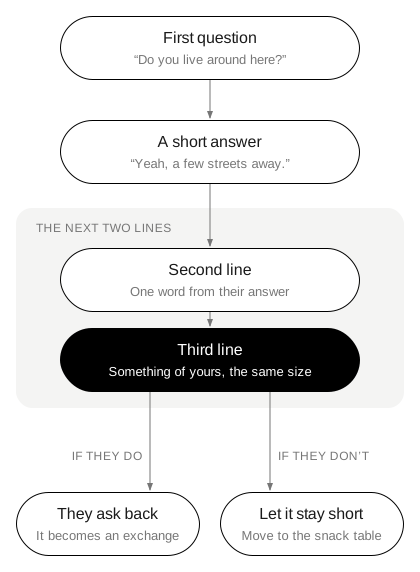
The short answer: the second line comes from their answer, and the third line comes from you. Pick one word they said and ask about it. Then add a small piece of your own, so they have something to ask back. This guide gives scripts for both lines, the research behind them, and a way to practice with one word on a card.
Why the talk stops after the first question
First questions like these are closed ones. “Do you live around here?”, “How do you know the host?” and “What do you do?” each have a short, complete answer. Once the answer is given, the question is finished.
Then each person waits. You wait because you asked and it’s their turn to add something. They wait because they answered and it’s your turn to ask. The format of question and answer has run out, and nobody has switched to a new one.
In online threads about this, people describe the same wall: they can open with a name and a neighborhood, and after that they don’t know how to carry on. What helps here is a plan for the next two lines.
The second line: take one word from their answer
Every answer holds more than it says. “A few streets away” has a place, a distance and a choice in it. The second line picks one of those and asks about it with an open question, one that can’t be answered with yes, no or a number.
Here are second lines for three common first answers:
- “Yeah, a few streets away.” “What made you pick this part of town?”
- “I’m a friend of Sam’s from work.” “What’s Sam like at work?”
- “I do logistics.” “What does a normal Tuesday look like for you?”
Each of these takes something they already said and asks for the story behind it. It’s easier for the other person than a new topic, because they’re already holding it.
In three studies of live conversations, people who asked more questions, particularly follow-up questions, were better liked by their conversation partners. In a speed-dating study, people who asked more follow-up questions got more agreements to a second date. The same research found that people didn’t expect asking questions to make them more liked (Huang et al. 2017). That gap may be why the second question doesn’t come: asking can feel like prying, while the other person may take it as a sign you’re listening.
The third line: put something of yours on the table
A run of questions starts to feel like an interview. The third line breaks that by giving them a piece of you to respond to. Keep it the same size as what they told you. If they told you about their street, tell them about yours.
Third lines for the same three answers:
- Their street. “I moved here recently and I still get lost near the station.”
- Sam from work. “I know Sam from a running group. I had no idea about the office side.”
- Logistics. “I keep wondering how a parcel finds my door. My job is the opposite, all screens.”
Now they have something to ask about. The conversation turns from your questions into an exchange.
A study of get-acquainted conversations compared pairs who took turns sharing about themselves with pairs where one person shared while the other listened, and then they switched. The turn-taking pairs reported more attraction, especially after the first conversation. They also felt more listened to, enjoyed it more and felt more liked (Sprecher and Treger 2015). Both studies looked at conversations set up in research settings, so a party is a looser fit. The pattern is still a fair one to try: ask, then share, then let them ask.
When the answer stays short
Sometimes the second line gets another short answer. “I picked it because it was cheap.” That’s still a full answer. The Thesis rule card puts it this way: “A short answer is a full answer. You can always ask for more.”
One more follow-up is fine. After that, the third line does more work than a fourth question. Share something of yours and see if they pick it up. If they don’t, a short exchange is allowed to stay short. You can move to the snack table without a reason.
Silence after a short answer isn’t always a dead end either. Give it a few seconds. Some people add the interesting part only after a pause.
Practice with one word
Scripts are easier to use when you’ve tried them somewhere with less at stake. One way is to play with a friend or two, using a single word as the topic. The Thesis deck has 50 cards, each with an idea on one side and an everyday thing on the other. Draw a card, choose a side, and take turns with the second and third lines.
The die adds an angle. It has six faces: MEMORIES · BODY · PEOPLE · VALUES · CHILDHOOD · FUTURE. The only instruction is “Look at the word from that side.” The rule card then gives three follow-ups that work for every word:
What did that feel like? Who else was there? Has it always meant that to you?
These are second lines you can carry into any conversation. You can play on the free online table, or write a word on a napkin.
Questions for the second line
These questions work after almost any first answer. Swap in the word they used. They’re sorted from light to deeper:
- How did you end up there?
- What’s the best part of it?
- What did you expect it to be like before you started?
- What’s something about it that surprised you?
- Who got you into it?
- What would you change about it, if you could?
- Has it changed since you started?
- What would you miss if you left it?
- What do people get wrong about it?
- Where do you see it going next?
Two of these, plus one thing of your own, carry a first conversation a long way.
Three cards for the next conversation
Each of these three cards fits the kind of talk this guide is about.
Home has Spoon on its other side. It’s the word behind “Do you live around here?” The idea side moves past the address to what makes a place feel like home, or doesn’t yet. The spoon side is lighter: a kitchen, a family meal, the drawer that was always full of the wrong cutlery.
Community has Mirror on its other side. It fits the moment after “How do you know the host?”, when you’re both trying to place each other in a group. The idea side can lead to the groups someone belongs to. The mirror side brings up getting ready to go out, and how people see themselves before they walk in.
Curiosity has Sewing machine on its other side. It’s the habit the second line depends on. The idea side can lead to what someone wants to know more about, which is a good second line on its own. The sewing machine side brings up a grandparent, a school class or a hobby that took over a winter.
Before your next party
Pick one first question you’ll use, and then plan only the next step: one word from their answer, and one thing of yours the same size. Try it once. If it lands, you’ve got a conversation. If it doesn’t, you’ve had a short, friendly exchange.
To practice first, play a few rounds on the online table, or see the rules and the box. The three cards have their own pages: Home, Community and Curiosity. For groups of friends, see Thesis for friends. For the research behind the deck, see research. If you’d rather start the talk with an object, see low pressure conversation starters.