You’re at a party, by the window, with someone you met earlier in the evening. The good part of the talk ended a while back. Now you both nod, sip, and wait for a reason to move. Neither of you wants to be the one who walks away first.
This post gives you a way out in three steps that leaves the other person feeling good about the talk. It works at parties, meetups and work events. The lines below are examples to adapt, not scripts.
The other person may be waiting too
Ending a conversation is harder to time than it looks. In one study, 126 pairs of strangers talked in a lab about whatever they liked, for as long as they wanted, up to 45 minutes. Afterward, each person said when they had wanted the talk to end. Only 2 of the 126 conversations (1.59%) ended when both people wanted them to. In 46.83% of them, both people had wanted to stop earlier (Mastroianni et al. 2021).
People in the study also guessed badly when their partner wanted to stop. The authors describe the end of a conversation as a coordination problem: solving it takes information that each person keeps to themselves. The pause by the window is two people waiting on each other. A clear, warm exit can solve it for both of you.
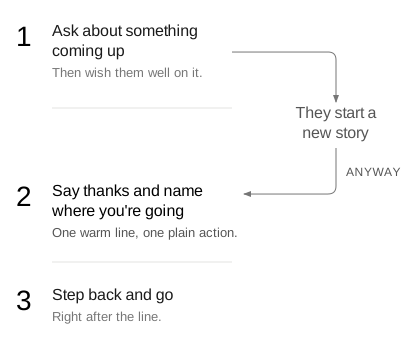
Step 1: Ask about something coming up
Start the exit with a question about later: the rest of the evening, the weekend, a trip they mentioned. A question about the future moves the talk out of the present, and the reply gives you something to wish them well on. Vanessa Van Edwards calls this a future cue and suggests pairing it with a compliment or an action (on The Diary of a CEO).
These questions fit a party or a meetup:
Any plans for the weekend?
Are you staying for the talk later?
You said you’re off to Lisbon next month. When do you leave?
Let them answer, then wish them well on it: “Have a great time in Lisbon,” or “Enjoy the wine bar.” That line already sounds like a goodbye, and both of you hear it.
Step 2: Say thanks and name where you’re going
The second step is one warm line about the talk and one plain action. The warm line works best when it points to something they said. The action tells them the talk is ending and leaves nothing to answer, so neither of you has to find a new topic.
It was good to hear about the bakery. I’m going to say hi to the host.
Thanks for the Lisbon tips. I’m going to grab some food before it’s gone.
I loved the story about your grandmother’s garden. I promised a friend I’d find her, so I’ll go do that.
Keep the reason true. The bar, the host, the restroom, another friend or the train home all count. If you’d like to see them again, this is the moment to say so: “Let’s swap numbers. I’d like to hear how Lisbon goes.”
The Thesis rules close a game in a similar way: “each player names one thing they discovered about someone at the table today.” At a party, naming one thing you learned about the person makes the thanks specific. It also shows you were listening.
Step 3: Step back and go
The last step is physical. Say the line, take a small step back, turn toward where you’re heading, and go. A goodbye that stalls is what makes an exit awkward: you both say “well, anyway” and stand there. Leaving right after the line is the kind part, because it spares both of you that moment.
Sometimes the other person picks up the future question and starts a new story. Listen to the end of the sentence, then go to step 2 anyway. “That sounds great. It was good talking to you. I’m going to get a drink.” A warm line and a step back still work after a detour.
When it’s harder to leave
A few situations need a small change to the three steps:
- They keep talking. Wait for a breath at the end of a sentence, then say the step 2 line. A short pause is enough of an opening.
- You’re in a group. One line to the group and a wave is enough. There’s no need to say goodbye to each person.
- You know someone they’d like. Introduce them: “Have you met Sam? She climbs too.” You leave, and they have a new conversation.
- You were the one who started it. Take the exit anyway. Starting a talk doesn’t mean you owe it the whole evening.
Give the next conversation something to hold
Some conversations stall because there’s nothing in the middle of the table to talk about. A word gives a group something to pick up and put down. At a game night or a small gathering, one person draws a card, chooses the idea or the thing, and says as much or as little as feels right. The others ask what they’re curious about. Then the turn passes, and nobody has to plan an exit. The rules put it plainly: “Play for as long as it feels good.”
The die gives each turn an angle. Its six faces are MEMORIES · BODY · PEOPLE · VALUES · CHILDHOOD · FUTURE. Roll, then look at the word from that side.
Boundaries has Shoes on its other side. For anyone who finds it hard to leave, the idea side opens a talk about time, people and saying when you’re done. The shoes give a lighter start: a pair that hurt by the end of a wedding, the row of shoes by a friend’s door.
Rest has Clock on its other side. After a crowded event, the idea side lets someone say how they recover from a room full of people. The clock is the object you glance at when you want to go home.
Try it at the next event
Pick your lines before you need them. Choose one question about later and one true place you’re heading. When the talk winds down, say both, take a step back, and go. The other person might be waiting for the same exit.
If you replay the talk on the way home, read about the liking gap. For playing with a group, see Thesis for friends or the free online table. The cards above have their own pages, Boundaries and Rest. Gratitude, with Fence on its other side, fits a closing round. See the rules and the box, and the research behind the deck. For the start of the next one, see networking conversation starters.