You’re holding a drink at a high table. The person next to you says, “So what do you do?” You give your job title, they give theirs, you both nod. A moment later you’ve swapped résumés and neither of you knows what to say next.
This post gives you openers for networking events and meetups that lead somewhere after the first answer. It covers why the job question stalls, ten starters sorted by where you are in the room, a first-round rule with no work talk, and a way to use one word on a card as a shared topic.
Why the job question stalls
“What do you do?” asks for a fact, and a fact is a complete answer. “I’m in logistics” closes the thread. The other person has to find a new topic, and the easiest one is to ask you the same question back. That’s the résumé swap.
There’s also a reason the swap feels uncomfortable. In research by Casciaro, Gino and Kouchaki, people who recalled building a professional tie for career benefit were more likely to complete word fragments with cleansing words, like “soap”, than people who recalled forming a personal connection. In a survey at a North American law firm, lawyers who felt dirtier after networking did it less often (Kellogg Insight summary of Casciaro et al. 2014). When the first minute is about what each of you can use, it can feel like a transaction.
An opener that asks about the person, their evening or something they care about moves the first minute away from that. The job can come up anyway, a few minutes later, with a story attached.
Ten networking conversation starters
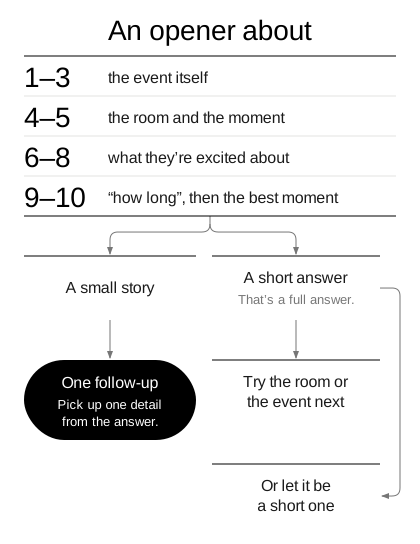
The starters below are grouped by situation. Each one asks for a small story, so the answer gives you something to follow up on. Pick two that sound like you.
About the event itself. You both chose to come, so the event is common ground.
- What brought you here tonight?
- Have you been to one of these before? What was it like?
- Which talk or session are you most curious about?
About the room and the moment. Something you can both see is the easiest start.
- How did you find this place? I’d never been here.
- What’s the story behind that pin on your bag?
About what they’re excited about. These replace the job question and still let work come in.
- Working on anything exciting these days?
- What’s something you’re learning right now?
- What’s the best thing that happened to you this week?
A “how long” question, then the best moment. A number is easy to give, and it opens a story.
- How long have you been in this city? What’s been the best part so far?
- How long have you been coming to this meetup? What keeps you coming back?
Words like “best” or “most surprising” help. They point the other person to one moment instead of a summary. If an answer is short, that’s a full answer. Try the room or the event next, or let the conversation be a short one.
What to do with the first answer
The opener is the smaller half. What makes the conversation go is the next question. Huang and colleagues studied live get-to-know-you chats and speed dates and found that people who asked more questions, especially follow-up questions, were better liked by their partners. People didn’t expect asking questions to have that effect (Huang et al. 2017).
A follow-up picks up one detail from the answer. If someone says they moved here for a job, ask about the move, the job or the city. Three short follow-ups from the Thesis rule card work after almost any story:
What did that feel like? Who else was there? Has it always meant that to you?
A deeper question may go better than it feels like it will. In experiments by Kardas, Kumar and Epley, conversations between strangers felt less awkward than participants expected, and participants overestimated the awkwardness most for deep conversations. Participants also expected strangers to care less about what they shared than the strangers did (Kardas et al. 2021). Treat each question as an invitation. If the other person picks it up, keep going. If not, let it go.
A first round with no work talk
If you host a meetup, one rule changes the start of the evening: in the first round of conversations, nobody talks about their job. Behavioral researcher Vanessa Van Edwards describes a party with that rule. She says it took her off autopilot and made her more creative with her questions (The Diary of a CEO interview).
Announce it when people arrive and keep it short. “For the first round, no jobs. You’ll find out later.” Then give people something else to talk about. Without a replacement topic, the rule can leave people standing in silence.
You can use the rule as a guest, too. When someone asks what you do, give a one-line answer and ask them what they do when they’re not working. The job can come up later, after you know something else about each other.
One card on a high table
A word on a table gives strangers a topic that neither of them brought. Place one card face up on each high table, or write one word on a sticky note. People who walk up can read it, say what it brings to mind, and ask the person next to them. The word does the opening, so nobody has to.
If the meetup has a seated part, you can run a short round with the Thesis deck or the free online table on a screen. Each person draws a card, chooses a side, and says as much or as little as feels right. The rules start with “Before you start, agree together how passing works.” At a meetup, agree that anyone can pass without a reason.
The die can give each turn an angle. Its six faces are MEMORIES · BODY · PEOPLE · VALUES · CHILDHOOD · FUTURE. Look at the word from that side.
Curiosity has Sewing machine on its other side. At a networking event, the idea side invites people to talk about what they’re learning or what they want to find out at the meetup. The sewing machine gives a lighter start: someone’s grandmother, a costume, a repair that went wrong.
Work has Stone on its other side. This card lets work into the conversation on new terms: the first job someone had, or a task they’d gladly hand off. The stone side works for people who want a break from work talk, with a story about a beach, a wall or a garden.
Community has Mirror on its other side. It fits a meetup well, since a room of people with one shared interest is already a small community. The mirror side can lead to a story about getting ready for the evening, or about how people see themselves in a group.
Before your next event
Pick two starters from the list and say them out loud once, so they come out in your own words. Choose one from the event group and one from the “how long” group. At the event, use one, listen for one detail, and ask one follow-up.
For a group version at work, see Thesis for teams and classes. The cards above have their own pages: Curiosity, Work and Community. See the rules and the box and the research behind the deck. For more on the second question, read follow-up questions. When it’s time to move on, see how to leave a conversation politely.