You’ve had the friend’s name open in your phone for weeks. The last message in the thread is from two years ago, maybe a birthday emoji. You want to write, and every draft sounds either too heavy or too casual.
This guide covers the first message, what to send after a reply or a silence, and a first call that has something to do in it. The sample texts below are examples to adapt, not scripts.
The first message is welcomed more than it feels
Writing to someone after a long gap feels like a risk. Research suggests the risk is smaller than it looks from the sender’s side. In a series of preregistered experiments, Liu and colleagues found that people underestimated how much others appreciated being reached out to with a brief message or a small gift. The gap was larger when the contact came as more of a surprise, and between people who were less close at the time (Liu et al. 2023).
An old friend you haven’t written to in years fits both conditions. The silence that makes the message feel awkward is the same thing that makes it land.
Drifting apart is also common. In two national samples of US adults (2,420 people in 2022 and 2,243 in 2023), 35.9% to 37.4% said they had lost touch with a friend in the past year (Pennington et al. 2024). Your friend has likely lost touch with someone too.
Step 1: Write a message that needs no answer
The first message works best when it’s short, specific and easy to reply to. A long apology for the gap puts the other person in the position of forgiving you before they’ve said hello. A message with a question they have to answer well puts them on the spot.
Three things carry a first message:
- A reason. Something reminded you of them: a song, a street, a photo.
- One warm line. Say plainly that you thought of them.
- An open door. A light question, or no question at all.
These examples follow that shape:
Walked past the old pizza place on Fifth today and thought of you. Hope you’re doing well.
I found the photo from the camping trip with the broken tent. Still laughing about it. How are you these days?
It’s been way too long. I miss our talks. No pressure to reply fast, I’d love to hear how you are.
Saw that your band played last weekend. Are you still writing songs?
Leave out “sorry I disappeared” as the opening line. If the gap needs naming, one clause is enough: “I know it’s been ages.”
Step 2: After a reply, suggest one small thing
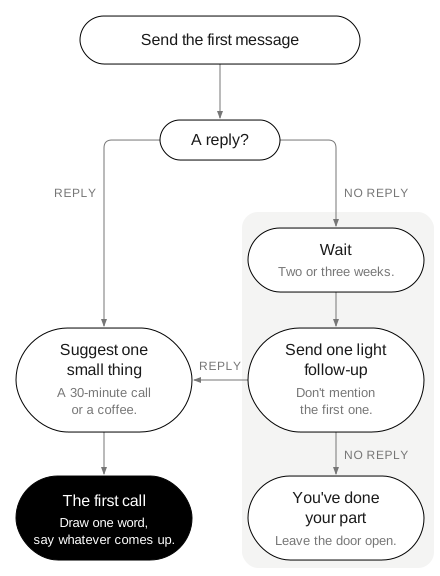
A reply is the moment to turn messages into a plan. Long text threads with an old friend often fade after a few days, because neither side knows what comes next. A small, specific suggestion gives the thread somewhere to go.
Keep the first plan short and easy to say yes to. A 30-minute call or a coffee is easier to fit in than a whole evening. Offer two options so the other person chooses instead of deciding from scratch.
So good to hear from you. Want to do a quick call this week? Thursday evening or Sunday morning both work for me.
I’m in town on the 14th. Coffee for half an hour, if you have time?
We live too far apart for coffee. How about a video call and a card game I found? It’s free online and takes about as long as you want.
Step 3: If there’s no reply, wait and send one more
A silence after a first message can mean many things. People read texts at work, mean to answer properly, and forget. Give it two or three weeks, then send one light follow-up that doesn’t mention the first one.
Saw this and thought of you. Hope life’s good.
If that one goes unanswered too, you’ve done your part. You can leave the door open without writing again. Some friendships come back a year later, when the other person is ready.
If you’re the one who started every plan for years, a pause can feel like the end of the friendship. It can also be a pause. You don’t have to decide which it is today.
The first call: give it something to do
The first call after years apart can stall after the catching up. You both report on jobs, cities and families, and then there’s a pause. A shared activity carries the call past that point.
One option is a word game. You draw one word, look at it from one side, and say whatever comes up. The other person asks a question or two. Then it’s their turn. You can play on the free online table on a video call, with the Thesis deck at a table, or with a word written on a napkin.
The rules open with “Before you start, agree together how passing works.” With an old friend, agree that either of you can skip a word without a reason. A pass on a first call means only that.
The die gives each turn an angle. Its six faces are MEMORIES · BODY · PEOPLE · VALUES · CHILDHOOD · FUTURE. Roll, then look at the word from that side.
Nostalgia has Key on its other side. With an old friend, the idea side brings back the years you shared, which is where your common ground is. The thing side gives a lighter start: a key to a first apartment, a key you both had to a place that’s gone.
Friendship has Ball on its other side. The idea lets you talk about what friendship meant at 15 and what it means now, without making the call about the two of you. The ball can be a game you played in a schoolyard, or a story with no history attached.
Forgiveness has Door on its other side. Hold this one back for a later call. If something went wrong between you, the word can open it when you’re both ready. If not, the door side works as a story about a house or a move.
Questions for the first call
A few open questions help the call move from updates to stories. Pick two or three, not all of them:
- What’s something you’ve started doing since we last talked?
- Who do you spend most of your time with now?
- What does a normal Tuesday look like for you these days?
- What do you remember about the year we met?
- Is there something you used to love that you’ve stopped doing?
- What’s been the hardest part of the last couple of years?
- What are you looking forward to this year?
- What do you miss about where we grew up?
When your friend answers, the rule card’s follow-ups keep the story going:
What did that feel like? Who else was there? Has it always meant that to you?
The third one fits old friends well. You knew what things meant to them years ago. Now you can hear what changed.
Ending the call
End the call with a next date, even a loose one. “Let’s do this again next month” is enough, as long as one of you puts it in a calendar. A friendship that went quiet for years doesn’t need weekly calls. It needs a second call.
The last round of a Thesis game gives a way to close: “each player names one thing they discovered about someone at the table today.” On a call with an old friend, name one thing you learned about who they are now.
What to do today
Pick one name. Find one specific thing that reminds you of them. Write two sentences and send them. The reply, if it comes, will tell you the next step.
For more on playing with friends, see Thesis for friends. The cards above have their own pages: Nostalgia, Friendship and Forgiveness. See the rules and the box, and the research behind the deck. The follow-up questions also carry a slower evening with a partner: see deep date night questions for couples.