An all-hands opens with a host on stage asking for volunteers. A microphone travels along the rows, and the same few people take it. Everyone else hopes their row gets skipped. This guide runs the opener in pairs instead: each person turns to the person beside them, the pair shares one word, and nobody speaks to the whole room unless they choose to. It fits into a short slot, works in a full hall, and needs a word per pair on a slide, a sticky note or the free online table.
Why a big room talks better in pairs
A whole-room round shrinks as the room grows. In a full hall, a round where everyone speaks would leave each person a few seconds, so the host picks a few speakers and the rest listen. Group size also changes how talk works. Fay, Garrod and Carletta compared discussion in groups of 5 and groups of 10. In the groups of 5, members were most influenced by the people they talked with. In the groups of 10, talk worked more like a series of monologues, and members were most influenced by the dominant speaker (Fay et al. 2000).
Even turns also go with what a group gets done. In two studies with 699 people working in groups of two to five, Woolley and colleagues found a general factor that predicted group performance across many tasks. Groups that scored higher on it had more even turn-taking in conversation and members with higher social sensitivity (Woolley et al. 2010). In a pair, the turns split in two by design. The steps below are in the order you’d run them.
1. Put the purpose and the time on the first slide
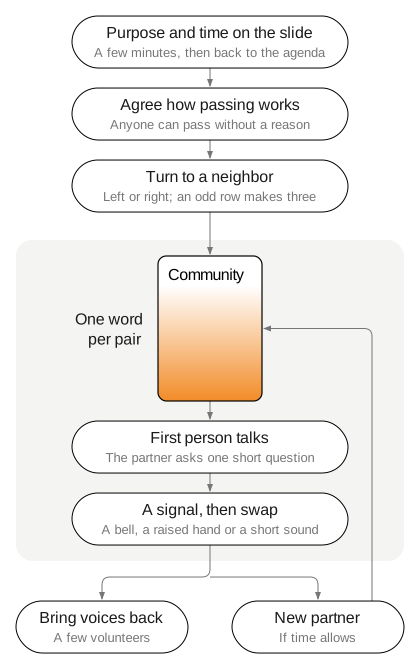
People in a large audience can decide fast whether to join in or check their phone. One sentence on the slide helps them decide. “We’re one company in three offices, and this is a few minutes to meet someone outside your team” is a purpose. Add the time box under it: “A few minutes each, then back to the agenda.” A stated end can make it easier to start, because people know the exercise won’t run long.
2. Agree how passing works, from the stage
The Thesis rules say it in one line: “Before you start, decide together how passing works.” A full hall can’t decide together, so the host decides for everyone and says it before the first turn. Anyone can pass without a reason. A pair can also skip the word and talk about the agenda instead. If a senior leader is hosting, they say it, so the permission comes from the top of the room.
3. Pair people with whoever sits next to them
Moving a full hall of people across the room can take longer than the exercise. Ask each person to turn to the person on their left or right. An odd row makes a group of three. People who know each other well can pair with someone in the row behind. Keep the pairing rule to one sentence on the slide, so nobody has to choose a partner and nobody is left over.
4. Give each pair one word
One word per pair gives two strangers the same starting point. The word can be on the slide for the whole room, on a card handed down each row, or on a sticky note under every second seat. A word on a slide is the simplest. Cards on the seats make each pair’s talk a little different, which helps if you plan a second round. Each person picks a side of the card: the idea or the everyday thing. The thing side can be an easier way in for anyone who’d rather keep it light.
Community has Mirror on its back. It fits an all-hands because the room is a community of some kind, and people can talk about that or about one they belong to outside work. Someone might describe the first week at the company and who showed them around. Someone else might pick the mirror and talk about the one in the office bathroom, or how they get ready for a day with a lot of people.
5. Run two short turns, then swap
A short turn is enough for one person to say something and the other to ask about it. The first person talks about the word. The partner listens and asks one short question. The Thesis rules cover both parts in two sentences: “Say as much or as little as you like. The others ask, gently.” Then they swap. Ring a bell, raise a hand on stage, or play a short sound at each switch, because a large room won’t hear a voice over a room full of conversations. For the partner’s question, the rule card gives three examples: What did that feel like? Who else was there? Has it always meant that to you?
Independence has Mug on its back. It suits a company that’s growing, because answers can turn to working alone and working with others. Someone might talk about the first project they ran without a manager checking in. Someone else might pick the mug and talk about the one they bring from home, or the coffee they make before the first call.
6. Bring a few voices back to the room
The report-back is where a large-group icebreaker can turn back into a stage. Keep it optional. Ask for a few volunteers to share one thing their partner said, with the partner’s permission. A second option is a shared board or chat where people type one line. The rule card has a line for what stays in the pair: “What is said at the table stays there.” Say it aloud before asking for volunteers, so nobody repeats a partner’s story without asking.
Courage has Bicycle on its back. It works for an all-hands after a hard quarter or a reorganization, and the depth stays with the speaker. Someone might talk about raising a problem in a meeting. Someone else might pick the bicycle and describe learning to ride one, or the bike they ride to the office.
7. Repeat with a new partner, if time allows
A second round doubles the number of people each person meets. Ask people to turn to the person on their other side, or to stand and find someone from another team. Use the same word or a new one.
Prompts for pairs in a large room
If you’d rather give pairs a question than a word, the prompts below work between strangers and leave out family, money and health:
- What’s a tool you use every day at work?
- What’s the first thing you did at this company?
- What’s something you learned from a colleague?
- What does a good week at work look like for you?
- What’s an object on your desk with a story?
- What’s a skill you picked up outside work?
- What’s something you’re curious about in another team?
- What’s a small thing that makes a long meeting easier?
- What’s a place where you do your best thinking?
- What would you like to learn this year?
Running it with the cards
With the box or the online table on a phone, each pair follows the same steps. Draw a card, pick the idea or the thing, roll the die and look at the word from that side. The die has six words: MEMORIES · BODY · PEOPLE · VALUES · CHILDHOOD · FUTURE. The only instruction is “Look at the word from that side.” In a big room, the die is optional. A pair with only a word on the slide can skip it and talk.
For your next all-hands, write the purpose sentence and the pairing rule on one slide, and pick one word to go with them. The cards above have their own pages: Community, Independence and Courage. For more on running it at work, see Thesis for teams and classes. For the studies behind the deck, see the research page. See the rules and the box. If part of the room joins by video, see hybrid meeting icebreakers.