Your mother-in-law texts in early November to ask what time you’ll arrive on Christmas Eve. Your own parents haven’t asked yet, because they assumed. One of you answers the text in the car, and the other finds out at dinner. By then the holiday is half decided, and nobody decided it together.
This post is for married couples who split Thanksgiving, Christmas, or both between two families. It gives you one conversation to have before the invitations arrive: what each holiday meant to you growing up, what you each want this year, and a plan you both say yes to. You need no deck. A word written on a sticky note works.
Why the talk goes better in October
The plan can get made by whoever answers first. One family invites early, the other assumes, and the couple ends up defending a schedule neither of them chose. Once a parent has heard “yes,” changing it turns into a talk with the parent instead of a talk between the two of you.
Couples on marriage forums describe a version of this pattern. One spouse notices they visit one side almost every holiday and the other side rarely. Nobody may have planned it that way. It grew out of distance, habit, or which parent calls first. By the time someone says it out loud, it can come with years of resentment attached.
Holiday stress is common enough that it’s worth planning around. In a 2023 Harris Poll for the American Psychological Association of 2,061 US adults, 89% said concerns such as not having enough money, missing loved ones, and anticipating family conflict cause them stress during the holidays. In the same poll, 38% named missing family or loved ones (APA 2023). A plan made in October won’t remove that, but it moves the hard part to a calm evening at home.
In-laws matter, in different ways for different people
How close you feel to your partner’s family is part of the marriage, and it doesn’t work the same way for both spouses. A study by Orbuch and colleagues followed 373 couples who married in 1986 in Michigan for 16 years. Closeness was rated on a four-point scale. For husbands, each step closer to their in-laws in the first year went with about 20% lower odds of divorce over that time. For White wives the link went the other way: the closer they felt to their in-laws early on, the higher the odds of divorce. For Black wives, closeness went with lower odds (Orbuch et al. 2013).
The study is correlational, closeness was a single question, and the couples married four decades ago. It can’t tell you how many days to spend with anyone. It does suggest that time with in-laws can feel like support to one spouse and like pressure to the other. That’s the reason to ask each other, instead of splitting days by a formula.
One talk before the invitations
This works on a walk, at the kitchen table, or in the car on a quiet weekend. Do it before either family has asked.
- Agree how passing works. Either of you can skip a question without a reason.
- Each of you describes one holiday from childhood: who was there, what was on the table, what you did the night before.
- Each of you names one thing from that holiday you’d like to keep, and one you’re happy to let go.
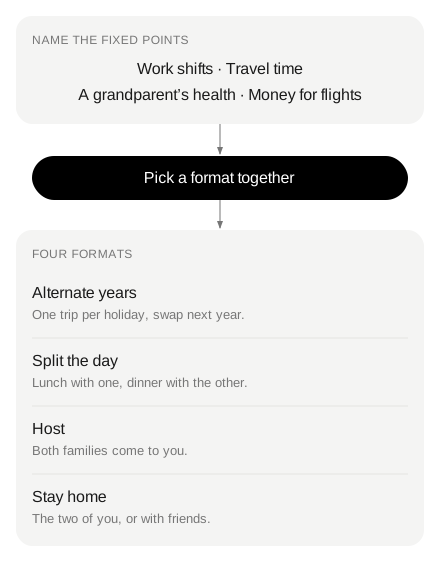
- Name the fixed points: work shifts, travel time, a grandparent’s health, money for flights.
- Pick a format together (see the options below).
- Decide who tells which family, and when. Each of you tells your own parents.
Step 6 matters more than it looks. When each of you carries the news to your own family, neither of you has to defend the plan to people who aren’t your parents.
Four formats couples use
Each of these four ways to split holidays between two families has a trade-off.
- Alternate years. Thanksgiving with one family and Christmas with the other, then swap next year. It’s easy to explain and keeps travel to one trip per holiday.
- Split the day. Lunch with one family, dinner with the other. It works when both families live close to each other, and it’s tiring when they don’t.
- Host. Both families come to you. You trade travel for cooking and for two families meeting at one table.
- Stay home. One holiday a year, the two of you, or with friends. Telling both families at the same time keeps it even.
The format matters less than the fact that you chose it together. If a plan feels uneven to one of you, say so in October. It’s a smaller talk then than on the drive home in December.
Questions for the talk
If you’d like a list to start from, these ones keep the talk on what you each want, not on whose parents are harder:
- Which holiday from your childhood do you remember best, and why that one?
- What did the night before look like in your house?
- Which family tradition would you miss if it disappeared?
- Which one would you be glad to drop?
- What does a good holiday feel like to you, hour by hour?
- When do you start to feel tired at a family gathering?
- What do you need from me when we’re at your parents’ house?
- What do you need from me when we’re at mine?
- Is there a holiday you’d like to spend with only the two of us?
- What would make this year feel fair to you?
Take two or three per evening. Follow each one with one of the three questions from the Thesis rule card:
What did that feel like? Who else was there? Has it always meant that to you?
The third one fits this topic well. A tradition you’ve followed since childhood may mean something different to you now than it did at 10.
Words for a holiday talk
A single word can carry this conversation when a direct question feels too loaded. These three from the Thesis deck fit it.
Tradition has Fridge on its other side. Tradition is the word both families use when they mean “the way we do it.” Saying what it means to each of you helps separate the parts you love from the parts you do out of habit. Fridge is an easier door: the fridge in your parents’ kitchen in December, the leftovers, the drawings on the door.
Family has Bread on its other side. Family is the word at the center of every holiday plan, and the two of you may draw its edges in different places. One of you may count cousins and a godmother. The other may mean three people. Bread leads to who baked, who sliced, and who always got the end piece.
Fairness has Sweater on its other side. Fairness fits the moment when one of you feels the visits are uneven. Talking about the word first, before the calendar, lets each of you say what fair means without arguing about dates. Sweater keeps it light: the holiday sweater, the one a grandmother knitted, the one you had to wear for the photo.
When the talk gets hard
Some of this touches old things: a parent who’s lonely, a sibling who doesn’t come, a family that judges. If a question lands somewhere heavy, the pass agreement from step 1 covers it. The Thesis rules put it this way: “A short answer is a full answer. You can always ask for more.”
If you disagree about the plan, set it down and agree on a day to come back to it, still before the invitations. “Every view is welcome, especially one that differs from yours.” Travel costs can sit under the disagreement. If they do, see how to talk about money with your partner.
Try it this weekend
Write Tradition on a sticky note and put it on the fridge. On Saturday, each of you tells the other about one holiday from childhood, and the other asks Has it always meant that to you? Then pick a format and decide who calls which family. End the way a game of Thesis ends: each of you names one thing you found out about the other.
For more on playing as a couple, see Thesis for couples. For the studies behind the deck, see the research page. You can play a round on the online table, or read the rules and the box.