Yes, two friends is common. In a 2021 survey of 2,019 American adults, 49% said they had three or fewer close friends (Cox 2021, Survey Center on American Life). Two close friends sits inside that group, not at its edge. The number itself says little. What it says about your life depends on two other things: how close those two friendships are, and whether you want more.
This guide puts two friends next to the survey numbers, then splits into two paths: making two friendships deeper, or adding a third person. Both work with the Thesis deck, the free online table, or a word written on a napkin.
Where two friends sits in the numbers
Two large US surveys asked adults how many friends they have. They counted in different ways, so their numbers don’t line up exactly, and both are useful.
- Close friends, 2021. In the Survey Center on American Life poll, 12% reported no close friends, 49% reported three or fewer, 36% reported four to nine, and 13% reported ten or more (Cox 2021).
- All friends, 2023. In the American Friendship Project, a national sample of 2,243 adults, the most common answer was 1–5 friends, chosen by 44.4% (Pennington et al. 2024). The authors sum it up as four or five friends on average.
- No friends at all. The same project puts the share of US adults with no friends at about 2–3%.
So a person with two friends has fewer than the average of four or five, and still falls in the largest single group. The 2021 survey also compared its results with a 1990 Gallup poll, where 27% had three or fewer close friends. The report notes that the two polls used different methods, so the change is a rough guide, not a precise trend.
The number matters less than the fit
Counting friends hides the question people care about. The American Friendship Project asked both. Over 75% of adults said they were satisfied with the number of friends they had, yet over 40% felt they weren’t as close to their friends as they’d like (Pennington et al. 2024). For a large share of people, the gap is closeness, not headcount.
The 2021 survey adds the other side. Satisfaction did rise with the number of close friends. Among people with one close friend, 39% chose one of the two highest satisfaction answers. With two or three close friends, it was 43%. With four or five, 56%, and with ten or more, 75% (Cox 2021). These are averages across a national sample. They show a pattern in the population, not a target for your life.
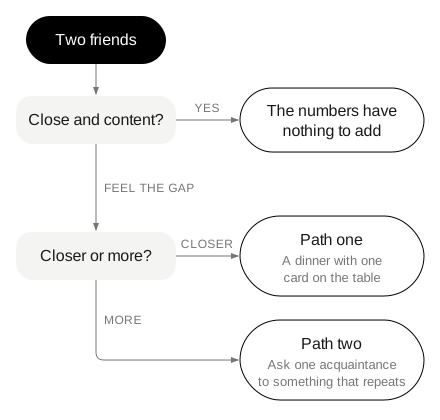
Reading both together gives a plain test. If your two friendships are close and you’re content, the numbers have nothing to add. If you feel the gap, decide which kind it is: two friends you’d like to know better, or a wish for more people around you.
Why the count stays low
Friends can become fewer for ordinary reasons: a move for work, children, a new job, or a new partner. In the 2021 survey, 47% of Americans said they had lost touch with at least a few friends over the past 12 months (Cox 2021). In the American Friendship Project, 46.6–48.9% of adults agreed that it’s difficult to make friends (Pennington et al. 2024).
That’s why the usual advice, “put yourself out there,” can go unused. It asks for energy at the end of a long week and gives no plan for the second meeting. A smaller step is easier to take: choose one of the two paths below and do one thing on it this month.
Path one: make two friendships deeper
Two friends you see often and talk with openly can be a full social life. When the talk has stayed on work and weekend plans for years, a change of format can open it up.
The Thesis deck is one way to do that. Each card has an idea on one side and an everyday thing on the other. You draw a card, choose a side, and roll a folded paper die with six words: MEMORIES · BODY · PEOPLE · VALUES · CHILDHOOD · FUTURE. The die’s only line is “Look at the word from that side.” A pair of friends is a full game, since the rules say 2–6 players.
Agree on passing before you start. The rules open with “Before you start, agree together how passing works.” With close friends, that agreement keeps a hard card from turning into a hard evening. Then ask what you’re curious about, using the three follow-ups from the rule card:
What did that feel like? Who else was there? Has it always meant that to you?
If you’d rather skip cards, these questions work over a long dinner with one friend. They’re sorted from light to deeper:
- What did we talk about the first year we knew each other?
- Which of your habits started because of me, or the other way around?
- What’s a place you’d like us to go together?
- Who were your friends at 15, and where are they now?
- What’s something you’ve changed your mind about in the last few years?
- When did you last feel lonely, even with people around?
- What do you wish I asked you about more often?
- What would you like our friendship to look like in ten years?
Path two: add one person
If you want more people around you, start with someone you already know a little. A coworker, a neighbor, or a regular at the gym is a shorter step than a stranger at an event. For more on that step, see how to turn acquaintances into friends.
A plan that repeats gives a new person a reason to come back: the same small group, on the same night each month. One of your two friends can come too, which makes the first evening less of an audition for everyone. A game or a card on the table gives the newcomer something to do besides answer “so, what do you do?”
Three cards for two friends
Each of these cards reads in its own way when the group is small.
Belonging has Headphones on its other side. With two friends, it raises a direct question: where do you feel you belong, and is it with each other? The headphones side is the light way in, through the music each of you played on repeat at 17.
Loyalty has Camera on its other side. Old friends have years of shared history, and this card can bring up what kept you together through moves, partners and jobs. The camera side brings out a photo one of you still has and the other forgot.
Loneliness has Perfume on its other side. A small circle can still feel lonely, and this card lets a friend say so at a table where that’s welcome. If the idea side is too heavy, the perfume side leads to a smell that brings back a person or a place.
One thing to do this week
Pick the path that matches your answer. For path one, text one of your two friends and suggest a dinner with one card on the table. For path two, ask one acquaintance to something that repeats.
See the rules and the box, or play on the online table. The cards above have their own pages: Belonging, Loyalty and Loneliness. For small groups, see Thesis for friends. For the studies behind the deck, see the research page. If you’re starting over after a move or a life change, see how to make friends in your 30s.