The last bedtime story is done. The dishwasher is running, one of you is answering a school email, and the other is on the sofa with eyes half closed. Date night was on the calendar. Neither of you wants to cancel it, and neither of you has the energy for it.
This post is for parents who reach the end of the day with little left. It gives three date night formats sized to that: one object on the sofa, one word with two turns, and a small date at the kitchen table. None of them asks you to leave the house or book a sitter. A word written on a sticky note works.
Why the usual date night plan gets cancelled
The common advice is a weekly night out with a sitter and a booking. Parents on marriage forums describe what happens next. Some haven’t had a date night in years. Others say the time they do spend together happens with the kids along, and it feels like one more chore on the list.
A full evening out asks a lot from two tired people: a sitter, money, a decision about where to go, and the energy to be good company. When one of those is missing, the date gets moved, and then moved again. A format that fits on the sofa late in the evening keeps the habit going on the nights a full date can’t happen.
Doss and colleagues followed 218 couples through their first 8 years of marriage. The 132 couples who had a first child showed a sudden drop in relationship functioning after the birth. The drop was small to medium in size and tended to last. The 86 couples without children declined more gradually (Doss et al. 2009). These are averages, and the study didn’t test date nights.
Why a tired night calls for a light start
Sleep can shape how a conversation goes. In a study by Amie Gordon and Serena Chen at UC Berkeley, 78 young adults in relationships kept daily reports for two weeks. After a poor night’s sleep, they reported more conflict with their partners. In a second study, 71 couples rated their sleep and then discussed a conflict on video. After poor sleep, partners felt more negative toward each other, and they were less able to read each other’s emotions (Gordon and Chen, UC Berkeley 2013). The release doesn’t describe the couples as parents, so for parents the result is a hint.
An exhausted evening is a poor slot for the talk about money, in-laws, or who does more at bedtime. It’s a good slot for a story. So each format below starts on something concrete and leaves heavy subjects for a morning when both of you have slept.
How to pick tonight’s format
Each of you says how much you have in you tonight: a little, some, or a second wind. Take the smaller answer. A little means the sofa, some means one word, and a second wind means the kitchen table. If one of you says a little and the other has a second wind, it’s a sofa night, and that counts as a date.
Before any of the three, the Thesis rules ask for one agreement: “Before you start, agree together how passing works.” A simple one fits: either of you can pass on anything, without a reason.
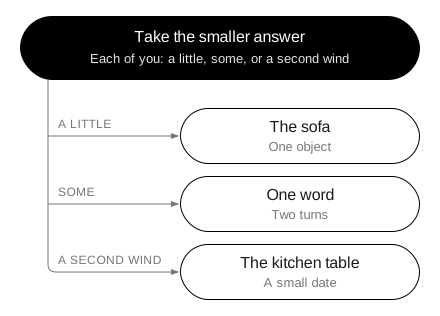
A little left: one object on the sofa
This one works lying down. It needs one card on its object side, or one everyday thing you name out loud: a chair, a clock, a book.
- Put the card between you, object side up.
- One of you tells one story the object brings up. A chair at a grandparent’s house, a clock in a school hallway.
- The other asks one follow-up. Then swap.
- Each of you names one thing you found out about the other tonight.
Objects suit the end of a day because they lead to a scene. A scene needs no opinion and no decision, only a memory of a place.
Some left: one word, two turns
Stay on the sofa, but turn the card to its idea side. If you have the die, roll it. Its faces are six plain words: MEMORIES · BODY · PEOPLE · VALUES · CHILDHOOD · FUTURE. “Look at the word from that side.”
One of you says what the word brings up, as much or as little as feels right. The other asks one of the three follow-ups from the rule card:
What did that feel like? Who else was there? Has it always meant that to you?
Then swap, and take the same word somewhere else. For parents, the third follow-up can do the most work. Words like rest or joy may have shifted since the kids arrived. Hearing how your partner’s meaning moved is news, even after years together.
A second wind: a small date at the kitchen table
Move to the kitchen table, switch off the overhead light, and make a drink you’d only make for a guest. Phones go in another room, unless one of them is running the online table.
Use two cards. Play the first on its object side, one story each. Then draw a second card on its idea side and play it the way the one-word version runs, with the die if you have it. End with one last round: each of you names one thing you found out about the other tonight.
If the first story runs long, let it. For an evening with more time and a longer plan, see date night at home ideas.
Words that suit a tired evening
These three cards from the Thesis deck fit.
Rest has Clock on its other side. Rest can start as a plain comparison: what did a day off look like for each of you at 19, and what does one look like now? One of you may describe sleeping in. The other may describe a long walk with nobody asking for anything. Clock suits the sofa version: the clock in the kitchen you grew up in, or a night you stayed up far too late on purpose.
Joy has Chair on its other side. Joy can open with what made each of you glad before the kids and what does it now. The answer can be small, like a hot coffee drunk while it’s still hot. Chair leads to scenes: a favorite seat at a parent’s table, the one you sit in to feed a baby at night.
Kindness has Book on its other side. It fits a night when you’re both short on patience, because it turns the talk to someone who was kind to you once. Book can bring up a book read to you as a kid, or the one you’re reading to yours now.
Questions for when you’d rather have a list
If a question suits you better than a word, these leave room for a story:
- What’s the best nap you’ve ever had?
- Which meal from your childhood would you eat tonight if someone made it?
- What did a lazy Sunday look like when you were 10?
- What’s a small thing that made today a bit better?
- Where’s the quietest place you’ve ever been?
- Who in your family was best at doing nothing?
- Which chair or corner in our home feels most like yours?
- What did you do for fun on a weeknight before we had kids?
One question can fill a sofa night. Follow it with one of the three follow-ups.
When one of you falls asleep
Some nights, one of you will drift off mid-story. That’s a fine ending. You still sat together and talked about something other than the schedule. Leave the card on the table and pick it up tomorrow.
If a light word lands somewhere heavy, like a parent who’s ill or a friendship that ended, the pass agreement covers it. Either of you can stop or turn the card to the object side. The rules put it this way: “A short answer is a full answer. You can always ask for more.”
Tonight, before the kids are in bed
Write one word on a sticky note and put it on the fridge. Rest is a good first one. When the house goes quiet, each of you says how much you have left: a little, some, or a second wind. Take the smaller answer and start that format.
The three cards have their own pages: Rest, Joy, and Kindness. For more on playing as two, see Thesis for couples. For the studies behind the deck, see the research page. To see the cards and die, read the rules and the box. For a night with more energy, try deep date night questions for couples.