You’re at a party, talking to someone you met that evening. They finish a story about their flight. There’s a pause, and you can feel it’s your turn to ask something. Your mind goes blank. You smile, look at your drink, and say “yeah, totally.”
The blank comes when you try to invent a new topic from nothing, in a few seconds, while someone watches. What helps is taking the next line from outside your head. There are three places to look: the last thing they said, the room around you, and one word you brought with you. This guide covers all three, plus a way to practice with a deck or a word on a napkin.
What the blank is
The feeling has a name in psychology: mind-blanking. Ward and Wegner described it as a state where attention brings nothing into awareness, and they separated it from mind wandering, with seven experiments behind the work (Ward and Wegner 2013). Their studies weren’t about conversation. They found that sometimes people had lost track of where their attention was, and sometimes the mind seemed to be absent.
In a conversation, the blank can arrive with a task: find a new topic, now. Searching harder for it may keep the blank going, because the search is the thing that stalled. A prompt from outside skips the search. You stop inventing and start reacting to something that’s already there.
The fear runs ahead of the conversation
The blank can start before the pause, with the worry that you won’t know what to say. Researchers measured that worry directly. A mini meta-analysis pooled seven studies with 2,304 participants and compared their fears before talking to a stranger with how the conversation went. One of the fears was lacking the skill to carry the conversation (Sandstrom and Boothby 2021).
Across all six fears they measured, people were more worried before the talk than their own reports afterward supported. One finding speaks to the obvious advice. Giving people tips on how to start a conversation raised how much they expected to enjoy it, but didn’t change how the conversation went. Having one pleasant conversation did shift their predictions for the next one. That points to a few more conversations, with something outside your head to lean on, rather than a longer list of tips.
Three places to find the next line
When the pause comes, these three work in order. Start with the first. If it doesn’t fit, move to the next.
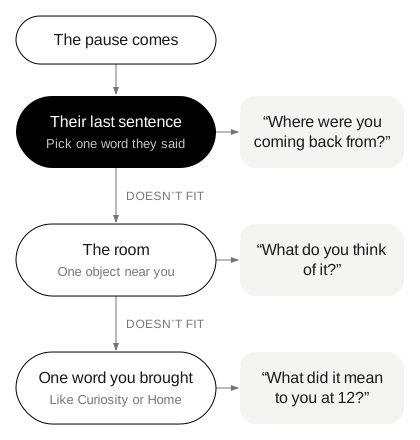
- Their last sentence. Pick one word from what they said and ask about it. “Flight” turns into “Where were you coming back from?” You don’t need a new topic. The old one has more in it.
- The room. Look for one object near you: a lamp, a bike by the door, the song that’s playing. Say what you notice, or ask what they think of it. Objects bring up places and people, and the talk can move from there.
- One word you brought. Before you go out, choose one word, like Curiosity or Home. When the first two fail, ask what that word means to them, or what it meant when they were 12.
Each of these turns the job from “invent” to “react.” The first one does more than fill the gap. In three studies of conversations, including speed dates, people who asked more questions, particularly follow-up questions, were better liked by their partners. People didn’t expect questions to raise liking (Huang et al. 2017). A follow-up can feel like prying from the inside. From the other side, it reads as listening.
A short answer is allowed
A blank mind can answer in a few words, and then the worry that you’ve killed the conversation adds to the blank. The Thesis rule card has a line for this: “A short answer is a full answer. You can always ask for more.” It goes both ways. Your short answer stands, and theirs does too.
When you have nothing to add, hand the turn back with one of the three follow-ups from the same card:
What did that feel like? Who else was there? Has it always meant that to you?
They work for any story, any word, and any person. You can memorize three lines on the way there, and they’re there when everything else isn’t.
Practice with a word on the table
The third place to look, the word you brought, gets easier with practice. A card game is a low-stakes way to get that practice, because the topic is on the table and nobody has to invent it. That’s the idea behind Thesis: 50 double-sided cards, an idea on one side and an everyday thing on the other.
The die adds an angle. It has six faces: MEMORIES · BODY · PEOPLE · VALUES · CHILDHOOD · FUTURE. The only instruction is “Look at the word from that side.” One word turns into six places to start, so the blank has less room. The rules also open with “Before you start, agree together how passing works.” Knowing you can pass can take some of the pressure off before the first card.
You can try it now on the free online table. It draws, flips and rolls.
Questions that work with any word
If you’d like a few questions in your pocket, these fit any word from the deck. They go from light to deeper:
- When did you last notice this word in your week?
- What object reminds you of it?
- Who in your family would talk about it most?
- What did it mean to you at 12?
- Where did you see it in the last month?
- Has your view of it changed in the last five years?
- What would a close friend say it means to you?
- What would you like it to mean ten years from now?
Two of these are enough for one word. The rest wait for the next pause.
Three cards for a quiet start
These three cards each read in their own way when the mind goes blank.
Curiosity has Sewing machine on its other side. The idea side shifts the focus away from you: the question becomes what the other person wonders about. The sewing machine side is easy to answer from memory. A parent’s, a school class, a repair shop, or never having touched one is a story too.
Belonging has Headphones on its other side. For someone who feels out of place at a party, the idea side names the feeling without asking anyone to confess it. The headphones side is the light way in: what someone listens to on the way home says a lot, and it’s an easy thing to ask.
Courage has Bicycle on its other side. Starting a conversation with a stranger counts as a small act of courage, and people may have stories about bigger ones. The bicycle side brings back learning to ride, a first commute, or a trip that went wrong, which works when the idea feels too big.
Before the next party
Pick one word tonight and write it on your phone’s lock screen or a slip of paper. Take three follow-ups with you: What did that feel like? Who else was there? Has it always meant that to you? When the pause comes, look at their last sentence first, then the room, then your word.
To practice before the next evening out, play a few rounds on the online table, or see the rules and the box. The cards above have their own pages: Curiosity, Belonging and Courage. For playing with a group, see Thesis for friends. For the studies behind the deck, see the research page. When the talk stays at the surface, see the space between small talk and deep conversation. When you’re ready to move on, see how to leave a conversation politely.